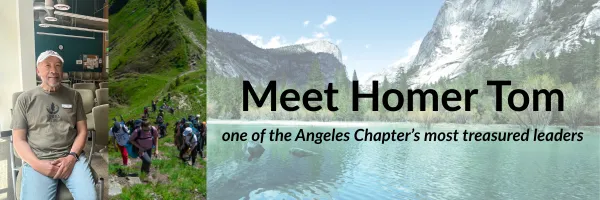
Among the many inspirational Angeles Chapter leaders and true Sierra Club ambassadors, there is Homer Tom. If you’ve met him, you know his smile and welcoming spirit. If you haven’t met him – yet – please enjoy this conversation Jennifer Gregg - your Chapter Fundraising Officer - had with Homer back in April of this year.
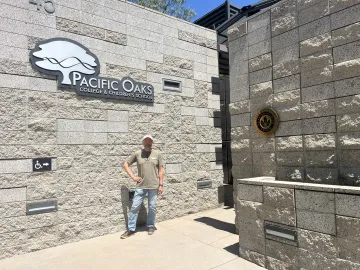
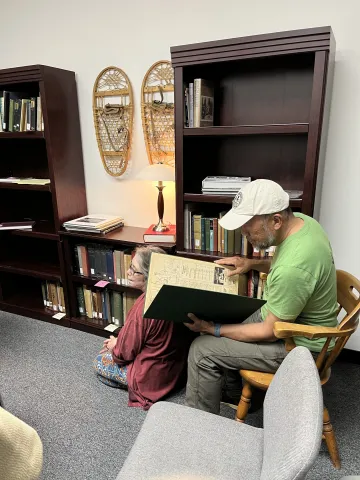
When the Chapter offices were still located in Korea Town, staff and several volunteers brought the Angeles Chapter library back to life. One of the volunteers who helped organize the library was Homer Tom, who would quietly say hello then disappear into the book room where you could find him absolutely taken by all of the history and information at his fingertips. It was no coincidence that when Jennifer and Homer met for this interview, it would be in a library. This time, in the library at the beautiful Pacific Oaks College in Pasadena – which you’ll read a bit more about in this interview.
What inspired Homer’s connection to the outdoors?
“I was born and raised here in Southern California. I had grown up as a city kid, you know, in the inner city basically. I was a total city kid latchkey kid actually. I went to school and immediately returned home. So I didn't spend much time outdoors. But when I was 10 years old, my parents put me and my brother and me in the back of their big Buick and we took a road trip that took us all around a western United States, highlighted by national parks. This was my first time out of Los Angeles. We went to the Grand Canyon and Yellowstone National Park and up to the north coast of California and drove along the coastline and went to Yosemite. I remember sitting in the back seat of the car just being thrilled at seeing all this nature. It made a real impression on me that there's a lot more outside than just your city block or the school.
“A number of years later, when I was volunteering in Yosemite, I was up really early one morning just walking around and I ran into a national park ranger by the name of Shelton Johnson. He's a celebrity park ranger because he was featured in the documentary by Ken Burns about the National Parks. I had a conversation that probably lasted over 45 minutes, one on one with Shelton Johnson, talking about any number of things, and he asked me: what's your first memory of the outdoors? I had kind of forgotten that memory but as soon as he asked, I realized like, that's right - It all started with national parks! Nature has a funny way of doing that.”
Let’s find out how Homer joined the Sierra Club and how Homer’s journeys continued, leading him towards leadership with the Angeles Chapter.
“In 1998 I was working in Burbank and I needed something to do in the evenings. My coworkers mentioned these Griffith Park night hikes led by the Sierra Club. Since Griffith Park was so close to work, I figured ‘why not!’ It was so unique to hike at night. Of course, I loved exploring all around the Observatory and seeing the night lights of LA. I joined the Sierra Club shortly thereafter. On these hikes, I got to meet so many nice people. I hiked with them for a long time - and I still do with some of the people I met back then! ”
“Hiking with the Sierra Club in Griffith Park at night got me interested in doing day hikes. From there, I knew I wanted to do more outings with the Sierra Club, starting with Griffith Park, and then into the San Gabriel Mountains, and eastern Sierra.
“At one point, I really wanted to do some car camping and backpacking, but I didn’t actually have much experience for that. I was offered a chance to go on a trip to Mount Whitney with a group I had met. None of us had the right skills. We had the desire – but we had limited amounts of equipment and limited amounts of knowledge. And, to top it off, we decided we were going to do Mount Whitney in May, which most of us who are familiar with the area know that you don't climb Mount Whitney in May. There is a lot of snow! We made it out fine, luckily, but it was pretty much a sleepless night for all of us, shivering in our tents. We determined that maybe we need to get some additional skills before attempting this again.
After that harrowing experience, somebody told us about the Sierra Club’s Wilderness Travel Course (WTC). We took the course in 2003. I just absorbed everything that was being taught. Then I wanted to give that experience back to other people who were like me - interested in doing these adventures but needing more skills to do it safely - and have more fun!”
WTC - the Angeles Chapter’s Wilderness Travel Course (previously known as Basic Mountaineering or BMTC) - is a 10 week program that teaches wilderness skills to thousands of Southern Californians.
“With an emphasis on outings, WTC really fills a niche because it prepares people for outings. It's really a poster child for what an outing education program can look like.”
For over 30 years, WTC has been offering classes in different locations within Los Angeles and Orange County. Students work in high instructor-to-student groups to learn about outdoor navigation, gear, conditioning, environmental impact and leave-no-trace standards, safety and first aid, cooking and water filtration, skills and maneuvering. During the course, students will experience snow camping, a cookout, and day hikes for practicing navigation and rock skills.
“WTC is based upon something a lot of people have heard of as The Ten Essentials. We really do take this to heart because in this 10 week program, maybe it's not a coincidence, we really focus on every aspect of the ten essentials. In a given week we will focus on clothing or your food and nutrition and hydration needs, or your sleeping bag and your tent, then we also focus on map and compass, which is my personal favorite because it's the thing that is I think the hardest to learn. We show students how to go about reading a map, reading the terrain, using the navigation piece correctly to determine where you are and how long it'll take you to get from where you are to where you need to end up, and what are the potential hazards and dangers of the area. We want you to be prepared for when things always go wrong - because to some degree when you're out there things can suddenly go wrong. Nature's in charge! We're just visitors out there.
“We have four outings on the weekends, and they get progressively harder. By the way, WTC students should be in some level of fitness so that they are able to hike 10 to 12 miles with 3,000 to 4000 feet of elevation gain.
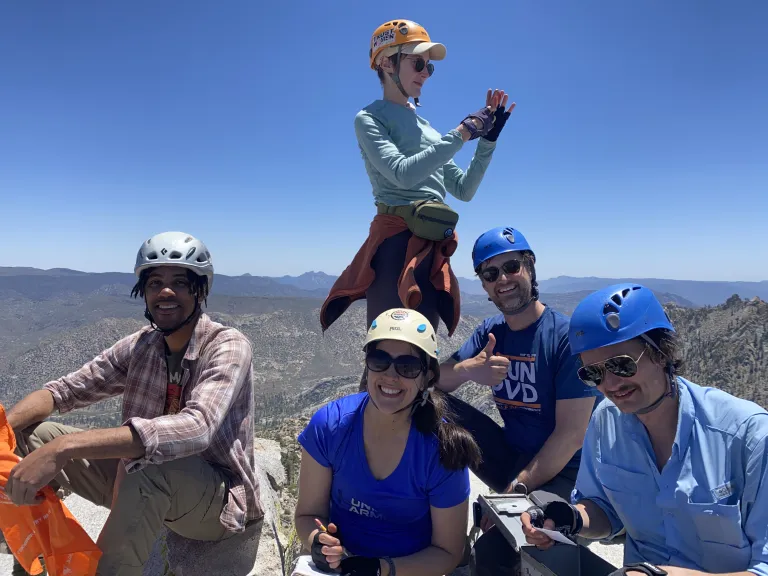
“The second outing is a weekend trip to Joshua Tree. We spend two days in Joshua Tree doing a combination of basic rock scrambling and skills on the rock, not technical, but we get to have some fun playing on the rocks. We do a full day deep dive into navigation and terrain recognition, using map and compass. It is a fantastic weekend and most students say that the Joshua Tree weekend is their favorite right. I really like it, too, but the 3rd and 4th weekends are my favorite.
“Weekend 3 prepares you for snow travel. We take a full day out into the local mountains for hiking on snowshoes.
“Then the 4th weekend is snow camping, which I've really come to love, is definitely grueling and often intimidates the students at the beginning of taking WTC- but they always end up loving it! We spend two nights camping up in the Sierra Nevada at upwards of 10,000 feet and very low temperatures. By that point, we've covered all the skills they should have and everyone does a great job. We end up with some of the best memories.
“In order to graduate from WTC, each student completes two backpack trips over the course of the summer where we take 6-12 people out. It could be the desert if it's early season, or it could be in the mountains if it's later in the season. We do an overnight backpack trip and practice all of our skills. These are really fun adventures. I can really see the confidence in each student!
“Then we get together in October for a nice graduation ceremony where we connect again as a group. This is always a good reunion - and where so many lifelong friendships take the next step.”
For many WTC students, this course is life changing – from the friendships made to the inspiration to explore and even become outings leaders themselves. Which is exactly what happened to Homer!
“After taking WTC, we finally summited Mount Whitney - safely. Then we started doing the Grand Canyon and Yosemite and all kinds of other adventures together. I was constantly thankful for having taken WTC in the skills I learned there, and I had made such great friends. I am still in contact with my instructors from WTC.
“I became an instructor in 2009 as a way of giving back to the Sierra Club something that is so special to me. I've been doing it ever since then, every year and it's just wonderful. I am an outings leader, a navigation leader, and I'm currently the area chair for San Gabriel Valley WTC.
“I take groups of people on outings off trail which I do frequently in the summer months where we go on backpack trips either to the mountains or out to the desert. In the winter, I lead back country ski tours with the Angeles Chapter’s Wilderness Adventures Section. The Wilderness Adventures Section goes throughout the year to a variety of fun places.
“So, this has been my routine for the last 15-16 years. Oh my goodness!
“It's been a great journey. I have learned so much as a WTC instructor. I get to learn how people learn and how they see the environment around them. I just love it when I see the look on their faces one day one day when they climb that peak, or when they scale that rock – the sense of accomplishment and empowerment WTC gives them is really what gratifies me. To see the light bulb moment for them to realize: oh I can do this! They can survive snow camp. They can hike 12 miles or even more in a day.
“It feels really good to know I can help people find what they love about being outdoors, and I really appreciate that the Angeles Chapter has these programs for people to join. We really are unique and offer so much. I've seen our students go on to do some amazing things with the Angeles Chapter activity sections such as the 100 Peaks, Sierra Peaks, Advanced Mountaineering, and become outing leaders themselves.
“I've heard from people who have said WTC turned their life around because it gave them new focus, confidence to face down some of their fears. and to get them to think methodically about how to approach problems. It just grows, right? This is like planting a seed. It opens the door to all of the wilderness. It's pretty life altering, literally, in many ways.”
The Eaton fire affected Angeles Chapter programs, including WTC and the Advanced Mountaineering Program (AMP). The Advanced Mountaineering program lost all of their climbing equipment in the Eaton fire. A number of WTC and AMP instructors were directly impacted because either they lost their homes or were displaced from their homes, or from their places of employment.
Funding to replace lost gear and support these programs has been challenging in this economy, which is why we are so thankful for every donation made to the Angeles Chapter. It means a lot to a lot of people that we can keep our programs up and running.
Due to the Eaton Fire, WTC lost its meeting location. As one of the WTC leaders, Homer connected with Dr. Breeda McGrath, the president of Pacific Oaks College. Not only was the location ideal for this group to meet, the alignment of mission and ethics shared by the Sierra Club and the college was truly a perfect match. The Angeles Chapter is incredibly thankful to Dr. McGrath and the college for opening up this space for WTC.
“We had to begin WTC in San Gabriel Valley one week after the Eaton Fire. It was a mad scramble to find a venue for our class. And I think it was just serendipity that pointed us and took us in our search to Pacific Oaks College. We were on the brink of having to cancel WTC for San Gabriel Valley because we could not find a suitable place in time, and we did not want to have the class held virtually. We tried that during the pandemic and did not work very well because I think the real strength of WTC is the in person interaction that students have with their instructors. We felt it was so important to keep these programs going.”
You can watch this video created by this year’s WTC students, thanking the college for opening its doors to this program.
Homer’s adventures and generous spirit for giving back extends beyond the Angeles Chapter’s borders and up to where Sierra Club began.
“Another thing I do with the Sierra Club is I volunteer in Yosemite for a week and a summertime over at the Yosemite Conservation Heritage Center, which is where I met Shelton Johnson. I've been doing that since 2002. It is such a wonderful opportunity to spend time in Yosemite Valley, to camp there under the stars and just to enjoy the beauty of the valley. In my role as a volunteer within this historic building, I get to interact with so many visitors from all over the world and they are just hungry for information and to actually talk to somebody. Especially now, in Yosemite or any of the national parks for that matter, because the staffing levels are so low, it’s really meaningful to share my knowledge with visitors, and help them with their questions about where to go, what's safe, what maybe not so safe, and just chat and share about this special place.”
With all the cutbacks at our National Park level, we've seen a lot of park employees lose their jobs as rangers and at the visitor centers. The presence of Sierra Club volunteers at the Yosemite Conservation Heritage Center is going to be even more meaningful to the visitors.
Homer shared some of the places he enjoys exploring and could not quite name a single favorite as there are so many different experiences that emerge, unique to each location. The journey itself, indeed, seems to be what calls Homer back into nature.
“I do like the exertion. I like the aerobic workout of climbing steep trails and navigating my way up there. And the reward is the fantastic views! The range of light, of course, is so true in the Sierra. For me, also, it's camping near a lake where I get to relax at the end of the day or at the end of a long day hike. Once you're up there, just enjoy the sunset, the lake, and the reflection of the peaks in the water, or just to admire peaks covered in snow above you, so that's where
“I've done most of my exploration in the eastern Sierra. I've come to love the desert and Joshua tree with WTC. Of course, I love Yosemite and the Grand Canyon.”
We talked about the future of WTC and how it can grow. Recently REI discontinued their Experiences business model, which took people on day hikes, multi-day adventures, and taught outdoors skills. These were popular among younger people who wanted to socialize in the outdoor space, people new to adventuring and people who wanted to fine tune their skills. Homer sees how the Angeles Chapter might be able to fill the gap now that REI no longer offers these activities.
“Of course, I’d like to see our outings programs and sections grow. We need more volunteer leaders and more funding, of course. We have plenty of interest from the community. I think we can offer a lot - not just to replace what REI discontinued - but to respond to what people are looking for, from hikes to training courses.
“Right now, a lot of people are feeling very isolated, especially coming out of the pandemic and all of the worry we’re having in 2025. To get out there and enjoy the outdoors with others, it builds a sense of community.
“Getting outdoors is so important for people as a respite from all of these difficult challenges that we're facing and threats to the environment. It’s so helpful to recover from this trauma by getting outdoors - whether it's in the desert or in the mountains, or even in the city on a stair hike.”
In Homer’s opinion, all of Southern California is a playground for wilderness adventures! Being in southern California, the Angeles chapter is such a unique location where we have desert, coast, and mountains.We have a wide range of environments to explore and come to love which leads to protecting the environment. To find an outing please visit the Angeles Chapter’s schedule of activities.
“Everybody can connect with outings and the need to get out there and to preserve it, right? You enjoy and you explore and then what does that lead to? That's what I want to do - lead people on a path safely, point them towards nature. That’s what I love about being a WTC leader and a volunteer for the Angeles Chapter. I feel like I'm really making my impact in that way.”
Indeed, Homer is making a very big impact on anyone with whom he crosses paths.
The Angeles Chapter appreciates the dedication of hundreds of volunteers and thousands of supporters. For more information on how to become a volunteer, please visit our volunteer page.
If you are interested in making a donation to support Angeles Chapter programs, please know that every dollar helps and 100% of your gifts stay in Los Angeles and Orange County to support our outings and conservation programs. Donate today at: https://www.sierraclub.org/angeles/give
To learn more about WTC, please visit their website at https://wildernesstravelcourse.org/