By Mathieu Bonin
I live in South Central and work in Burbank. So I have to travel about 10 miles each way to get to work. But as everyone knows, in Los Angeles or cities like it, distance isn't what matters—only time does. In the morning, it might take me 30 minutes to get to work, but in the evening, it has sometimes taken me 75 minutes to get back home. This absurd and intolerable situation doesn’t just have catastrophic consequences for the environment—it also affects my well-being. It’s a sign of a city that, at some point in its history, fell into the car trap, at the expense of public services. In his book Freewaytopia: How Freeways Shaped Los Angeles, Paul Haddad explains this history—often disastrous—and the “solutions” that were sometimes proposed (such as building even more freeways!).
While this story is extremely important and interesting, it still raises a fundamental problem: me—my well-being. How do you keep acting like a civilized person in a world of drivers who are frustrated, aggressive, distracted, or even dangerous? How has our entire biological history—our evolution—brought us to the point where we spend a part of our day, and therefore our lives, in a closed, stressful metal box, big or small depending on our taste for cars, yelling at everyone?
According to the INRIX 2024 Global Traffic Scorecard, people in Los Angeles lost 88 hours of their lives in congestion last year, at a cost of $1,575 per driver. Interesting, right? Driving is bad. And above all, traffic is terrible for our health and well-being. So, what do we do? We support car transportation, and we keep driving.
Huh? That wouldn’t be the first time our species has shown such strange logic—but not me.
One day, one of my mother’s friends told me that she sometimes parks halfway between home and work, then takes her bike and does the rest of the commute on two wheels. She said it was the smartest way to quiet that little voice that stirs inside us after work, to breathe a little, and to make sure she gets some physical activity. That’s when I realized that all this time, along my commute route, there was a bike path that runs alongside the LA River—allowing me to do almost 18 miles of my commute while watching the river flow. Mallards, Great Blue Herons, Double-crested Cormorants, Great Egrets, Black-necked Stilts, Black-crowned Night Herons, and Red-winged Blackbirds replaced the crazy delinquent drivers in my daily view.
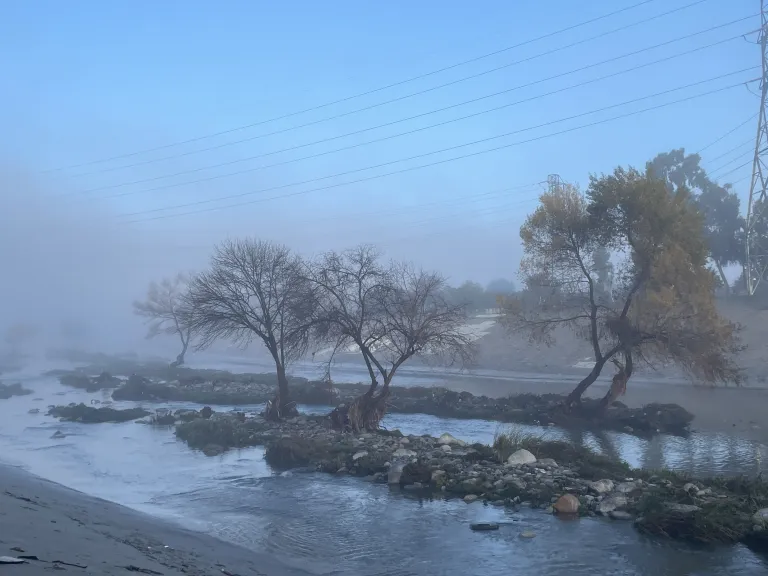
I’ve had the chance to see the river in every season: under the rain, in thick fog, or shining in full sun. Below the path, every morning, the beautiful San Gabriels become the backdrop of my ride, as I get closer to the Verdugo Hills. Sure, the LA River isn’t the kind of river Thoreau would have loved—it doesn’t quite fit the romantic ideal. But still, it’s full of life.
The benefits of being outdoors go far beyond just physical and mental health or well-being. I realized, thanks to my bike—my new best commuting friend—that the city isn’t only what it makes you feel, but also what you choose to see in it. Change your perspective, and you’ll start to see nature and beauty—even in the middle of the city.
When Mathieu isn’t teaching philosophy at the French School, he volunteers with the Central Group, leading Trash Talk Saturdays and being its Conservation Chair.