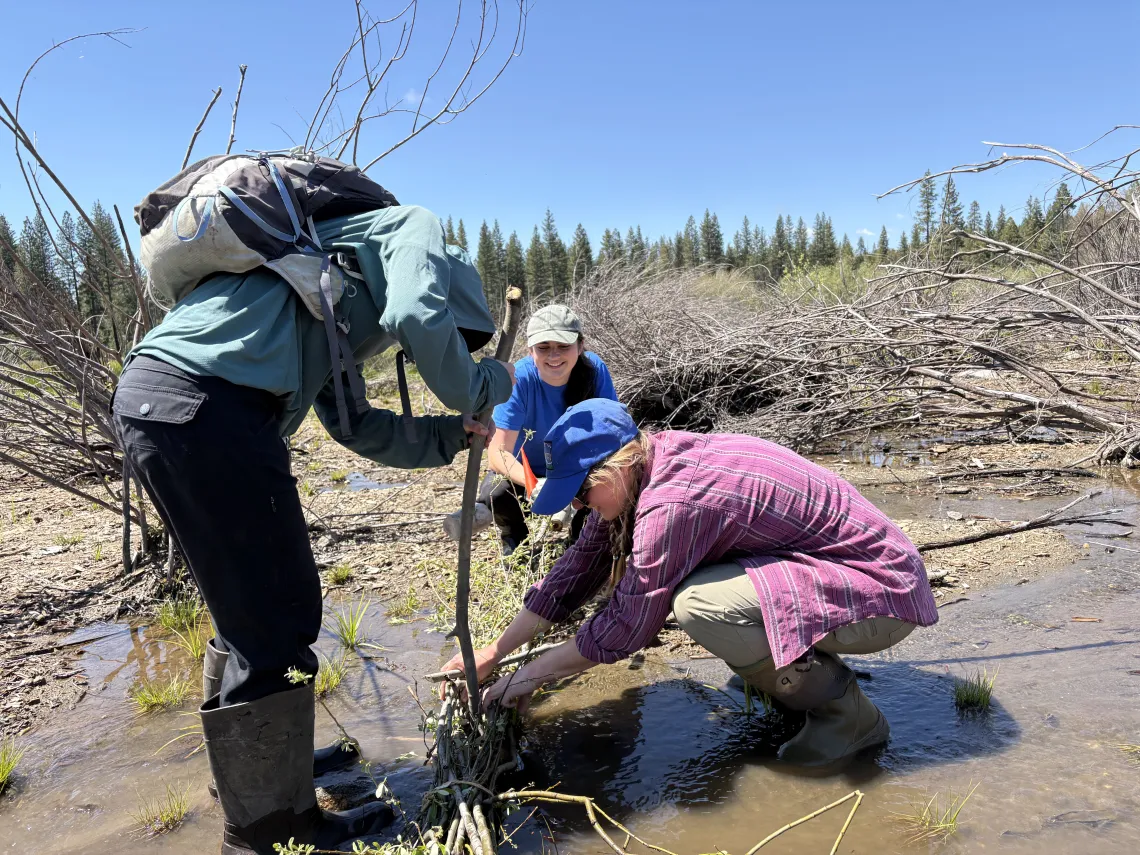
At the western gate of Yosemite National Park lies Ackerson Meadow, where a collaborative restoration effort is bringing a degraded meadow back to life.
My cohort of Sierra Nevada AmeriCorps Partnership (SNAP) members drove down Highway 120 toward Ackerson Meadow on a hot early-May day. Heat rose off the pavement, and the smell of dry pine forest surrounded us. When we arrived at Ackerson, the meadow appeared like an oasis in the heat.
Ackerson was purchased from private ownership in 2016 and gifted to Yosemite National Park, and restoration work began soon after.
Intact meadows are places of slow-moving water, where runoff from mountain slopes is slowed by vegetation and spreads out laterally. Water-loving plants — sedges, rushes, willows — create habitat for wildlife - in Ackerson, that includes the endangered Great Grey Owl, Willow Fly Catcher, and Western Pond Turtle.
Over a century of farming, ranching, timber harvest, and water diversion left the meadow in poor condition. The shallow channels that once braided the meadow had eroded into a fifteen foot deep gully, funneling water straight through the meadow and worsening the cycle of erosion.
The restoration began with heavy machinery work to fill in that 15-foot channel and bring it back to the same elevation as the rest of the meadow. Crews then planted over 400,000 native plants, laid down with coconut-fiber netting to slow erosion while the plants took root and grew large enough to hold the soil on their own.
In these early years, as the plants reestablish themselves, erosion is bound to occur again — even small low points in the meadow allow water to pool and start carving new channels. Our hosts referred to this ongoing work as "babysitting the meadow" for a few years, until it can function on its own.
To manage that erosion, we used a set of "low-tech" solutions: willow fascines and beaver dam analogs (BDAs).
Willow fascines are bundles of willow branches driven into channelized areas along with larger willow stakes. We cut the branches from living willows within the meadow, taking no more than 20% from any single tree to protect its health. Willows regrow readily from cuttings, so beyond slowing the water as they settle in place, these fascines let new willow take root throughout the meadow — encouraging a longer-term slowdown of water flow.
For areas with deeper channelization, we built and patched post-assisted beaver dam analogs. Wooden posts are driven deep into the soil, with layers of conifer branches woven in between and packed with mud from the meadow — mimicking how beavers build their own dams.
This served a second purpose - along the meadow's edges, conifers had grown in densely, raising wildfire risk and lowering the meadow's water table. Our group thinned conifers roughly six feet and under, which both reduced that density and supplied material for the BDAs.
By the end of the day, the dry mound where we'd placed sandbags was submerged, and the trickle of channelized flow had gone quiet. In a single day’s work, the flow had spread out as it was meant to.
Leaving the meadow, I found myself wondering what this work may mean for meadows and wetlands closer to home - several organizations are working to maintain the health of our Placer wetland and meadows. What could
Placer County look like with intact wetland and meadows?
To get involved with wetland conservation, contact the Sierra Club Placer Group or one of our partner organizations today.
https://www.facebook.com/betterbeavermanagement/