April 2025 Program
Indigenous History of Nashville
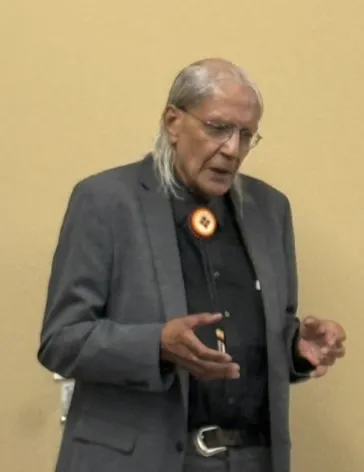
Program speaker Albert Bender offers fascinating glimpse of ancient city
‘At a time when ancient Nashville had a population of 400,000, it ranked as one of the largest cities in the Americas, in fact one of the largest cities in the world.’ Nashville’s East Bank and all downtown sit atop the ruins of a huge, ancient indigenous city that flourished centuries ago.
LINK TO VIDEO HIGHLIGHTS ON FACEBOOK:
https://www.facebook.com/share/v/16F5s4BNtH/
Nashville, before it was Nashville, has gone by the names “Buried City” and “Salttown,” facts seldom taught in Tennessee history, with its focus on post-pioneer settlement.
Tennessee schoolchildren are taught that Middle Tennessee was a rich hunting ground—the landscape encountered by settlers in the 18 th century—where Native American tribes shared game and resources.
They aren’t taught much detail about what transpired along the Cumberland River (called the “River of the Shawnee” by French traders), or about its prehistoric culture and inhabitants, before Europeans arrived.
Albert Bender, Cherokee activist and president of the Indigenous People’s Coalition of Nashville, told a different story at the April 10 MTG program meeting.
The area’s forested hills and ridges, and its rich river basins, provided abundant salt springs. Springs drained from the hillsides through underground mineral deposits, creating brine in abundance.
For thousands upon thousands of years, natural salt springs such as French Lick (located where Bicentennial Mall now sits downtown) shaped the region’s history.
Still Bender was astonished when he learned the magnitude of Indigenous settlement and industry that grew from this natural feature.
“When I heard this information, I was just astounded,” he told meeting attendees. Bender is tall and spoke deliberately, with the conviction of a standard bearer. He wore a bright, beaded bolo tie.
It turns out the reason indigenous locals called the area the Buried City is because the site of an indigenous metropolis lies beneath the pavement and buildings of modern Nashville.
When developers were excavating for the Sounds baseball stadium in 2014, they found evidence of ancient habitation and commerce, first indicated by finding very large earthen vessels.
“Further archaeological excavation confirmed that these large vessels were used for the production of salt. The salt industry was so huge that they actually exported salt not only throughout all of middle, west and east Tennessee, but the entire Southeast.”
Bender described an ancient city with a population of 400,000 in the 14th century, during the Mississippian Period of Indigenous history and the medieval era in Europe. “I had no idea these huge, huge cities existed 1,000 years ago,” Bender said.
“At a time when ancient Nashville had a population of 400,000, it ranked as one of the largest cities in the Americas, in fact one of the largest cities in the world.
“At the same time,” he added, “Paris, France had a population of something like 500,000. London, England at the same time had a population of 200,000.”
What caused these Indigenous people to leave before European settlement, and where did they go? “I believe drought was the most likely cause of the dispersal of these huge populations,” Bender said.
“The descendants of the ancient Nashvillians I would say are Cherokees, Chickasaws, Choctaws, Muskogee Creeks and Seminoles.” Many of the dispersed Eastern Woodland inhabitants of the ancient city on the Cumberland were eventually forced west by colonialization and the U.S. government.
If not for the development of modern Nashville, we could perhaps see the signs and relics of their presence.
French Lick, thus named for the French fur trappers and traders who frequented the area beginning in the late 17 th century, had been a natural magnet for wild game, native hunters and commerce for millennia. But settlers, and later Nashvillians, couldn’t build in the flood-prone bottoms, so around 1892 French Lick Creek was buried, its flow diverted, and the bottoms filled for development.
Likewise, nearly all of the 80 Native American mounds observed by early European traders and settlers—likely used for civic and ceremonial purposes in the ancient city—were lost to development in the 20th century. “The majority of those mounds have fallen prey, have become victims of residential and commercial development,” Bender related.
As Native Americans continue to struggle for preservation of Indigenous sites, Bender and the Indigenous People’s Coalition work to raise awareness. Bender’s outspoken support was instrumental in the push to rename Cumberland Park downtown “Wasioto Park,” reflecting the original Shawnee name of the Cumberland River.