Written by F. Green
Mountain Lions in Peril
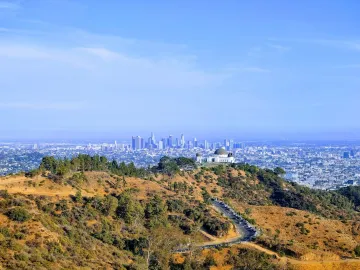
More than a decade ago, a mountain lion nicknamed P-22 made a perilous journey across the 405 and 101 freeways to reach Griffith Park. The mountain lion made waves, becoming a beloved celebrity who made rare, exciting appearances and caused various shenanigans, including eating a koala at the local zoo. P-22 resided in the urban park until his death after being hit by a vehicle in 2022.
While adult male mountain lions are typically solitary, P-22 remained mateless and isolated from other mountain lions for most of his life. He was lucky to make the initial journey across the freeways alive; a trip back would likely have killed him.
P-22 is not the only one of his kind to be cut off by highways. Los Angeles is one of just two megacities worldwide with big cats living within city limits. However, roads and1 human development are increasingly fragmenting the mountain lions' territory in Southern California. Since 2022, at least 32 mountain lion deaths from vehicle collisions have been documented in LA. Habitat fragmentation has led to inbreeding and territorial fighting among mountain lions. If a solution is not found, mountain lions in the Santa Monica and Santa Ana ranges may go extinct.
A New Path for Animals
Inspired in part by P-22, the Wallis Annenberg Wildlife Crossing is a vegetated bridge that crosses 10 lanes of the 101 freeway at Liberty Canyon, reconnecting the fragmented ecosystem of the Santa Monica Mountains. As part of the same project, a similar structure also stretches over a nearby side road. At 210 feet long, the main Annenberg Wildlife Crossing will be the world's largest animal crossing when it opens on December 2nd, 2026.
The project will help preserve native species, including Los Angeles County’s mountain lion population, by providing safe passage over the dangerous freeway below. Intended to replicate its natural surroundings, the overpass is covered in native plants with seeds sourced directly from the nearby landscape. Looking at the overpass, you would see a beautiful array of bush mallows, native sages, and California poppies.
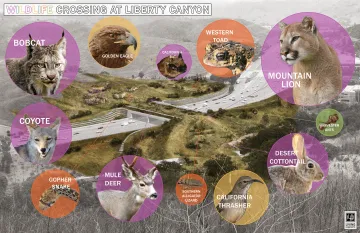
The Santa Monica Mountains are located in one of 36 ‘biodiversity hotspots’ in the world and contain over 50 threatened or endangered plant and animal species. The crossing is expected to restore migration routes and benefit bobcats, coyotes, black bears, mule deer, crocodile lizards, and Pacific gopher snakes, many of which have found food and habitat growing scarce from drought and wildfires. By helping preserve ecosystems, the wildlife crossing also supports California’s 30x30 conservation goal.
The bridge not only connects habitats but also aims to reduce wildlife collisions, which endanger both animals and people. According to the California Highway Patrol, nearly 400 people were injured in over 2,000 vehicle collisions involving wildlife in 2019. Exclusionary fencing is going up along the freeway for about a mile in either direction to funnel animals away from the dangerous highway and onto the crossing.
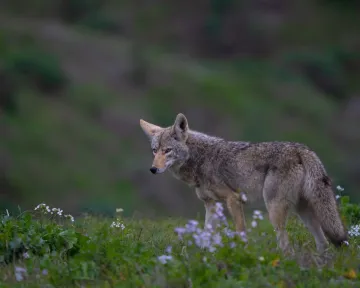
Even before it was completed, a coyote captured on camera attempting to use the bridge generated excitement. Speaking about the project to KTLA, Beth Pratt, the California regional executive director for the National Wildlife Federation, said, “I want the Los Angeles area to be proud of this. What started out as an L.A. story, P-22, and the plight of our local cougars turned into one of the most significant global conservation projects of our time.”
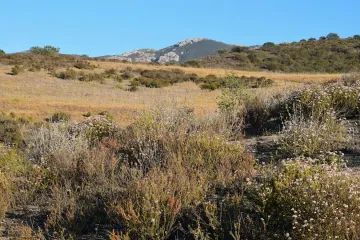
Why we should care about habitat fragmentation
Habitat fragmentation is the process by which a habitat is broken into disconnected, isolated fragments or sites, often through human activity and occasionally through natural events. While this may not seem like much at first glance, habitat fragmentation is actually a primary driver of biodiversity loss. Ecosystems face human disturbance and reduced resilience, while migratory pathways may be cut off.
A 2015 study in Science Advances synthesized fragmentation experiments across five continents over 35 years and showed that habitat fragmentation reduces biodiversity by 13 to 75 percent and impairs key ecosystem functions by decreasing biomass and changing nutrient cycles. Effects magnify over time, making it important to act now.
The Wallis Annenberg Wildlife Crossing may help fight habitat fragmentation in the Santa Monica Mountains, but it is only the start. In recent years, favorable legislation has enabled more crossings to be built across the United States. Today, more than 1,000 dedicated wildlife crossings exist in the country. These crossings not only support ecosystems but can also reduce wildlife collisions by over 90% in certain areas.
While these gains have been instrumental, we cannot stop here. The same 2015 study found that 70% of remaining forest worldwide lies within 1km of the forest edge due to the degrading effects of fragmentation. Across California, urban development has invaded ecosystems, harming their potential to adapt. While it is too late for the mountain lion P-22, our remaining wildlife needs us. Acting now will help protect our ecosystems' diversity and richness for generations to come.