As the year 2024 comes to a close, with the the days shorter and the nights long, we tend to come together to take comfort in family and friends, while taking stock of the blessings that surround us.
Traditions can be important in providing a sense of continuity. Music, lights and most importantly the holiday traditional dishes and treats bring back fond memories.
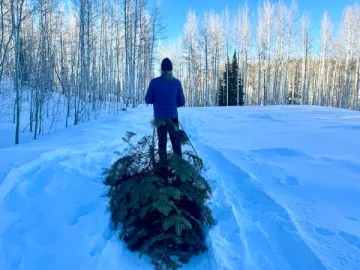
The ritual of going into the forest and selecting a tree provides me a feeling that all is as it should be, at least for a moment in time. I bless the tree and thank Mother Earth. My home will be filled with the scent of conifer and lights to keep the darkness at bay. Soon, presents and loved ones will gather around the evergreen tree. As I sip my egg nog I feel a sense of peace.
Shouldn’t our food be sacred? Should I be any less thankful that I am to be fortunate enough to have more food than I can eat and a public forest that provides me the access to take a tree to adorn my home?
What about holding the air, water sacred?
Air, water, food we need them for life. To have them in abundance is perhaps something we should not take for granted.
On January 2nd the Headwaters Group will meet and select our leaders and set our priorities for the year ahead. We try to keep our mission to our four W’s - Wilderness, Water, Wildlife and Weeds. It is a struggle for most to narrow it down into something manageable.
The challenges are so vast that one must focus on what resonates the most passionately with them and hope the effects ripple into a broader context. The wolf and wild horses are my nexus of focus. The wolf issue ripples into how we find common ground with the ranchers and the Ag industry they operate in. What is a wilderness area absent the call of the wild? Wild horses exemplify how our public lands are used, they too are in direct conflict with ranchers and the Ag industry. The stakes are high and the battles furious.
While I recognize the conflicts, I also am well aware of the beauty in a healthy sustainable farm or ranch. Coloradans can be thankful for those producers that alongside food production provide habitat for wildlife of all kinds.
The pressures the ranchers and farmers face from the middleman who take a bigger cut than the producers get themselves, is compounded by constant pressure to sell the land to developers. These pressures are more of a threat to the rancher than loss by predation. I’d like to see the Sierra Club work in partnership with our food producers with values reflecting coexistence with wolves and other predators, while easing their economic stressors. Promoting sustainable agriculture, doesn’t just sound nice it is absolutely urgent. Our current industrial Ag system is not sustainable and it harming the planet and us.
Growing and processing crops to feed farmed animals represent 45% of global agricultural emissions. In the US, factory farms account for 13% of methane emissions.
Overtime the livestock industry has been a major driver to biodiversity loss. Brazil has cleared rainforests in order to become the number one cattle producer in the world.
Animal to human diseases can be traced back to factory farms. Factory farms with inhumane and unsanitary conditions are responsible for the latest bird flu outbreak, measles originated from farm cows, and Swine flu from pig farms. How we treat the animals we eat is also endangering our health.
Colorado’s cattle production is increasing and we are now the 4th largest exporter of fresh and frozen beef in the United States. That growth needs to encourage and support good grazing practices, which help with carbon sequestration. Cows fart less on grass than being fed corn and soybeans.
Some environmental groups are working to close a processing plant in Denver. I’d like to see the Sierra Club use its legislative clout to oppose such legislation. Instead, work toward promoting more small processing plants on the Western slope, shortening the travel expense to market and creating more access for communities to connect with their food. Additionally, the Sierra Club should commit resources toward supporting higher prices for producers and pass that cost onto the middleman and grocers who record ever increasing profits.
As an organization and as individuals we can take actions that would partner with our ranchers and farmers, together working for the health of our public lands and increasing and stalling the loss of our biodiversity.
Some of our best farmland is swallowed up by sprawling housing developments. Know where your food comes from. If you can, support you local family farm and ranch by purchasing your food from a local supplier. Look for 100% grass fed labels and humanly raised USDA certified. It will be better for you, the animals, and the earth.
Don’t waste your food. Food waste measured globally, is third in greenhouse gas emissions behind only China and the USA. The average American family can save 200.00 a month by not wasting food.
This is what I’m bringing to the table January 2nd. Advocating for saving the planet one bite at a time. Fighting for food, water and air for all life that we are interdependent on is essential and equitable. Nothing is more of a human right than what is needed to survive.
Food binds us and the entire world together. It connects us to the animals and plants that sustain us - give us life. That in and of itself, should be enough for us to share these blessings equitably.
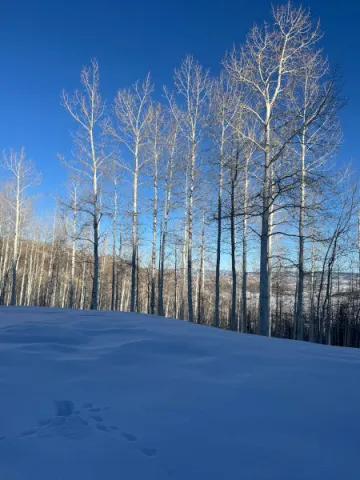
Tonight we recognize the Winter Solstice and the return of increasing light. I hope you bring your passions and presence, once again, for our Headwaters Group this coming year.
Until then, Happy Holidays to all and with gratitude for all the care and light you put forth into the world.
Kent Abernethy
Headwaters Chair
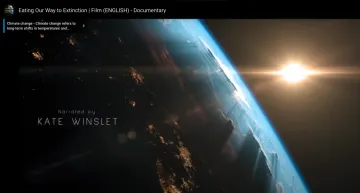
"Eating Our Way to Extinction" – A Documentary Narrated by Kate Winslet