We used to speak of Egans Creek Greenway in Fernandina as being a "preserve". But what is a preserve?
In the Greenways' case, it's a Conservation/wildlife refuge/nature reserve. In other words, it's a protected area of importance for flora and fauna which is reserved and managed for purposes of 'conservation' which can be defined as the planned management of a natural resource to prevent exploitation, destruction, or neglect.
Seemingly, conservation area or preserve is an idea that no longer is respected or honored in Fernandina Beach. We used to protect and honor the wildlife that we shared this island with but in respect to the Greenway- now gone are the bobcats, less frequent are the otters, and on their way to being gone is the ability to see wading birds — the herons, ibis, egrets, and the endangered American Wood Stork.
We've become the other Florida, only we're on an island. An island that sports excrescent growth like mold on an orange with sprawl, increasing traffic, trees and natural fauna disappearing, buildings being built, and an ever-burgeoning population. A recent article on the frontpage of the Fernandina Beach Newsleader stated that Nassau County's population would increase 73% over the next 20 years. Did anybody notice that??? 73%!!!
At one time Fernandina Beach could be touted as being in the forefront for our foresight and outlook. The creation of Egans Creek Greenway was a far-sighted program to protect a large swath of land from development. It also helped to provide a network of connected habitats stretching from the south of the island north to Fort Clinch and these connected habitats were a wildlife corridor. Florida black bears have even frequented the hallowed connected hallways we preserved as they migrated from Talbot Island and further south on their way to swim across the river to Georgia.
I think there are few who live in the city that would argue that now is a critical moment in Fernandina for natural habitat- especially for our many unique, and in some cases endangered, plants and animals.
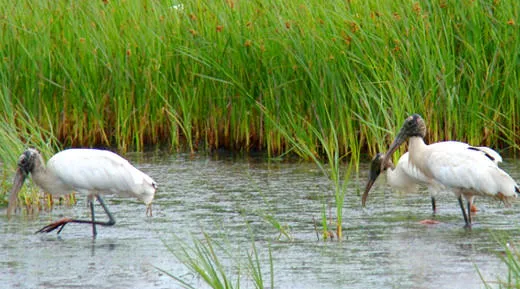
Ever see a Wood Stork on the Greenway? They breed solely in Florida and Georgia. If you see them, they're big. They stand 3-1/2 ft tall, weigh about 8 pounds with a wingspan up to 5 feet. They hold an “endangered/threatened” classification meaning that there is a concern that this species could become extinct if negative impacts continue. Their population decline has been the result of loss and alteration of the wetland feeding habitats they need to survive.
Wood Storks have a specialized style of feeding, relying on touch. They feed on small sized marsh fish, shrimp, amphibians (tadpoles), and small reptiles (snakes) by slowly wading through the water with open bills. When the bird's bill touches a fish, it quickly snaps it shut to secure the meal. The habitats that these birds require for nesting, feeding, and roosting are- according to federal regulations- to be protected throughout the year. One would then think that the Greenway and its habitat of lowland wetlands which our neighbors, the Wood Storks, require for feeding should be 'protected'.
The Wood Storks' other Greenway neighbors, the herons and egrets, are daylight foragers because they are visual feeders. They must be able to see their prey before they spear it or grab it with their sharp bills hence, they are restricted to feeding during the day and being able to forage on the edges of wetlands. All of these wading birds are susceptible to disturbances like loud noises and an increase in human activity. If we want wildlife and birdlife in our midst leaving the wetland areas they inhabit alone, or as alone as possible, is the best policy.
However, is that what our new policy of allowing e-bikes on the Greenway going up to 10 mph will do? Disturbances will have an effect, but it seems we in Fernandina make continued community decisions ensuring that we will live in an environment devoid of life other than that of humans and domesticated animals.
The Nassau County Sierra Club opposes e-bikes on the Greenway because police won't be able to stop people using the bikes irresponsibly and enough conflict exists on the trails between cyclists and pedestrians without adding another set of travelers. It's one of the few places where you can just be a human, if you throw in electric motors or electric assist motors, it changes the whole dynamic.
It's understood that e-bikes are the next new thing and the market for them is growing. That means that we can all rest assured that their use will not be limited to the old and infirmed. Due to our population growth in the City and County more and more people are seeking recreation. For the Greenway this means that more and more people will be in competition with wildlife. Is this what we want?
By the way, the Parks and Recreation Department keeps a golf cart for any infirmed person who wants to visit the Greenway. Kathy Russell is willing to give tours and take people out so there is no valid argument that people who can't walk far or pedal a normal bicycle are prohibited from enjoying the Greenway. The City made equal access provisions long ago.
Humans are the greatest single factor in the loss of species. The ever-increasing pressure on our local ecosystems and their life-supporting services is great and serious. Ask yourself, what is our place in the universe? Are we protectors or invaders?
Julie Ferreira, Nassau County Sierra Group Chairperson