By DENNIS JOYCE
Two dozen fifth graders set out on a Saturday morning in April with high expectations about what they’d see — flying birds, swimming birds, and most exciting of all, alligators — along a wetlands trail rich with wildlife.
The Sierra Club volunteers who served as their guides, many of them regular visitors here at the Circle B Bar Reserve near Lakeland, had high expectations, too. Joining them this day was Ben Jealous, executive director of the Sierra Club, and his 11-year-old son Jack, who was about the age of the other children on the hike.
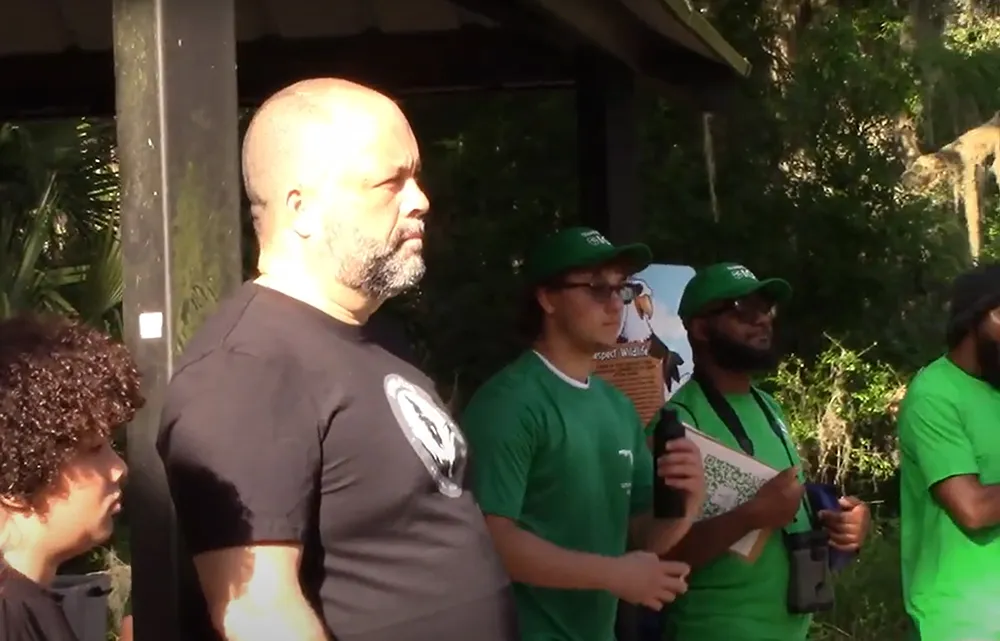
Ben Jealous, executive director of the Sierra Club, brought along his 11-year-old son Jack, to his left, for a hike at the Circle B Bar Reserve near Lakeland. The outing was organized by the Tampa Bay Inspiring Connections Outdoors group. Bob Rice photo.
51, leads one of the oldest, largest and most successful conservation organizations in the nation, building on the legacy of founder and first president John Muir. When he was named to the post in 2023, Jealous became the first black leader in the Sierra Club’s 133-year history. He brought to the job his own legacy as an advocate for social justice, formed through his years as a campus activist, Rhodes scholar, community organizer, investigative journalist, Ivy League professor, New York Times best-selling author, investment fund manager, gubernatorial candidate, and president and CEO of the NAACP, one of the oldest, largest and most successful civil rights organizations in the nation. He “electrified” an NAACP that was struggling at the time, said CNN political commentator Van Jones, who praised his friend and fellow activist as “the foremost turnaround artist on the American scene."
Jealous has shown the same energy during his two years at the helm of the Sierra Club. The organization successfully lobbied to shut down oil drilling in the Arctic, secured the retirement of the last coal plant in New England, and is bringing pressure to bear on asset managers to fund clean energy. And these are just a few among dozens of Sierra Club initiatives spanning all 50 states and a host of conservation issues. Jealous has penned more than 100 essays on conservation topics for Sierra, the magazine of the Sierra Club. In March, after the inauguration of Donald Trump, he wrote, “Generations of movements — and the activists who led them — have faced moments like this, when dark forces rose to power to reverse hard-won social and democratic progress. … The Sierra Club and our movement are stepping forward to meet this moment.” One essay blended Jealous’ commitment to environmental activism and social justice, telling the story of a man just released from prison who feared he’d return to crime but found a new path instead through the outdoors and the community gardens of his neighborhood.
As he hiked among the lush wetlands of Circle B this bright April morning, Jealous was getting a first-hand look at a Sierra Club initiative he also had written about — Tampa Bay Inspiring Connections Outdoors (ICO). Jealous featured the program in an article for the Black-owned news website The Washington Informer, profiling Tampa Bay ICO’s long-time leader Rocky Milburn and Levi Randolph, who was inspired to get outdoors through ICO as a fifth grader and now serves as an adult volunteer with the program. Tampa Bay ICO conducts monthly outings and a year-end camping trip for some 90 students from Academy Prep, a private, nonprofit organization that operates middle schools for low-income students in Tampa, St. Petersburg and Lakeland. Enrollment is largely Black and Hispanic and most graduates later enroll in college.
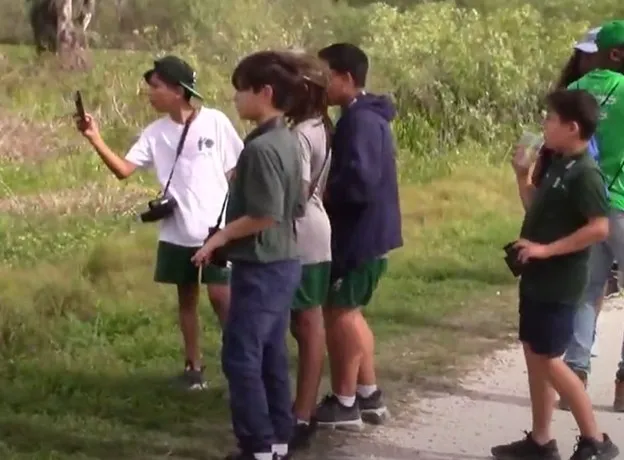
Binoculars at the ready, Academy Prep Lakeland students stop for a photo opportunity along the nature trails at Circle B Bar Reserve. Bob Rice photo.
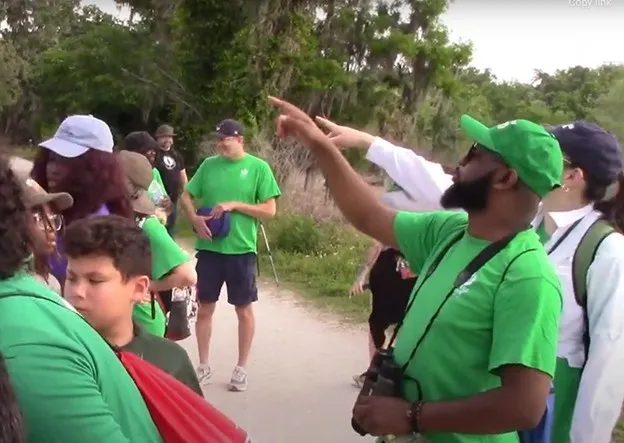
Volunteer Levi Randolph, right, helps spot wildlife during a hike at Circle B Bar Reserve. Randolph once was an Academy Prep fifth grader, like those he now helps guide. Bob Rice photo.
Wonders of Circle B
Knowing he’d be chatting over pizza and salad with the grownups after the hike, Jealous mainly played the role of dad on the Circle B trails. He left the tour-guiding and youth education to the volunteers as he and son Jack walked together, sharing observations and snapping photos on their cell phones. They were visiting from their home in the Baltimore area, where California-born Ben spent his summers as a youth and where the NAACP is headquartered. He told the NAACP when he stepped down after five years in 2013 that he needed to get off the road and spend more time with his family, as he had promised daughter Morgan, then 7.
Father and son were treated to all the wonders of wildlife that keep the Tampa Bay ICO and Academy Prep Lakeland coming back to Circle B every year. The sounds often hit hikers first, before they even round the first bend — maybe the hoot of a barred owl hidden in an oak tree or the musical “conk-la-ree” from flocks of red-winged blackbirds. Then the marshes opened up on both sides of the dirt trail, and clumps of students jockeyed for the best spot to watch gallinules swimming and sounding their downward trill, glossy ibis wading, and up in the air, roseate spoonbills flying purposefully as osprey and vultures circled in the thermals above them. At the first fork in the trail, signs declared that Alligator Alley is closed because so many of Circle B’s star attractions have been mating down there. Some students complained, but the volunteers assured them there would be more. The internet is full of videos shot on cell phones at Circle B showing alligators more than 10 feet long high-stepping it from one marsh to another across the trail.
At a stop along Eagle’s Roost trail, students spread their arms across a silhouette of a bald eagle’s wingspan. In years past, volunteers would tell them to train their binoculars on a tall pine tree in the distance to see an eagle’s nest big as a man, maybe even some eaglets poking their heads up as mother and father circle above. Lately, though, this has become a place to talk to students about the effects of climate change — a top concern for the Sierra Club — and how it can intensify the tropical storms that blow through Florida and the Circle B. Eagles build the biggest nests of any bird in North America, but this one couldn’t stand up to the winds. As the students hiked on, cormorants and anhingas competed for space atop pilings along the open waters flanking the trail, fed by sprawling Lake Hancock to the east. But attention quickly turned to the alligators. A few of them were spotted gliding right offshore. A few more were slowly crossing the middle of the lake.
Favorite things
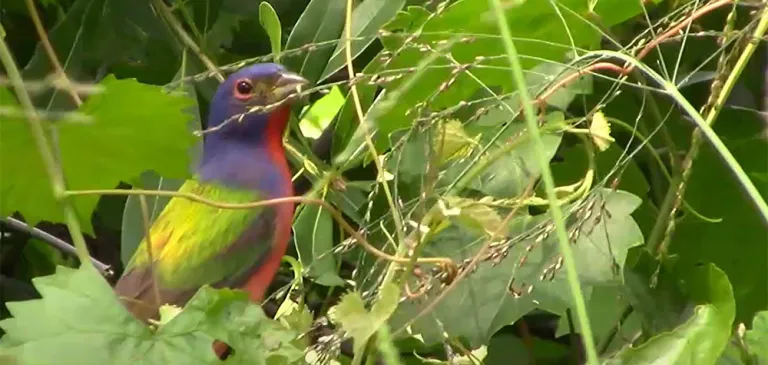
Cypress, oak trees and tall grasses form a tunnel through the final stretch of the trail, along Banana Creek Marsh. A great blue heron struck a perfect hunting pose from a low branch just 20 feet away, beady eyes focused on a school of fish swimming among tree snags in the water. Red-eared sliders sunning on logs slipped into the water as the hikers approached. Students squealed at the size of a slow-moving softshell turtle just beneath the surface. The adults got excited when word spread between groups that a painted bunting (see header image) — in all its feathered blue, green and red glory — was perched in the bushes up ahead. It was a first sighting of the colorful species for the students, so out came their cell phones — only permitted during ICO events for taking nature photos. As the hike wound to an end, students passed beneath a towering oak tree before one girl noticed a red-shouldered hawk in its branches. As if on cue, the bird flapped off, delighting those who looked up.
Volunteers gathered the students into ICO’s traditional post-outing circle and they recounted their most memorable moment from the morning. The creatures they spotted and just being outdoors figured prominently in their brief reports. Ben Jealous joined in, urging the students to embrace the outdoors and standing with them for a group photo. They boarded school vans for the trip back home as the volunteers gathered for lunch with Jealous at Circle B’s Polk County Nature Discovery Center complex. The 1,267-acre reserve was acquired for preservation by the Polk County Environmental Lands Program and the Southwest Florida Water Management District.
Before a couple dozen adults, leaning at times on a picnic table, the man declared “one of the nation’s most prominent civil rights leaders” by the Washington Post spoke with authority and intensity. He advised Sierra Club recruiters in the crowd to start with a stripped-down, nonpolitical message when they approach prospective members: “Do you like to go hiking?” He demonstrated the qualities that also commend him as one of the nation’s most prominent conservation leaders. Jealous described the joy he found in nature as a boy, growing in California and Maryland. Before taking the helm at the Sierra Club, he served on the boards of The Wilderness Society, the Trust for Public Land and the Environmental Defense Fund.
The ICO’s Milburn, who also serves as chair of the Tampa Bay Sierra Club group, worked more than a year with Jealous and his staff to find a spot on the executive director’s busy schedule for a visit to witness the work of the local ICO program. Plans for a weekend-long tour were pared back to the morning hike at Circle B. But Milburn believes he still got his message across: A program introducing youth to the outdoors is vital to ensure the future of the Sierra Club and rates a higher priority within an organization perhaps best known for its lobbying efforts. The audience this day heard the same commitment from Jealous that Milburn would later describe.
“The most concern was the lack of support for ICO from (Sierra Club) national and chapter,” Milburn said. “He was very sympathetic to this and seemed dedicated to improve. He was genuinely concerned — and pleased with what Tampa Bay was doing.”
Dennis Joyce writes for a group of military magazines and is a former editor at the Tampa tribune and the Tampa Bay Times.
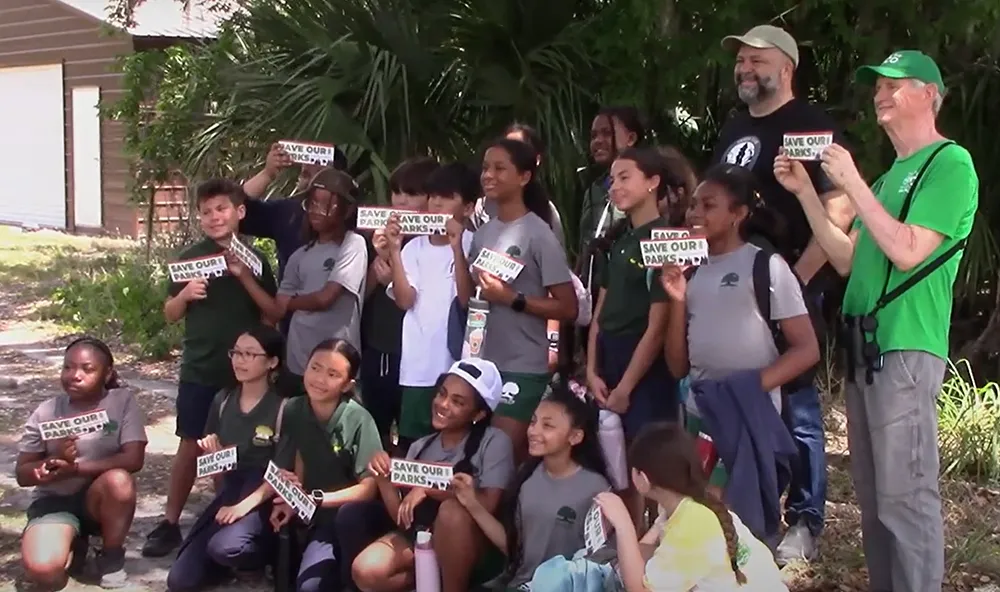
Rocky Milburn, right, Tampa Bay Sierra Club chair, joins national Executive Director Ben Jealous and students from Academy Prep Lakeland for a group photo at the end of their hike. Bob Rice photo.