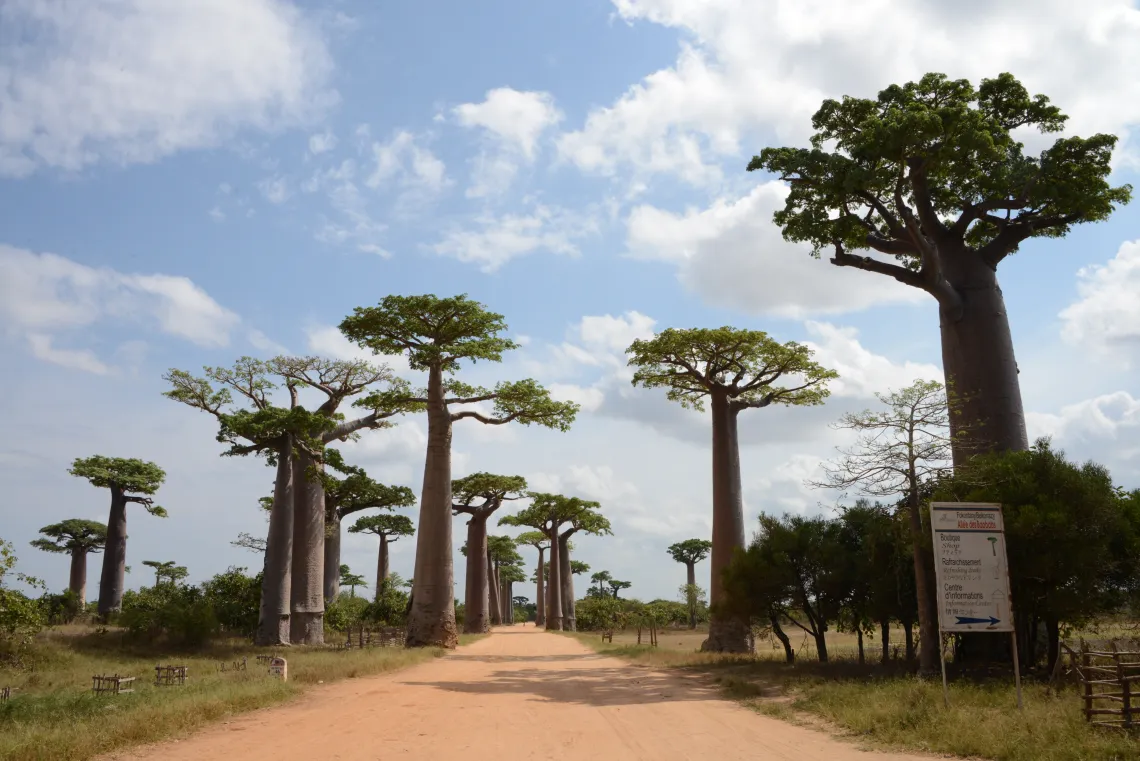
When I met them, I wanted to run to them. Throw my arms around them. I wanted to sit among them and listen to their stories about what they’ve seen, what they’ve heard. I wanted to tell them what I just learned from a Malagasy woman who was using their shade as protection from the sun as she sold handmade items to tourists, including miniature twisted wood sculptures of their very likeness.
“The trees are in trouble. They are all being cut down. They are dying.”
This is what she said. So I didn’t go to them. Not only was time a factor — leaders in my group were in charge and I was merely along for the ride — but I was also scared. I was worried I’d somehow do something wrong. Hurt them in some way. Make them sick. I was a traveler from so far away. I didn’t want to intrude. I was there to do good, not harm. So I would stand back and admire from afar for the few moments I had.
And those moments standing along the Avenue of the Baobabs on an orange-brown dirt path known as Road No. 8 that connects Morondava and Belon’i Tsiribihina in Madagascar changed my life forever.
This is one of those moments where you question everything you thought you knew or believed. Spirituality smacks you straight in the heart. The emotions are undeniable. Something special is happening here.
***
I'm fascinated by the baobab. So I've done some research. According to Britannica, the baobab tree is a genus of nine species of deciduous trees of the hibiscus family. Of those nine species, six are endemic to Madagascar. The ones along the Avenue of the Baobabs are Adansonia Grandidieri, and they can’t be found anywhere else on the planet. In the past, this area was part of a dense forest with towering trees of about 100 feet. Now, the Avenue has only about 25 trees left. There are an additional 25 or so Adansonia Grandidieri nearby that grow over rice paddies.
Locals call the baobab “reniala,” or “Mother of the Forest.” The tree, like so many living things in this world, is in trouble. Climate change, deforestation, fires and natural disasters threaten their existence. And when the trees die, life around them changes — or dies — too. Everything is connected.
Baobab trees are sacred and offer nutrition (the fruit is a good source of vitamin C, potassium, phosphorous and carbohydrates), medicine and water for local people, who have for centuries told stories about these breathtaking beauties. In one of these stories, it is said that the gods didn’t want the majestic trees to wander off, so they reached down, pulled all of them from the ground and stuffed them back into the earth upside-down.
Think about that. The gods didn’t want the majestic trees to wander off.
And here we are.
We’re not only allowing trees all over the world to die, we are helping to murder them. Humans have been destroying forests for thousands of years.
Logging. Agriculture. Urban expansion. Unsustainable resource extraction. Climate change.
There’s no time left. We must act now. We must do everything in our power to protect and revive these precious baobab trees and all of Earth’s living things.
Mother Earth is in trouble. The trees are in trouble. As are the animals, plants … and us.
We can all do better. We must all do better.
For our mother.
Learn more
International Day of Forests is observed annually on March 21. This year's theme is Forests and Food.
Support forests
You can help protect forests here in Indiana! Join the Sierra Club Hoosier Chapter or complete the volunteer interest form today!
Kasey Grau Jackson
Secretary of the Sierra Club Hoosier Chapter Executive Committee, and a lover of all trees and forests.