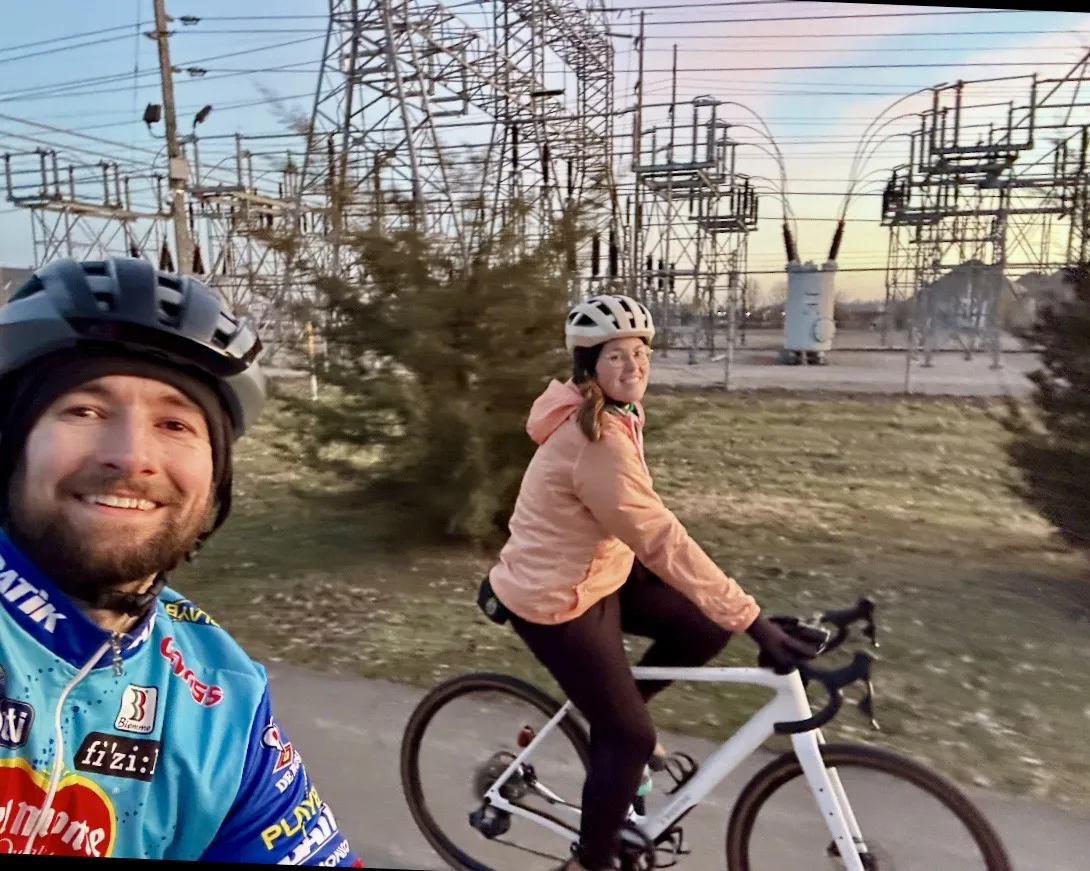
April 2026, 7:30 am. The sun rises from behind the distant treeline as Koopa and I walk the Pennsy Rail Trail, his ears bouncing with every step. As the dew begins to dry, I take deep breaths, smelling the earthy comfort of morning air before we head back to our home in Irvington, on the not-so-far Eastside of Indianapolis. On our left sits Irvington Community Elementary School, where classes will begin shortly after the sun emerges from behind the trees. Opposite the school is a field, grown over with silver maples, black willows, cottonwoods, dogwoods, and a few red cedars sprinkled among the shrubs. I hadn’t realized, living in Irvington for the last three years and having walked and biked past the field by the school countless times while admiring the trees and shrubs that slowly reclaimed the land, that it had once been the old Ford Visteon plant—and is now considered a brownfield.
I’d come to learn about brownfields after attending a community forum with my partner in late April: the District 14 Community Forum on Proposed Data Center in Warren Township where a developer (Lauth Group) also known as Thunderbird Commerce LLC (their shell company), and Atlanta based company DC Blox, also known as DC Blox Indianapolis LLC (their shell company) attempted to convince our community that it was okay that they had already bought the brownfield—and are moving forward with plans to build a massive data center complex there—a 2 billion dollar project.
The developer, or rather their representative, Vincent Ash, told us¹ that other things could go in there—things far worse than a data center—he said. He went on to explain that Thunderbird LLC had received a “comfort letter” regarding the brownfield site (a highly contaminated piece of land containing arsenic, lead, thallium, solvents, forever chemicals, and a number of other unpronounceable industrial waste by-products, including PFAS). The comfort letter Mr Ash showed us simply meant, that upon purchasing the land from Ford, Ford had confirmed that it complied with U.S. Environmental Protection Agency regulations, and that Thunderbird LLC (Lauth Group) would not be held responsible for Ford’s toxic legacy at the brownfield… That is, as long as they follow a specific set of rules designed to protect the public and the environment, such as fugitive dust mitigation.²
The fact that the intersection of Kitley and Pennsy Trail has essentially been an urban dust bowl for the last three years suggests a dereliction of the duty to follow those rules—a duty that upholds the dignity of hundreds of people living in close proximity to the field.
At the forum, the DC Blox Sales Representative, David Armistead, claimed that the land would be developed – and that a data center was a better option than anything else. Yet there had been no mention of bioremediation—a natural path to cleaning up the land using trees, many of which had already taken root along the edges. Would that not be a safer, more respectable way to handle toxic land that happens to be a stone's throw away from an elementary school?
Sealing off the brownfield with an enormous data center in the middle of a thriving community, housing any manner of data, is what they plan to do instead, and as soon as possible. —And they refused to tell us what kind of data or anything specific about what would be contained inside the building (apart from vague explanations of its construction). Transparency.
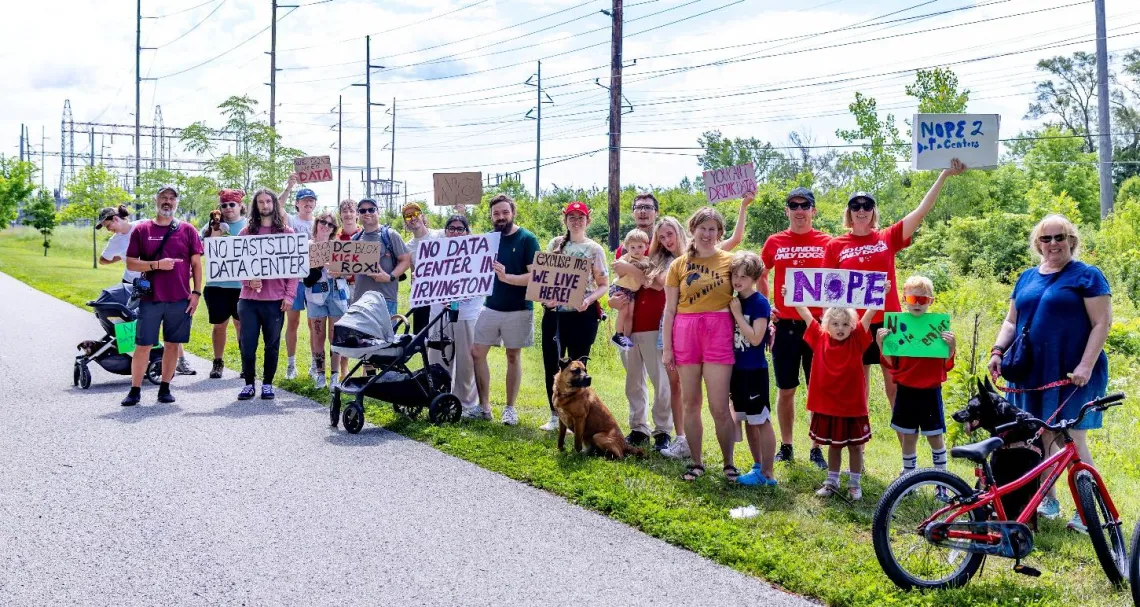
Their attempt to sell our community on their proposal (see the link to the video above) was unsuccessful, to put it lightly, despite many of us — I include myself here — not being opposed to technology or to the fact that some data centers serve a clear functional purpose. —But not right by our school—not right here where we live, and not without telling us what kind of data or what customer(s) they would be leasing.
And what really bothered me, as I take pride in trusting others, unless or until they show me I should not, was that their presentations contained gross misrepresentations that we would later learn: 18 fewer diesel generators³ than their website clearly stated for the proposal at the time of the presentation. For context, one generator (roughly 2 megawatts) for this project is about the size of a school bus—and is powerful enough to supply electricity to over 2,000 homes.
I can understand if their numbers were off and it was an honest mistake, but they never admitted it—and they never reached out to the people who attended the forum, all of whom had signed in and provided a way to be reached. They never announced it on their shell company's website, DCBlox Indianapolis LLC, nor did they mention it on their official, Atlanta-based website.
But there could and would be worse things to go in, they said. Worse than a company that takes us for fools? Worse than one whose commitments provide no other times to reasonably test generators, the loudest thing they will do, outside of school hours? Is it as simple as a dichotomy between them, or something worse, as they’d like us to believe?
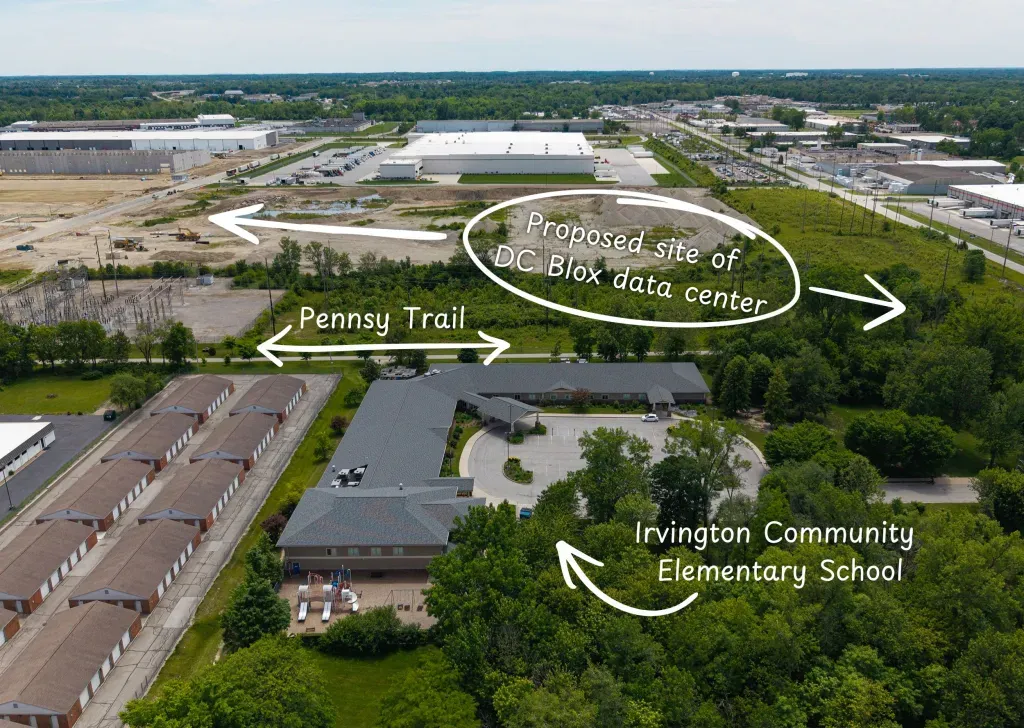
Then something dawned on me as I began to learn more about the history of the old Ford Visteon site, something that felt like being given the invisible person treatment. I remembered many occasions over the last three years when my partner and I would be riding along the Pennsy, only to be greeted by a cloud of dust, and days spent outside gardening with a fog-like haze hanging in the air, and the dusty patina that formed all too quickly on our breezeway furniture. For the last three years, the brownfield near our home has been recklessly developed—and continues to be developed without water trucks, silt fences, tarps, or any form of dust management whatsoever⁴—right next to our elementary school—while children play outside during recess.⁵ Going rogue on a brownfield to save a buck.
The arsenic dust—the lead dust—and the industrial waste from the brownfield have penetrated our community.⁶ The fumes float along the Pennsy trail and through the surrounding neighborhoods, like ghosts of the heartland’s cruel past, conjured by developers, by greed, by the disease of power, this apparent addiction to capital gain far beyond one’s need: It’s nurtured by an economic system that awards it, promotes it, encourages it, and only feeds itself while more and more of us have less.
Perhaps we’re reaching an end to this attack on human dignity: cancers and deaths caused by known carcinogens, wafting on fugitive dust, taking years, maybe decades to manifest; An end marked by the forever droning of a data center right outside the windows of Irvington community elementary school while children stumble and struggle, and the rattling windows of our homes when the generators are tested, at least those who could not afford to move away.
And when the dust finally settles after their digs, and their vapour barrier is installed under the monstrous data center, dwarfing the school in its shadow, in the infrasound, the murderous plume of toxins and the contaminated water table will have migrated—yet we can only hope it will have migrated away from the school, despite what is contained in the virtual filing cabinet on the old Ford Visteon site.
But perhaps, if enough of us come out to the next public hearing for DC Blox on July 15th, we can prevent further harm to our community.
Will you join us?
What: Metropolitan Development Committee Zoning Hearing Protest
Where: 200 E Washington St, Indianapolis, IN 46204
When: Wednesday, July 15, 12pm ET (Hearing at 1pm)
For more information, follow: NO to Irvington Data Center
Eastside Community Action against Data Centers
Marcus Ramey
Eastside Resident
SOURCES:
¹Vincent Ash’s comments during Andy Nielsen's community forum on April 27 can be found here. Ash's comments start at the 48:15 mark. He talks about the brownfield at the 50:10 mark. His comments about the options that would be far worse than a data center are at the 51:45 mark.
²The specific set of rules is outlined in the ERC (Environmental Restrictive Covenant), which, for this brownfield, includes an additional set of rules specific to managing the heavily contaminated soil called an SMP (Soil Management Plan).
³The DCB Presentation showing 18 less generators than planned for building 3 sourced from the 26:14 mark of the April 27 community forum. The plan of operations that was available to the public at that time that explicitly stated 36.
⁴Both the excavating subcontractor and the general contractor publicly documented and celebrated uncontrolled dust conditions at this site on social media:
On July 31, 2025, Sub Surface of Indiana, Inc. (SSI) posted to their public Facebook page under the caption "We love to see dust flying!," explicitly identifying the Thunderbird Commerce Center as the project site, describing the scope of work as "380,000 CY of dirt work and over 20,000 linear feet of pipe work," and including a photograph of active excavation with visible fugitive dust and no suppression measures present.
On August 5, 2025, Lauth Group, Inc. - the general contractor acting as agent for the property owner - re-shared the same image to their own public Facebook page under the heading "Thunderbird Commerce Center construction update," with the caption "We love to see dirt moving!"
Drone shots from IndyStar in April show active earthwork with none of the SMP mitigations in place.
⁵Emergency response is documented in the VFC from 2022 when the school's principle called in to IDEM about the dust because he was unsure if the children could go outside. Link to incident report. There is also an open investigation at the site under Incident ID 123837.
⁶Documented contaminants in extensive environmental testing at the site can be found under AI #11510 in the VFC (link to repository of all documentation below):
This report was created for Lauth in 2021 and goes into detail about the remaining contaminants at the site.
A direct link to the entire repository can be accessed here.