The other day, I said to my partner as we were buying groceries, “I know it’s a treat, but we could use some cereal bars.” And after hearing those words come out of my mouth, I realized that, in our house, buying groceries has now crossed into “treat” territory. Increasingly, it is getting more and more expensive to afford our usual items. From gas prices to our utility bills, it is difficult to just get by. Every day our worry increases right along with costs.
It may seem odd to start off a piece about wetlands with an anecdote about the cost of living, but affordability issues are directly linked with political decisions. In fact, political choices have economic impacts. And when elected officials make environmental decisions, these have economic impacts as well.
One example is water. As we all know, water is vital for life. Humans are roughly 60% water. We are water creatures on a water planet. As Hoosiers have seen all too recently, water has a huge impact. Let’s dive in and see how Indiana has been managing our waters.
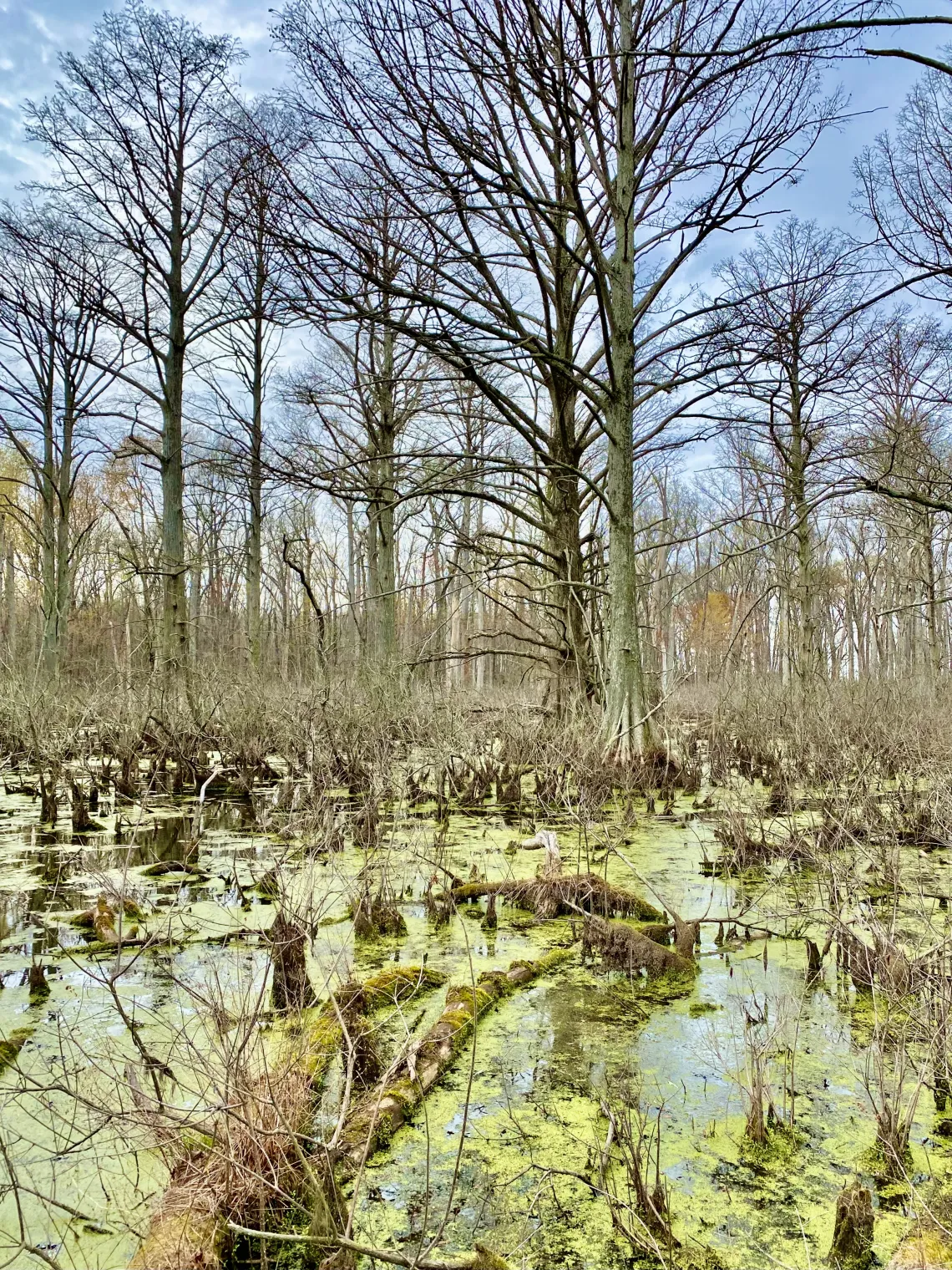
Indiana Wetlands
Before colonization, the area that would later become Indiana, had 24% of its area made up of wetlands; approximately 5.5 million acres were wetlands. By the 1980s, 85% of our wetlands had been lost leaving the Hoosier state with about 830,000 acres (Hoosier Environmental Council 2025).
However, today there are even fewer acres of wetlands remaining. Since the 1980’s we have been losing these vital habitats with the Indiana Department of Environmental Management (IDEM) estimating an approximate current total of 813,000 acres, representing a loss of about 27,000 acres since the 1980’s (IDEM 2025a).
Indirect Costs of Wetland Losses
There are social, environmental, and economic benefits of wetland habitats. According to the EPA, “[w]etlands are important because they protect and improve water quality, provide fish and wildlife habitats, store floodwaters and maintain surface water flow during dry periods,” (EPA 2025).
IDEM lists several factors that showcase the importance of wetlands (IDEM 2025b). More than a third of America’s threatened and endangered species live only in wetlands and more than 200 species of birds rely on these critical habitats. Wetlands act as natural filters by storing and filtering nutrients and sediments while cleaning lakes, rivers, streams, and drinking water. Wetlands also recharge aquifers which support groundwater. Surprisingly, over 70% of Hoosiers rely on groundwater for their water supply. Wetlands also provide flood protection and erosion control.
While difficult to calculate all of the economic value that wetlands provide (how do you calculate the economic benefit of more than 200 bird species?) there are some numbers that have been attributed to wetlands. IDEM reports $59.5 billion nationally spent on activities dependent on healthy wetland habitats like hunting, fishing, and recreation (IDEM 2025b). Wetlands store 1-1.5 million gallons of water per acre (Hoosier Environmental Council 2025).
More Direct Cost Savings of Wetlands
Indiana Department of Natural Resources (IDNR) published a flier that lists the following economic values of wetlands, specifically in Indiana annually (IDNR 2021):
- $202 million in water purification
- $1.8 billion in water storage
- $850 million in erosion prevention
- 81 million acres of cropland runoff purification
This means, that with the continual loss of Indiana wetlands, acre by acre, we lose the economic benefit that wetlands provide. As indicated by the IDNR, one wetland acre provides the following economic benefits:
- $248 in water purification services
- $2,270 in water storage
- $1,055 in erosion prevention
- Nitrate removal from 100 acres of cropland runoff
For every acre that we bulldoze and fill in, we lose these economic benefits. Without our wetlands “paying” for these services, the bill falls to us to pay for water storage and purification services elsewhere. With the rising costs of everything else, I know my household simply cannot afford yet another bill.
Conclusion
Indiana wetlands are one key example that showcases the economic impacts of environmental decisions. When we lose wetlands, acre by acre, we lose the economic benefits that wetlands provide. This adds up to thousands of dollars year after year.
We don't only lose economic value from poor environmental decisions, we also lose intangibles. Lost wetlands of course mean fewer birds and wetland creatures, and fewer wild areas to enjoy. How do you measure the loss of not hearing birds? Or the loss of being able to walk in our wild wetland areas? How do you measure being able to listen to the frogs and toads that make our wetlands home? As Jennifer Ehara will illustrate in the next part in this water series blog, water is not simply a “resource” that needs to be managed, water is life and our elected officials have the responsibility to make sure that our waters are clean and available for us living creatures; not data centers. It is time for our decision makers to make better decisions for Indiana wetlands and Hoosier pocketbooks.
Nicole Snider
Chapter Chair
Resources:
EPA. 2025. “Wetlands Protection and Restoration.” Last updated November 25, 2025. epa.gov/wetlands
Hoosier Environmental Council. 2025. “Indiana’s Wetlands.” Accessed December 4, 2025. hecweb.org/indiana-isolated-wetlands
IDEM. 2025a. “Indiana’s Wetland Resources.” Accessed December 5, 2025.
—--. 2025b. “Importance of Wetlands.” Accessed December 5, 2025. in.gov/idem/wetlands/importance-of-wetlands
IN DNR. 2021. “Connecting Wetlands, Wildlife, and You.” Accessed December 5, 2025.