By Whitney Terrill
Memory culture has been on my mind for many weeks now. On September 5th of this year, Minnesota became the second state in the United States to raise the flags of eleven first Tribal Nations at the State Capitol Grounds. The experience left me wanting to recommit to deepening ways our work at Sierra Club overlaps with supporting the ongoing leadership and legacy of native people. The experience and testimonies at the Capitol reflected a combination of gratitude and a call for greater progress.
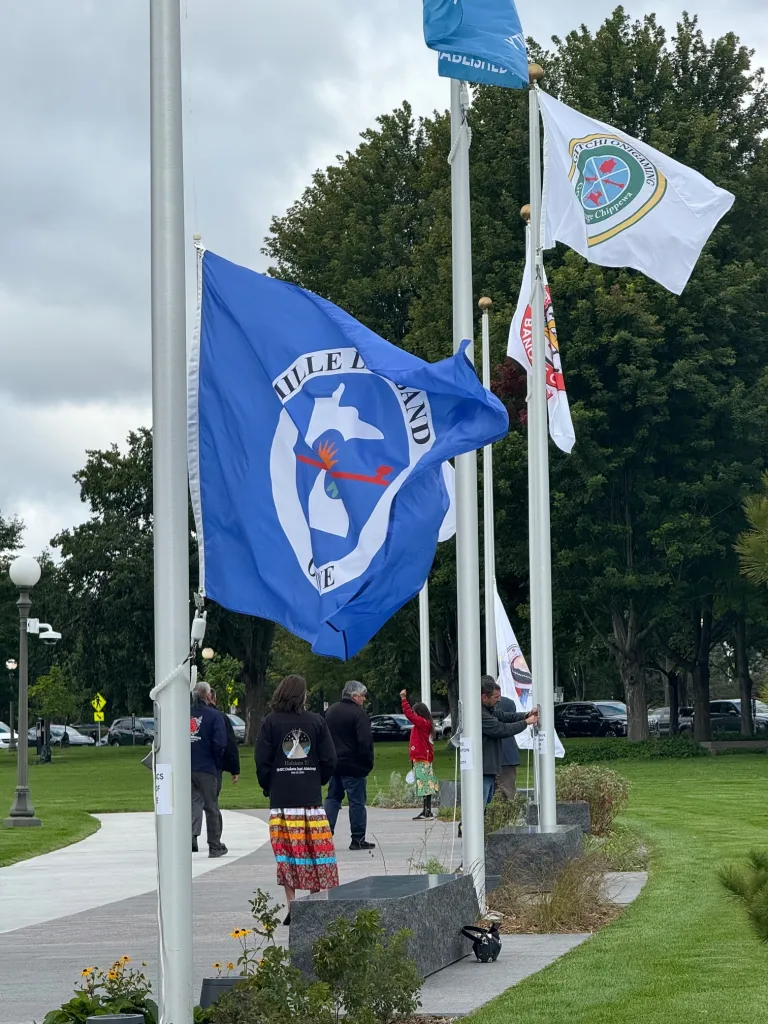
Raising flags and standing ceremoniously in renewed commitment felt powerful. In fact, it led me to propose this writing on topics of remembrance to honor the history, such as the ongoing remembrance of Indian Boarding Schools. Today, September 30th marks National Day of Remembrance for Indian Boarding Schools. Some also know it as Orange Shirt Day. Whichever name you choose, it is a day of deep mourning, reflection and accountability for the incredible loss and systematic removal and genocidal policies against native people, especially children.
These histories, policies, and realities of adult survivors and their families are with us still today. The cemeteries of thousands of children in Canada and the United States, including mass graves, are reminders of the grief we must feel and remember as a minimal action and foundation for greater change and accountability.
For years, I have struggled with the ways that participation in Boarding Schools was rampant including from my own undergraduate institution. It was an unmistakable building on my campus with an Indigenous name that sparked my curiousity about ways that institution participated in Indian Board Schools. I am horrified at the intersection, and am personally committed to addressing this history. It is likely that each of us have such a personal connection even if we are not personally responsible for these tragedies. I share this story with you so that we can dig deep and contribute to the kind of collective memory that may never fully repair but distribute the trauma of these events for all of us to carry.
Tomorrow, if you are capable of any kind of action, I encourage you to engage in this important form of memory culture and let it move you towards accountability and action to support better futures for native people and generations to come. Consider reading this blog or joining an event but let’s do something to remember this heavy history and ongoing reality. After all, all of our futures are interconnected.