By Debra Lucero, Director of Special Projects, Water Education for Latino Leaders
CHICO, CA — For years, locals have called Butte Creek Canyon Butte County’s “mini-Grand Canyon.” From Lookout Point along the Skyway, visitors gaze across spectacular foothills toward Butte Creek, home to one of California’s healthiest wild populations of threatened spring-run Chinook salmon.
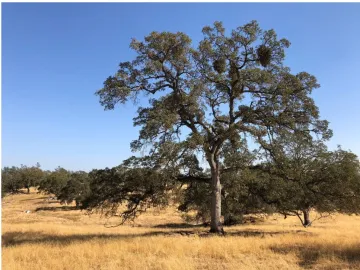
Across the Skyway, rolling grazing lands are dotted with magnificent blue oaks, some estimated to be 200–300 years old. These resilient trees shelter wildlife, stabilize soil, sequester carbon and define a landscape unmistakably Butte County. Now, approximately 2,000 blue oaks face removal under Cenergy’s proposed North Chico Solar project.
California desperately needs renewable energy. But does fighting climate change justify destroying the natural resources that help combat it?
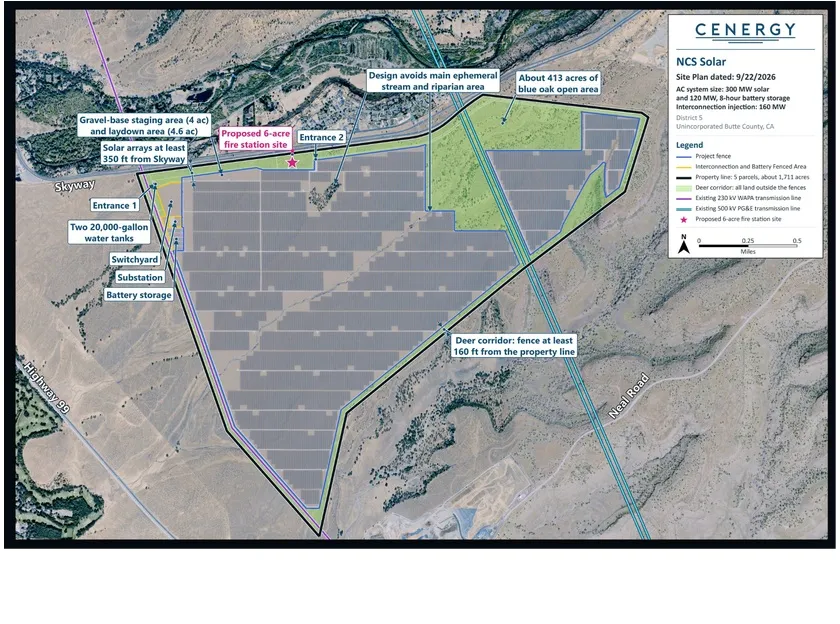
Cenergy is proposing an industrial solar and battery-storage complex on approximately 1,700 acres southeast of Chico, along the Skyway toward Paradise. The project includes 250 megawatts of solar generation and 120 megawatts of battery storage.
The controversy has divided environmental advocates.
“Every place is environmentally sensitive,” said Chico State sustainability expert Mark Stemen. “There are no good choices left because we have dragged our heels too long.”
Stemen’s argument is simply that the earth is running out of time. And … he’s not wrong. Research shows that “ … current climate policies put the world on a course for 2.8 degrees C of warming this century” according to a new United Nations “Emissions Gap” report.
Allen Harthorn, founder of Friends of Butte Creek, disagrees.
“I just don't understand how you can justify despoiling this beautiful foothill scenic highway, blue oak woodland, burrowing owl habitat, likely tribal resources, in a wildfire zone and destroying the neighborhood and property values.”
Harthorn’s organization has spent decades protecting the Butte Creek watershed and is currently restoring floodplain habitat near the proposed development.
“This project is absolutely contrary to the conservation efforts we’re trying to put forth,” Harthorn said.
The disagreement reflects a difficult environmental dilemma.
More Than Trees at Stake
The North Chico Solar Project raises serious questions about groundwater recharge, build-out dust and disruption for two years, wildlife migration, agricultural land and scenic resources. The volcanic foothills have been identified as an important recharge area for the Tuscan Aquifer, which supplies groundwater to Chico and surrounding agricultural lands. Grading, stormwater runoff and proposed herbicide use warrant careful examination.
The project also occupies a high fire-hazard severity zone near the Skyway, a critical evacuation route during the devastating 2018 Camp Fire where adjacent properties were burned. Industrial battery storage adds another concern requiring rigorous review. Cenergy reports 5.7 acres will be dedicated to battery storage.
California Native Plant Society representatives have emphasized that rare species evolved to thrive in these thin volcanic soils. Blue oak woodlands provide their own climate benefits, and their destruction cannot easily be reversed. Local ranchers and agricultural organizations have also questioned the conversion of active grazing land into an industrial energy complex.
Who Decides?
Cenergy is pursuing certification through the California Energy Commission’s Opt-In Program, established under Assembly Bill 205. This state-level process could approve the project without traditional county land-use approval. The commission generally has 270 days to decide after receiving a complete application.
At its October 27 meeting, the Butte County Board of Supervisors declined to consider Cenergy’s proposed community benefits agreement until an application is available. Earlier, the Butte County Resource Conservation District rejected a proposed $250,000 agreement. Its provisions included restrictions on challenging or opposing the project. Cenergy has shopped approximately $5 million in community benefits to local organizations and public agencies.
Meanwhile, the newly formed Foothills Coalition has launched its Save Our Skyway campaign, bringing together neighbors, ranchers, environmentalists and community advocates. The coalition is not opposing solar energy. It questions whether this environmentally sensitive location is appropriate and whether alternative sites have been seriously evaluated.
Access to existing Western Area Power Administration transmission lines makes the location attractive to developers. But transmission infrastructure exists elsewhere in Butte County.
The Real Environmental Test
California’s climate target for net-zero greenhouse gas emissions or carbon neutrality by 2045 demands action, but urgency should not eliminate responsible siting, environmental scrutiny or meaningful public participation. The Skyway’s blue oak woodlands have survived generations of drought, wildfire and development pressure. They shelter wildlife, store carbon and preserve a landscape that future generations deserve to inherit. The challenge facing California isn't simply how much renewable energy we can build. It's how much of the natural world we're willing to sacrifice in the process.
For information about the Foothills Coalition, contact saveourskyway@gmail.com.