Big Bend’s Big Day in Court
The Supreme Court allows a mega-construction project in this remote national park
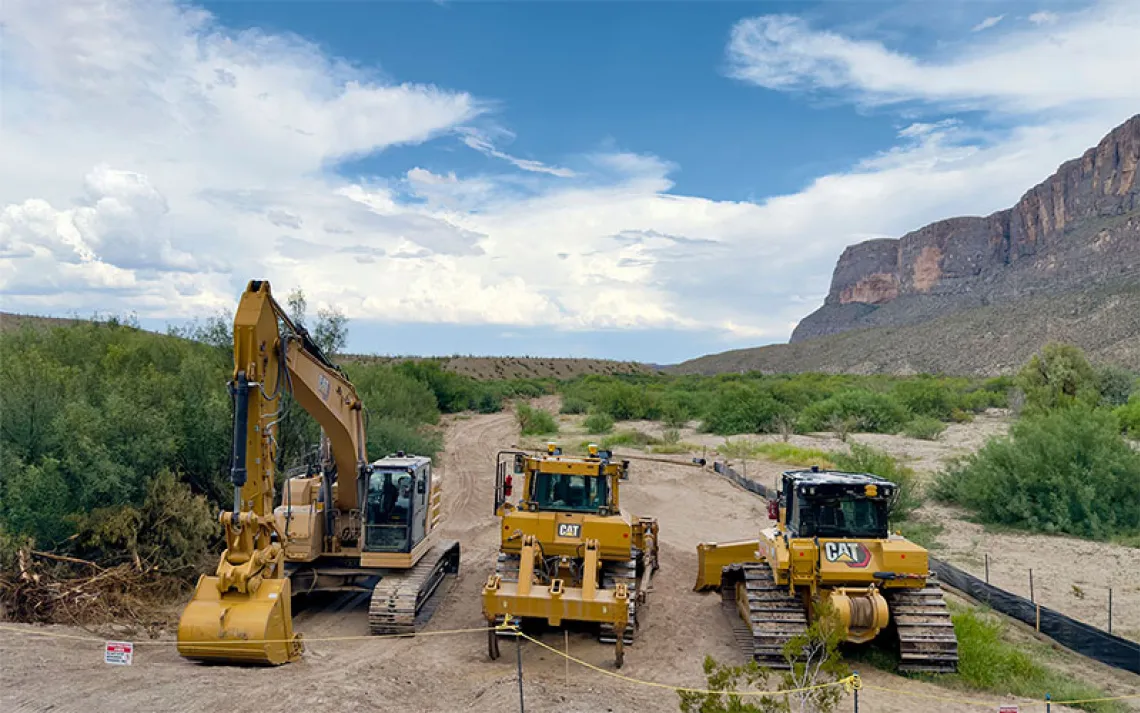
Heavy-duty construction equipment parked at Santa Elena Canyon in Big Bend National Park. | Photo by FangXiaNuo/Getty Images
One of America’s remotest national parks is one step closer to undergoing a construction bonanza now that the Supreme Court has cleared the way for a border wall through the Big Bend region in Texas. The ruling comes just a month after federal judge Kathleen Cardone issued an injunction blocking the project. She concluded that the federal government could not waive environmental regulations to accelerate border wall construction.
The SCOTUS decision pauses this previous order while the lawsuit that sparked Judge Cardone’s decision works its way through the district court level. In the meantime, US Customs and Border Protection is expected to bulldoze inside Big Bend National Park and begin work on a 30-foot steel barrier in parts of Big Bend Ranch State Park. Cary DuPuy, the Texas regional director for the National Parks Conservation Association, said she was “very disappointed” to see the SCOTUS decision.
Downstream from the state and national parks, she said, it fully authorizes CBP to build vehicle barriers and floating barriers throughout the remaining public lands along the river, including Black Gap Wildlife Management Area, Rio Grande Wild and Scenic River, Seminole Canyon State Park and Historic Site, and Amistad National Recreation Area.
“These places will not recover quickly,” DuPuy said. “They will show the scars of damage for years.”
What does this mean for the national park?
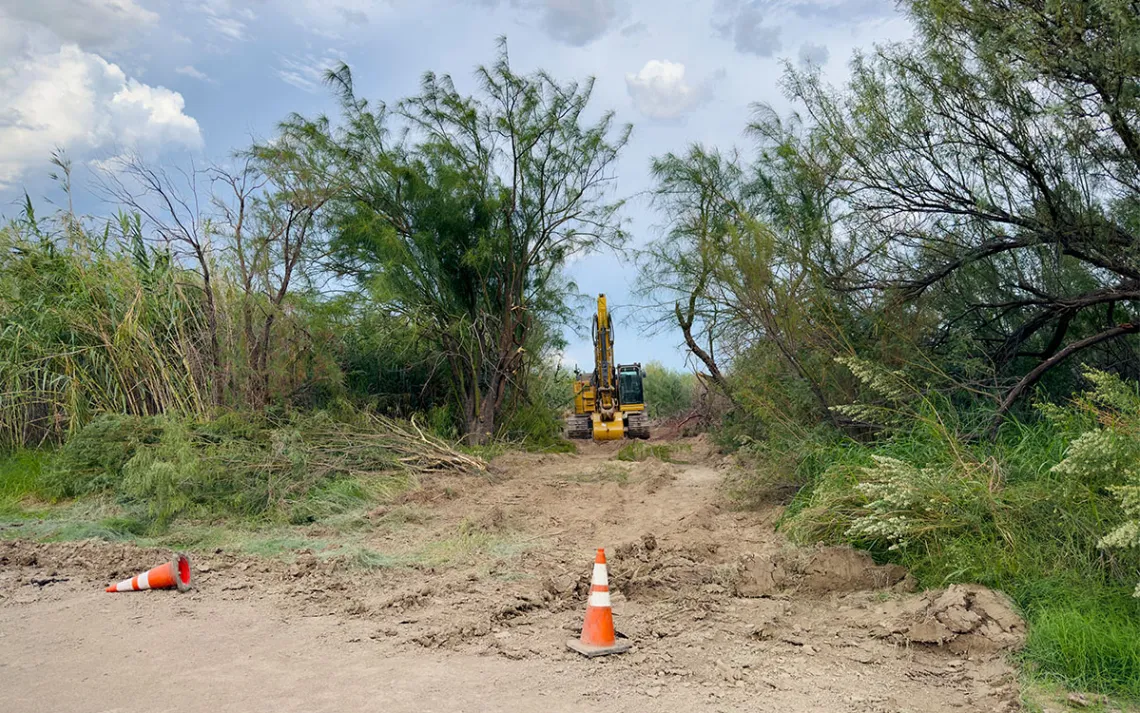
DuPuy stated that there’s no telling when construction will begin, but once it does, the impact will be readily apparent. Back in August, when construction workers were inside Big Bend National Park for a few days, the damage was significant and visible. Construction crews bulldozed a new road in the remote Mariscal Canyon, destroying rare and slow-growing desert plants. They also felled trees and shrubs in Santa Elena Canyon, along the riverbanks that make up essential habitat for many animals.
In a statement about the ruling, DuPuy urged the Trump administration to implement alternatives to heavy infrastructure “regardless of the court’s decision.” But CBP’s lack of transparency surrounding its plans and poor communication with other agencies and locals have presented other problems, she said.
“We have heard that CBP [has] an updated plan that takes impacts on the resources into account, but we have not seen it,” she said. “We are still calling for transparency.”
Despite the impact of the rule, the court did not decide on the merits of the case. Rather, the justices’ 8–1 ruling concerns procedure. In their final decision, they stated that Congress gave the secretary of the interior the authority to waive all conservation laws. In other words, the government’s interest outweighs any alleged harm by the plaintiffs in this case, which includes the Center for Biological Diversity, Friends of the Ruidosa Church, and a landowner named Danny "Billy" Miller Jr. Judge Ketanji Brown Jackson was the only dissenting opinion but did not comment.
John Leshy was the chief legal counsel and principal legal adviser to the secretary of the interior during the Clinton administration, when Congress began creating the legislation that grants the secretary authority to waive conservation law. In 1996, it passed the Illegal Immigration Reform and Immigrant Responsibility Act, later amended by the REAL ID Act of 2005, giving the Department of Homeland Security the authority to secure the border however it sees fit, waiving all other laws.
According to Leshy, the only thing that can affect the Supreme Court decision is if Congress changed that legislation. It is possible that a different Homeland could decide that the border wall is not necessary, he said, but it’s unlikely to happen under the present administration.
“This shows that Congress needs to step up and address these issues rather than handing a blank check to Homeland Security, which is what it’s been doing since 1996,” Leshy said. “If Congress wants to stop the border wall, it will need to act quickly. Otherwise, there will be a border wall."
What’s next for Big Bend?
For conservation advocates, the effort to protect the Big Bend region is far from over. Bob Krumenaker was the park’s superintendent from 2018 to 2023. He confirmed that CBP has been inconsistent and opaque in communicating with the public and other agencies.
“They recently announced that they have a new plan, which is responsive to stakeholder concerns,” he said. “But they have not shared it.”
Now, he is the chair of Keep Big Bend Wild, an organization formed with the goal of advancing federal wilderness designation for the most remote parts of Big Bend National Park. Such a designation would afford much of the area the highest level of conservation protection in the US.
Krumenaker said advocates have fought for wilderness designation inside Big Bend since 1978. However, until the public learned of the federal government’s plan to build heavy border infrastructure inside the park, it was challenging to get traction because people assumed that the park was protected. Krumenaker’s organization is calling for a bill in the next Congress that combines rolling back the waivers permanently, cancelling the contracts, and designating large parts of the park as wilderness. The nonpartisan group was part of the effort to assemble Democratic Representative Veronica Escobar’s recent sign-on letter, in which she and 22 other members of Congress request an independent investigation into the construction contracts.
“In five years of being superintendent, I never once heard a border patrol official say they needed more border infrastructure in order to keep the border secure,” he said. “No one is talking about open borders. We are all for a secure border. This isn’t the way to do it.”
DuPuy stated that although the injunction has been lifted, resistance will continue both legally and on the ground. Conservation groups have filed several lawsuits, which will continue to go through the legal process. And organizers with groups such as the NPCA are calling for people to reach out to their elected officials and ask them to call for a permanent end to border wall construction in the region.
“We’ve had several wins that might lead people to think that Big Bend is protected, but it’s not,” DuPuy said. “The message is even louder now—we all need to come together to protect this place.”