The Data Center Buildout Will Soon Face Congressional Opposition
Midterm voters voiced their disapproval of the centers, which are polluting and could erase years of progress in reducing emissions
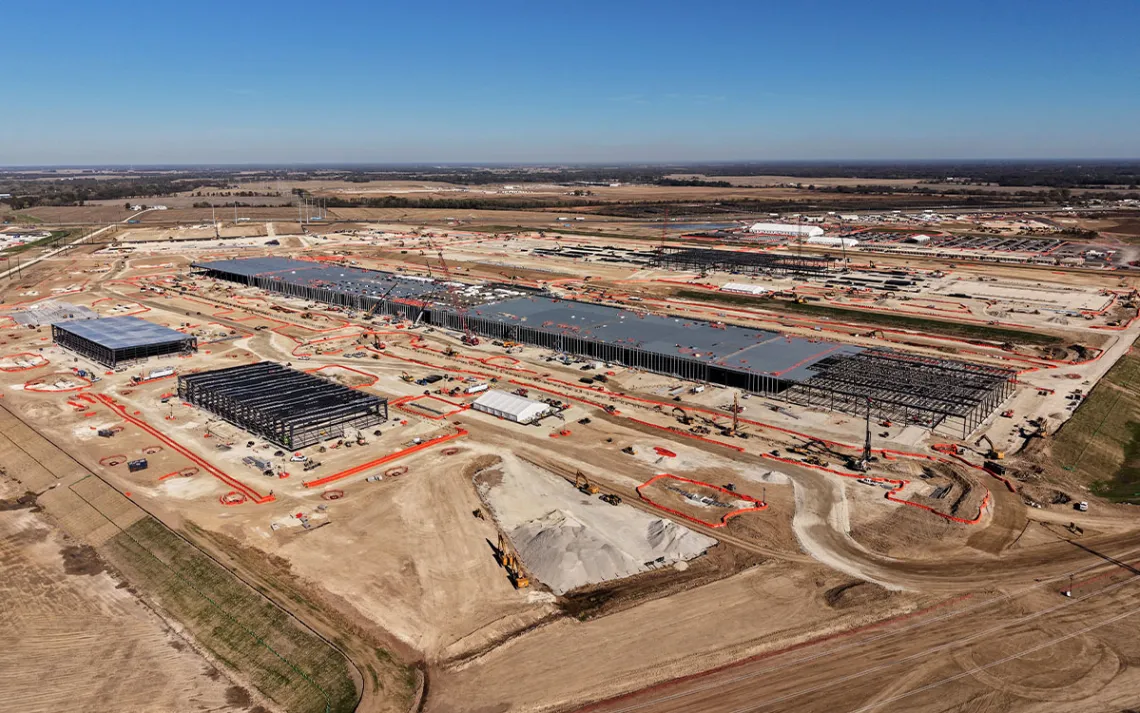
An Amazon data center is under construction in New Florence, Missouri. | Photo by Jeff Roberson/AP File
Two weeks after Democrats swept the midterm elections, several current and newly elected House members gathered with environmental and progressive advocates outside the US Capitol to call for strong new policies that rein in the rapid buildout of AI data centers.
“The American people resoundingly rejected data centers two weeks ago, and Congress needs to follow their lead,” said Jim Walsh, policy director at Food & Water Watch, the group that organized the rally. Walsh said that campaigners were delivering more than 250,000 petition signatures in support of Congress passing a national data center moratorium.
“We need an immediate change in the status quo,” Massachusetts Representative Jim McGovern told the assembled crowd. He is a co-sponsor of the Artificial Intelligence Data Center Moratorium Act, introduced by Representative Alexandria Ocasio-Cortez in June.
Maine Representative Chellie Pingree also called for urgent passage of a national data center moratorium. “Voters sent Big Tech a huge message this month. When energy prices are already sky-high in places like Maine and across America, Americans don’t want data centers,” Pingree said. She argued that the centers are “driving up the costs even further, they’re straining our grid, they’re dirtying our air and water, they’re degrading our health and our quality of life.”
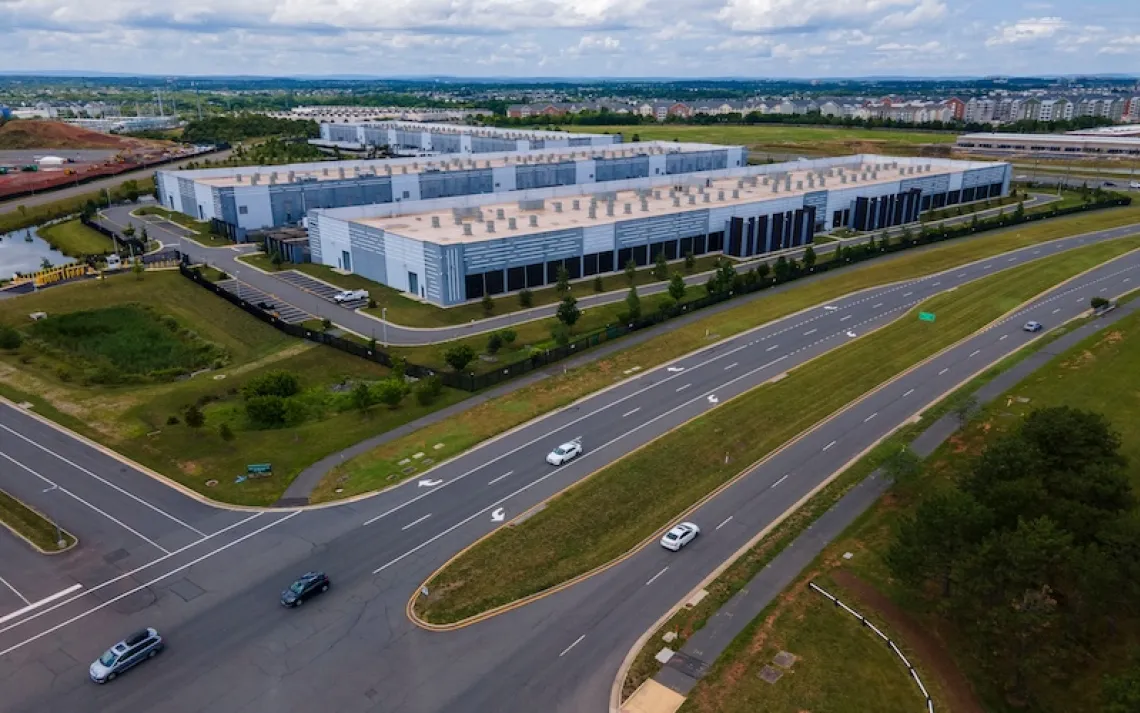
Tech companies are rapidly building gigantic warehouse-like facilities that house the computing infrastructure supporting Internet operations and, increasingly, the proliferation of artificial intelligence. The installations have become a major flash point in local, state, and national politics, with mounting concerns over their environmental, economic, and community impacts. The United States already has thousands of data centers in operation, the most out of any country in the world, and thousands more are planned or under development.
The rising public backlash to this frenzied buildout was on display in the results of the midterm election. From gubernatorial races to contests for the House and Senate, voters overwhelmingly chose candidates opposed to the unfettered buildout of AI data centers. So far this year, 53 ballot measures regarding data center development have been decided in more than a dozen states, including 47 measures on the ballot in the November 3 election—and voters chose restrictions on AI data centers in all but one of these measures.
“People are concerned about the impacts of data centers on electric affordability and on straining the electric grid,” Jeremy Fisher, principal adviser of climate and energy at the Sierra Club, told Sierra. “The voting public is also deeply concerned about impacts to their community from both land use and impacts on water sources. And they’re deeply concerned about environmental impacts—about local pollution, local water quality, and increasingly about climate pollution.”
Fisher is the lead author of a new report the Sierra Club released this week that warns that the data center buildout threatens to erase 15 years of progress in reducing greenhouse gas emissions in the US, progress attributable mainly to the decline in coal-powered generation and the promising growth in renewable energy. The report, Artificial Intelligence, Real Pollution, looks at the potential climate pollution that could come from new data centers planned to be built over the next few years. According to the analysis, these projects could add 680 million metric tons of greenhouse gas emissions, mostly from new gas-powered generation.
Another new study from researchers at Harvard University similarly illuminates the significant climate impact of the AI data center buildout. This study took a different approach in examining and attempting to quantify the substantial energy consumption and carbon footprint of existing hyperscale data centers in the US. Researchers found that their energy demand was equivalent to almost 2 percent of total US electricity consumption, and that corresponding emissions—about 25.7 million metric tons of CO2—amount to roughly the same level of annual carbon pollution produced by an entire country like Denmark.
“Both studies highlight sizable impact, both to our electric grid and to the way we’re looking at our greenhouse gas emissions,” Fisher said.
The Sierra Club report highlights regulatory measures that, if enacted, could help mitigate some of the adverse impacts on climate and public health, such as requiring data centers to match electricity demands with new clean energy and submit mandatory reports on their energy and water consumption.
The organization has not joined the calls for a national data center moratorium because, as Fisher explained, a pause would be temporary and what is really needed is durable regulatory policy.
“We think the ultimate objective is getting toward those accountability measures and regulatory structures,” he told Sierra. “A moratorium is not an end goal. It’s an interim step.”
Data centers on public lands?
Backlash is also mounting to the Trump administration’s push to facilitate the expansion of AI data centers onto federal public lands. One project near Boulder City, Nevada, that the administration had initially approved is now “back to square one” after an appeals board last month struck down the approval. Boulder City as well as the Sierra Club Toiyabe Chapter and the Center for Biological Diversity brought administrative appeals challenging the approval, and in September the Interior Board of Land Appeals temporarily halted the project, finding the government’s authorization was likely unlawful since it failed to conduct a project-specific environmental review.
But conservation advocates remain concerned, pointing to other projects that have been proposed or that are reportedly under consideration on public lands. The Bureau of Land Management is considering 35 data center and related infrastructure applications on public lands covering more than 24,000 acres in six western states, according to the Center for Western Priorities. That includes at least 17 applications for data center campuses. Secretary of the Interior Doug Burgum, who is overseeing this planned buildout of AI data centers on public lands, holds tens of millions of dollars in investments in the AI industry, ProPublica recently reported.
The public does not support these efforts, Sierra Club’s lands protection program director Athan Manuel told Sierra. “This election that just happened was driven in part by data center opposition in many states. And they can’t seem to figure out how to read the room,” he said. “It’s one of the few bipartisan issues out there too. Burgum doesn’t seem to understand that America’s public lands are our common ground, that we’re all in agreement on that. And to give them up to billionaires and tech bros to build data centers is just bad politics and bad policy.”
Democrats in Congress have also been speaking out in opposition.
“These lands are national treasures that belong to the American public. They do not belong to tech billionaires,” Pingree said during the rally calling for a national data center moratorium. She pledged that she would use her new position, as the chair of the House Appropriations subcommittee focused on the Interior Department, to conduct oversight and bring about accountability to the department’s dealings with Big Tech.
Some congressional Democrats are even authoring or supporting legislation to prohibit the building of data centers on public lands. Oregon Representative Maxine Dexter introduced a bill on November 11 that would ban construction of data centers and related infrastructure on federal public land managed by the US Forest Service and the Department of the Interior. Oregon Senator Ron Wyden introduced a similar bill in the Senate on September 30.
Manuel noted that the Sierra Club is supporting those bills, and he predicted that they could move swiftly in the new Democrat-controlled Congress.
“Whether it’s data centers on public lands or caps on prescription drugs or raising the minimum wage,” he said, “these bills fit into that pattern of doing things the public cares about, that the public voted on, and force the president to say, ‘I’m standing with the tech bros and not the public when it comes to our public lands.’”