Welcome!
Updated Oct 11, 2026
Our next Program
Eco-Social
October 13
6:30
at Tapped,
Our get togethers are now called Eco-Socials. They still take place the second Tuesday of each month, though now starting at 6:30 PM. And of course, we still meet at Tapped on Firetower Rd in Greenville.
You may also attend via Zoom: Here is a link
Our Program This Month
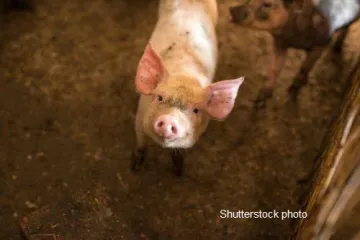
"Waste to Fertilizer, Using Partnerships to Build Conservation Capacity"
---pelleting hog waste.
Presented by
Tom Potter,
NC Foundation for Soil and Water Conservation.
As a nation we love to eat pork. Over 50 million hogs are being raised in the U.S. today. This presents a problem. What is to be done with all the pork bio-waste? Our Eco-Social presentation this month is by one of the people working on an answer.
Mr. Potter has worked with the NC Forest Service, NC State Parks, and with the NC Foundation for Soil and Water Conservation for 14 years as a program manager for a variety of projects.
Meet at Tapped, 650E Firetower Rd., Winterville, 6:30 for socializing, 7:00 meeting begins.
6:30 to 7:00 Social – Snacks and beverages (free), and socializing with really interesting people who love the natural world.
7:00 – 8:00 – Formal program, including:
Reports on what the Cypress Group has been up to and plans for the future, including outdoors and educational events,
A little bit (not too much) about what our local government folks are doing to protect and enhance our hometown environments,
Tom Potter's presentation on Waste To Fertilizer,
8:00 – End of meeting. Hang around a bit longer if you are liking the vibe.
The Cypress Group of the NC Sierra Club is a group of friendly local people who enjoy spending time in the environment, who seek opportunities to learn more about the natural world, and who want to help others understand our wonderous outdoors.
Everyone is welcome to our meetings and events. You do not need to be a member.
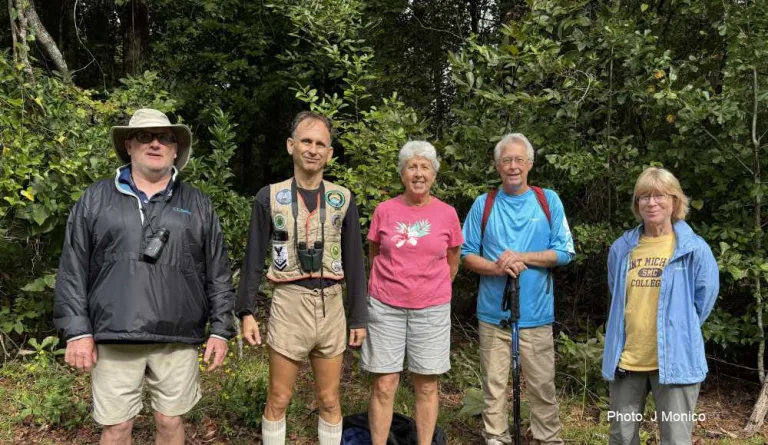
We would love to have you join us October 13 at Tapped, and in the future, for one of our outdoor adventures.
Outings Trip Report: Latham-Whitehurst Nature Park, October 10
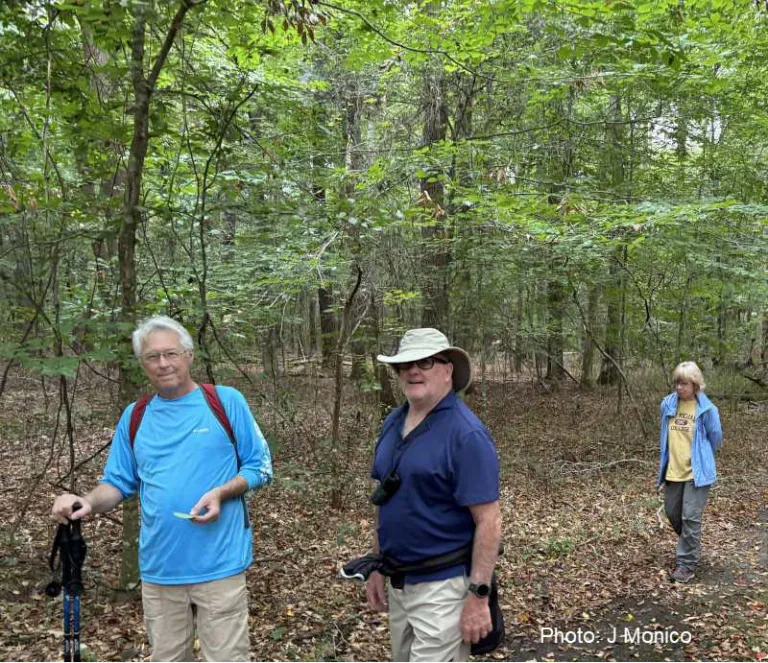
Cypress Group adventurers were out in the wild again on Oct 10, this time walking the low-land-forest trails of Latham Whitehurst Nature Park east of New Bern, with botanical guidance from Tom Glasgow, an expert in coastal North Carolina’s plant kingdom and recently retired from the Craven County Cooperative Extension. (On the left in the photo.) We were concerned about a rainy weather forecast, but ventured out anyway, and had a precipitation-free morning.
Tom identified for us ferns, small plants, flowers, shrubs, and trees. His knowledge included scientific names, regions of the state they normally grow in, invasive or native status, effects of fungi and pests on them, and whether they are good forest neighbors or potentially damage other flora. It made for an enjoyable couple of hours. A favorite on the walk was tasting wild persimmons picked off a tree along the trail.
We did make it out to Broad Creek; a brackish estuary flowing into the Neuse river and got a chance to go out on the pier.
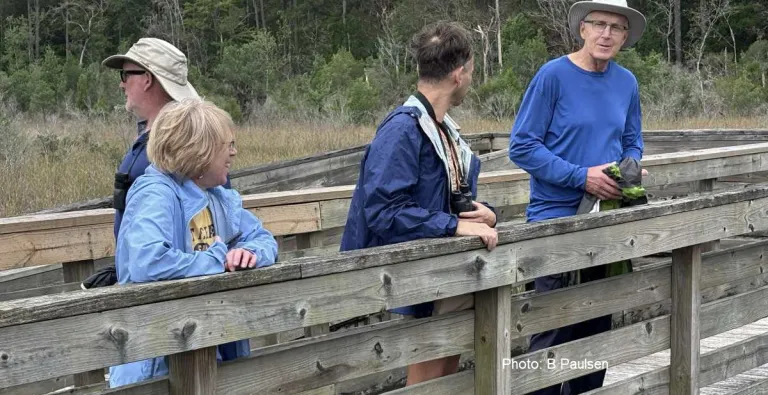
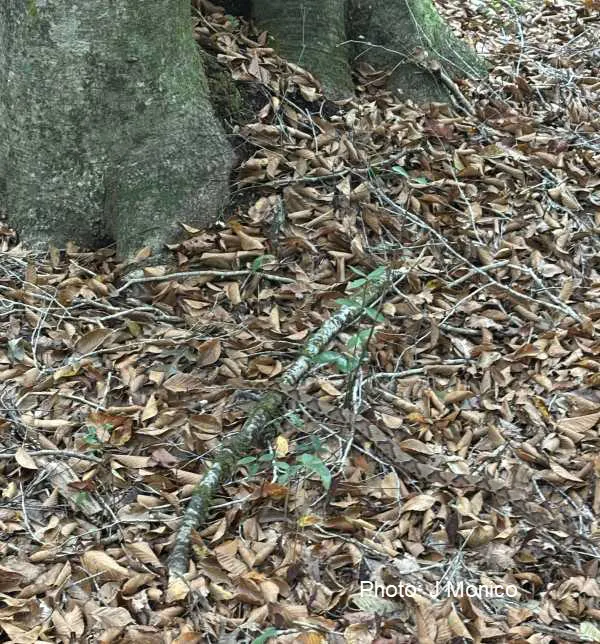
The second high point of the walk was a Cypress group lifer event: Tom pointed out a copperhead snake in the leaves along the trail. As snakes do, it pretty much ignored us, even though we were staring and taking pictures. It blended in with brown leaves on the ground. Can you find it in the photo? The sighting was a good lesson: keep an eye out for wildlife when in the woods, give animals space to do what they do, and everything will be okay.
We hope to see you at our next event!
Outings Trip Report: Rachel Carson Preserve, July 11
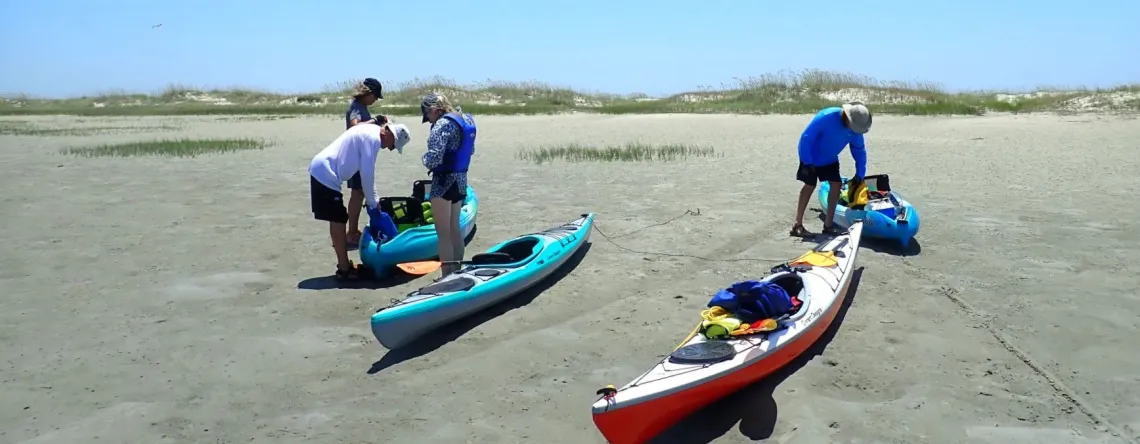
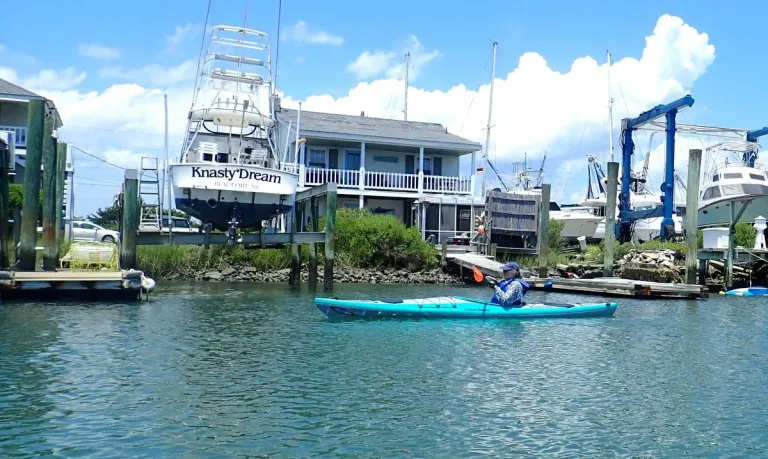
Cypress Group's kayakers were out in the wilds again this past Saturday paddling to the Rachel Carson Preserve outside of Beaufort, NC. We were blessed with beautiful weather; it was sunny and warm with a steady breeze.
Alas, we didn't see any of the feral horses that inhabit the island--they were likely hunkered down out of sight in the shade--but we did see lots of birds, had a nice walk on the island, and took a pleasant swim in the warm ocean.
Visible from Carrot Island was Shackelford Island about a mile further out. Two of our paddlers, Linda and Kevin, who volunteer there in support of the program to monitor and maintain its 100+ feral horses, talked about their adventures on that bigger island and provided information about horses on both islands.
After getting back to our launch point at Beaufort Paddle Company, we all agreed that this is a really, really beautiful part of North Carolina.
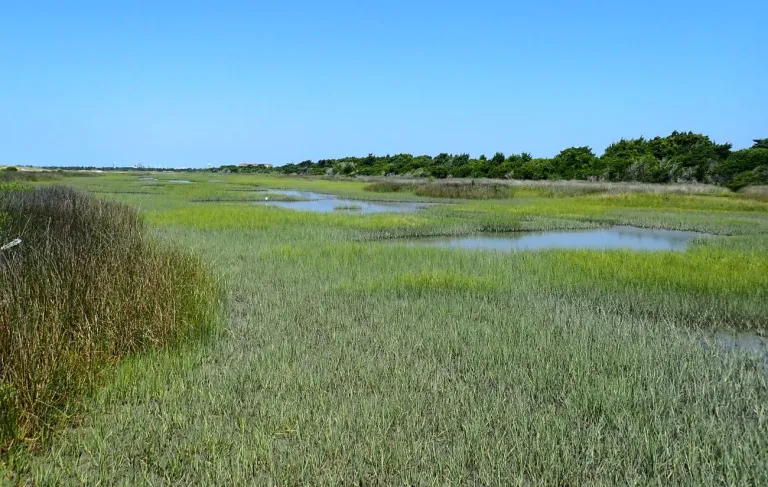
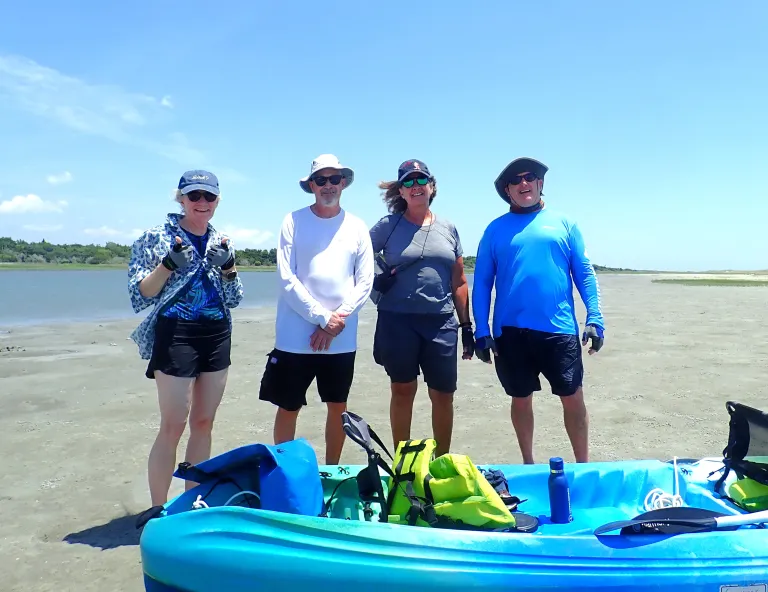
More photos are below.
All are welcome to our next event. You do not need to be a Sierra Club member to join us.
Outings Trip Report: Goose Creek State Park, June 13
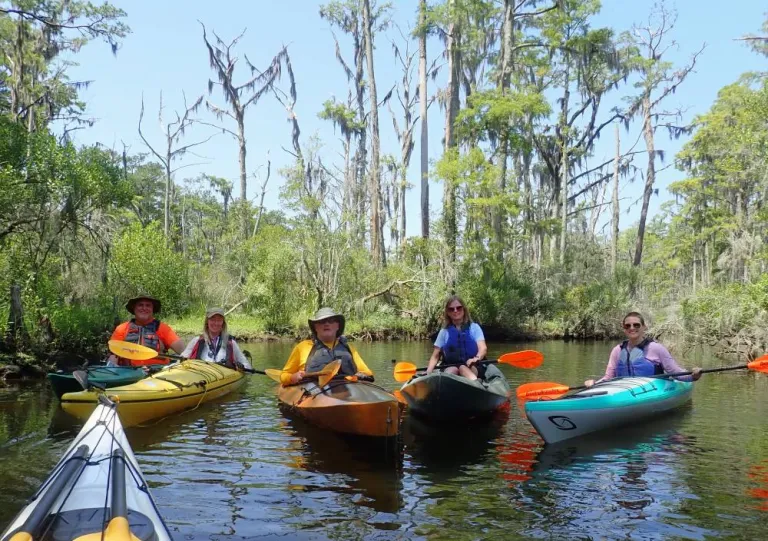
Saturday morning June 13, a group of fun-seeking Cypress Group kayakers departed Dinah's Landing in Goose Creek State Park, NC, and paddled east on Goose Creek and into the narrow waters of Upper Goose Creek. Beautiful, mesmerizing, informative, and at times spooky were some of the thoughts and words that filled the morning. We saw osprey, jelly fish, minnows, vultures, black birds, woodpeckers, osprey nests, old piers from the area's long-ago logging days, and myriad trees, including bald cypress, loblolly pines, red maple, and wax myrtle. It was a grand, nature-filled time. Here are a few pictures.
Cypress Group Had An Environmental Impact, April 21 & 22
Lobbying Against Environment-Damaging Legislation
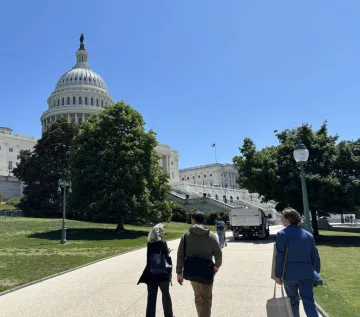
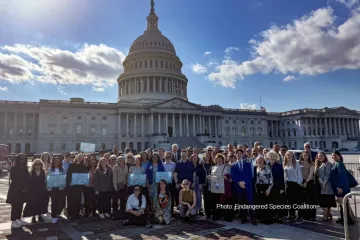
April 21 and 22, 2026, the Cypress Group of the NC Sierra Club, along with eight other national environmental organizations, was part of a two-day lobbying trip to Washington DC.
The goal was to convince House members to vote against the ESA Amendments Act, House Bill 1897 (also known as the Westerman Bill).
Defeating the bill was very important for the environment. It was written to gut the 1973 Endangered Species Act (ESA). If you are my age, you were around in 1973 when the ESA passed with nearly unanimous support in Congress and was signed into law by Richard Nixon.
The House vote to decimate ESA was scheduled for April 22, while we were there. Fortunately, the bill was pulled by Speaker Mike Johnson a little before voting was to start, presumably because he realized he did not have enough votes for it to pass. Needless to say, we celebrated that evening.
I was part of the Southeastern delegation. Our team of six included two from the Sierra Club and four from the Endangered Species Coalition. If you follow this link to their website, you will get the full story and see some more pictures.
Jeff Monico, Chair of the Cypress Group of the Sierra Club
Our recent Cypress Group Program Meeting, Tuesday, April 14
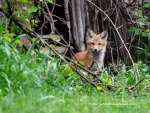
Landscaping for Wildlife: Re-creating an environment for a thriving biome in the first world
Presented by: Fred Boyd, PhD, & Cypress Group Member
Dr. Boyd shifted from a late-career, research emphasis studying water resources on Navajo Nation lands to enjoying flowers, bushes, trees, bugs, birds and squirrels of eastern North Carolina. In this new role, he has worked to build their Greenville city lot into a functional part of the Homegrown National Park, a huge network of privately owned land parcels managed for human-wildlife co-existence. His yard is a National Wildlife Federation "Certified Wildlife Habitat".
Road Cleanup
On January 23, 2026, Cypress Group members were outside helping the environment. This time we picked up trash from Corey Road, our NC DOT Adopted Highway. You can see from the photo, there was plenty to remove. Thank you to those who joined in on that chilly morning.

The Cypress Group of the NC Sierra Club remains committed to educating everyone about the importance of helping maintain a clean, healthy environment by disposing of trash properly.
Outing Report: Trip To Washington, NC Estuarium Museum and Nature Center
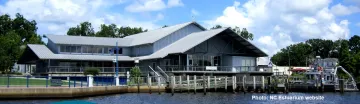
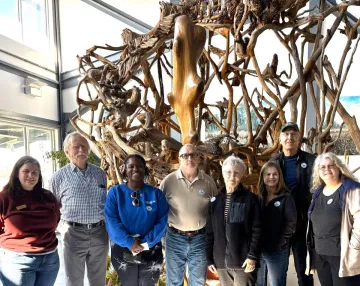
In our recent outing to Washington's Estuarium January 17, 2026, we learned the museum and nature center focuses almost entirely on the environment and history of the Tar - Pamlico river system. Those that joined us now better understand environmental and societal changes that occurred in eastern NC as it transitioned from villages of long-time indigenous people, to towns almost entirely populated by Europeans, and then to a multi-racial community.
This photo shows the Estuarium's main sculpture. It depicts the cycle of the estuary's water as it evaporates into the air, forms clouds high above the Earth, and then falls back down as rain. Actually the photo only shows a part of it. You may visit the Estuarium on your own if you missed the outing.
Our January 2026 Program
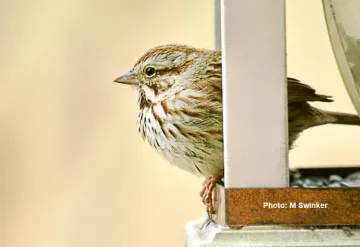
"Backyard Birds: A Photographer's View"
By: Marian Swinker
Sierra Club Cypress Group Member, amateur photographer,
and bird enthusiast
Birds make humans happy when they sing. Birds are our constant companions. Through pictures and stories, Marion will help us learn more about our feathered neighbors.
Previous Outing
A previous Cypress Group outing
Monday, November 3, 2025.
We went behind-the-scenes at the
NC State College of Veterinary Medicine Laboratory in Raleigh!
Outings Chair Kevin and NC State College of Veterinary Medicine alumnus Linda arranged a tour behind the scenes in the vet college's labs. We saw them as few others do. This included observing experts working on animals. The tour was fascinating, informative, and educational.
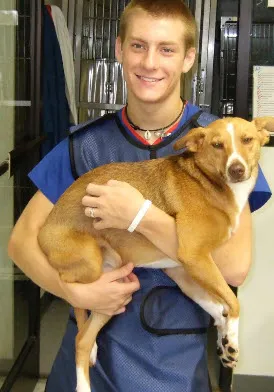
Stay tuned to this site for our information about our next Outing.

Here is a list of Good Trees to plant in yards
in northeastern North Carolina
Recently I attended a presentation where Andrea from Carolina Seasons Nursery; 549 NC-903 N, Greenville, NC; discussed good canopy trees to plant locally.
First, canopy trees are desired. Canopy trees are the tallest ones and grow higher than typical houses. Due to their great height, they provide lots of shade, reduced air conditioning bills, improved soil conditions, reduced flooding, and habitats and food for many animals. All trees in this list are canopy trees.
Trees may be called by different names. Provided below are at least one common name and the scientific name.
Native Trees
Common name | Other names | Scientific name |
Tulip tree | Tulip popular, American tulip tree | iriodendron tulipifera |
Sugarberry | Sugar hackberry | celtis laevigata |
American beech |
| fagus grandifolia |
Black gum | Black tupelo | nyssa sylvatica |
Bald cypress |
| taxodium distichum |
Yellowwood | American yellowwood | cladrastis kentukea |
Southern Magnolia |
| magnolia grandiflora |
River birch |
| betula nigra |
Native white and red oaks. Your plant nursery may refer to any of the following oaks as white or red.
Common name | Scientific name | |
White oak |
| quercus alba |
Swamp white oak |
| quercus bicolo |
Overcup oak |
| quercus lyrata |
Red oak |
| quercus rubra |
Live oak |
| quercus virginiana |
Southern red oak |
| quercus falcata |
Shumard oak |
| quercus shumardii |
Pin oak |
| quercus palustris |
Willow oak |
| quercus phellos |
Non-Native Trees. The following are non-native trees that grow well and are considered environmentally safe for our area.
Common name | Scientific name | |
Trident maple |
| acer buergerianum |
Shangtung maple |
| acer trunca |
Gingko |
| ginkgo biloba |
Dawn redwood |
| metasequoia glyptostroboides |
Some trees present special challenges. They may be fast growing but possibly not right for you.
Red maple - Needs nearly ideal conditions to grow well. Upper branches sometimes die. (acer rubrum)
Arborvitae - Fast growing. May start turning brown after 25 years. (thuja occidentalis)
Some trees should be avoided completely
Bradford pear - Once common, now considered environmentally-damaging. Please do not plant them. (pyrus calleryana)
Talk with a specialist at your plant nursery about trees that are best for your yard. Describe your soil, amount of sun, amount of foot traffic, and the nearby impermeable surfaces such as driveways and sidewalks. The specialist will help you pick trees with a high likelihood of growing well and providing a great "canopy."
Speaking out against NC Senate Bill 266
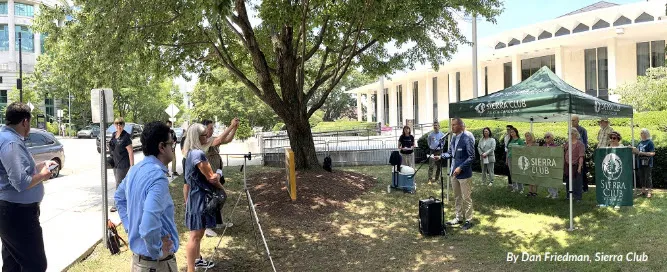
Sierra Club NC Chapter Director Chris Herndon speaks in front of the NC Legislative Building June 26
The Cypress Group joined the Sierra Club’s North Carolina Chapter and spoke in front of the Raleigh Legislative Building Thursday, June 26, 2025, and urged Governor Stein to veto the environmentally damaging Senate Bill 266. The Chair of the Cypress Group was one of the people who voiced concern about the bill that in part would allow Duke Energy to pass construction costs on to customers before construction project begins delivering power and end Duke’s decarbonization requirement currently required by 2030. Here is a link to the NC Sierra Club Chapter website with more information.
Helping Farming Be More Environmentally Friendly
Ever wonder where the animal protein that you eat comes from? Here is the short answer: 90 % comes from industrial farming operations, usually in the form of CAFOs (Concentrated Animal Feeding Operations). Would you like to learn more? (Please note, the following link is designed to be informative, not shocking or upsetting.) A good place to learn is the Sierra Club's Grassroots CAFO Team website. The Grassroots CAFO Team is working hard to educate people about how most meat protein is produced. The Team also works to let people know what can be done to reduce the negative environmental effects and how to make the process more humane.
The Grassroots CAFO team asks everyone to consider decreasing the amount of meat in their diets and to buy beef, pork, and poultry from farms using sustainable practices. Sustainable farms do not use CAFO methods. You can find sustainably produced meat at Pitt County's Leroy James Farmer Market. It is available elsewhere as well. An internet search will show you where.
Here's an update on recycling in Pitt County

Stock photo
Recycling rules may seem a bit overwhelming. And for some of us, not being sure may result in recycling fewer things. To help you out, here are some thoughts and information. First, the Pitt County policy may be found at this link. Second, the Sierra Club believes good recycling is critical to protecting our planet. We urge you to visit your county's waste management website to learn more.
In general, Pitt County solid-waste and recycling drop off-sites have recycling dumpsters for depositing corrugated cardboard, glass, white goods (appliances), metal, and electronics. Plus the sites have a dumpster for recycling household plastic (types 1,2, or 5 (five) only), paperboard (think cereal boxes and the like), newspapers, and magazines.
One final note. CLEAN ITEMS ARE REQUIRED. Dirty or contaminated items are likely to be pulled out and tossed in a dumpster headed to a landfill during the eventual sorting operation.
WHY SHOULD I GO THROUGH THIS TROUBLE, you may ask? Because it is an environmental necessity that we reduce the amount of waste getting buried in the ground. We are barely adequate at recycling now. We have to get better, and the way to get better is to practice recycling as much as we can. And more recycling will show our county and city that we are serious about taking steps to protect the environment. Or, in other words, we need to recycle as much as possible!
One final thought, this is our interpretation. Please visit the Pitt County link or your own county's website for more details, and make your decision.

Recent Events
Opinion
Quote from Ben Jealous, Executive Director of the Sierra Club
Mr Jealous in the Spring 2025 Edition of "Sierra" magazine gave us words of encouragement. He said:
"We are strong enough to keep making progress no matter who is president. The people of this democracy do not elect politicians to make change for us. We try to elect the best politicians who will make it easier for us to make change. And when our movement suffers setbacks, when the hill we climb gets steeper, we do not stop climbing.
This organization (the Sierra Club) has been around since 1892, and Donald Trump will be out of office in just a few years. Yes, he is doing a lot of (environmental) damage. Yes the people, places, and planet we love are threatened in serious ways by this man' corrupt, extremest agenda. But we are not going back. And, no, we will never stop fighting."
Well said Mr Jealous.
Information and Musings
10/27/2024 The possibility of something bad for Blounts Creek in Eastern NC is back in the news. Sound Rivers describes it this way on their website. "Mining company Martin Marietta Materials recently applied to renew its wastewater permit for a 649-acre limestone mine in Vanceboro, a permit that would potentially discharge up to 12 million gallons of fresh water per day into the brackish tributary of the Pamlico River in Beaufort County." Brackish water is defined as water that is somewhat salty though not as salty as ocean water.
Pumping a lot of non-salty ground water into its brackish-water eco system will likely change Blounts Creek's environment, making it difficult or impossible for some aquatic species to survive while allowing non-native species to migrate in. We humans need to be very cautious about disrupting ecosystems! In this case, the consequences are likely only partially understood and may in the long term be quite bad.
Do we want to disrupt and change Blounts Creek ecosystem in order to obtain cheap limestone?
Sound Rivers is pushing action to prevent renewing the permit. Here is how you can be involved. Attend, and maybe speak at, the public hearing on the permit, Nov 19 at 6 PM at Beaufort County Community College in "Little" Washington (more information). Also, Sound Rivers is having a workshop Nov 6 on making effective public comments. Use this Sound Rivers link to get the information.
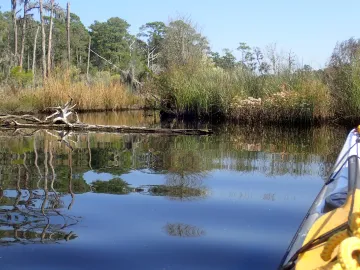
A brackish water ecosystem in Eastern NC, not too far from Blounts Creek.
Photo J Monico
7/21/2024: Here is a great quote: “We built our world for a climate that no longer exists.” This is from an opinion piece by Jeff Goodell writing in CNN online. Here’s the link. Mr. Goodell theorizes that the world’s infrastructure; things like highways, buildings, dams, electrical grids, buildings, and air conditioning systems; built up over the last two hundred years are designed for cooler and less stormy environments.
In the past few years, we have seen increasing numbers of news stories about events like flooding, dam failures, never-before-recorded droughts and rainfall, bridge failures, heat waves that create temperatures and humidity high enough to cause death, ocean level changes, and die-off of species. This is a big deal. During the centuries we were building all the things that advanced us, we spent many trillions of dollars and used trillions of hours of labor. Now, rapidly changing climates are making inadequate many of these creations. In response, people of the world must promptly dedicate their money and time to redesign and rebuild our expensive artifacts. Please support those who understand climate change is happening and those that create plans to respond to this unprecedented threat.
6/26/2024: Last year, North Carolina's legislature changed state laws in a way that eliminated protection for wetlands not having a surface-water connection to a river or lake. The new law allows removing the vegetation and wildlife and backfilling with gravel and dirt. In other words, filling in the wetland so that it becomes dry ground. Hundreds of thousands of acres of NC wetlands are under threat from this new law.
Here is some scientific information. A wetland is defined by the US EPA as: "... areas where water covers the soil, or is present either at or near the surface of the soil all year or for varying periods of time during the year, including during the growing season." The EPA goes on to explain their importance. "Wetlands may support both aquatic and terrestrial species. The prolonged presence of water creates conditions that favor the growth of specially adapted plants (hydrophytes) and promote the development of characteristic wetland (hydric) soils." Wetlands also cleanse water moving from the surface to aquifers.
6/26/2024: A recent AP online article (Iowa floodwaters breach levees as even more rain dumps onto parts of the Midwest) had a great quote by Minnesota Governor Tim Walz. The AP quotes Gov. Walz as saying "Nature doesn't care whether you believe in climate change or not. The insurance companies sure believe in it. The actuarials believe in it, and we do."
10/28/2023: You may have heard about the increasing global awareness of the existence of PFAS chemicals in the environment, including, sometimes, in containers we use every day. Ongoing research is seeking to define health risks associated with levels of PFAS chemicals ordinary people are exposed to and may have in their bodies. If you want to be cautious, here is a tip from Business Week magazine. Flip the container over. If printed on the bottom is "PET" or "PETE," the container is not suitable for treatment with PFAS chemicals. If it says "HDPE," the plastic is suitable for treatment with PFAS chemicals. Treatment makes the plastic tougher and more resistant to what is stored in the container. Business Week goes on to say, keep in mind, seeing "HDPE" does not mean it was treated with PFAS. In fact, many product manufacturers say they take steps to prevent PFAS in what they sell. Still, these are good things to be aware of.
10/12/2023: Recycling is a very green, very environment-benefiting thing, and is easy to do. Recycling reduces material going to landfills and reduces energy used to mine and process ore. Counties in North Carolina have multiple drop off locations at their trash transfer stations. One note, many things are recyclable, and many are not. Here is a link to what Pitt County accepts for recycling.
10/10/2023: Wind and solar power work! This from the Fall 2023 edition of Sierra Magazine: "Wind and solar power provided a record amount of renewable power during a Texas summer heat wave," 35% percent. This renewable power helped protect Texas's gird from becoming overstressed.
Explore, Enjoy, and Protect the Planet ... Join the Sierra Club TODAY!
Upcoming events in the Cypress Group
..
| When | Earliest: Latest: |
| What |
|
| Word or Phrase | Word or phrase to search for: |
| Leader | All or part of leader name to search for: |
No Matching Activities Found
Loading
| Date | Activity (click title for full description) | Sponsor | Category | Type | Difficulty | Links |
|---|
Loading ...
 Outing
 Team/Committee
meeting
Team/Committee
meeting
 Volunteer Event
 Activist event
 Multiple events
(map only)
Multiple events
(map only)