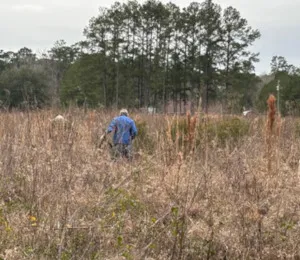
Since 1992, the Houston Sierra Club (HSC) has helped the Texas Land Conservancy with the restoration, management, and maintenance of the almost 13-acre Marysee Prairie (MSP). About 3 acres of MSP are forested and about 10 acres are prairie. There are woody boundary lines on the east, north, and south sides of MSP with a county road on the west side. There are also two small areas with widely scattered Loblolly Pine trees and pimple mounds are found throughout the 13 acres.
I call MSP the only restored tallgrass prairie in the Big Thicket. However, restored is a fragile stage where there is talk about ecosystems and it is constantly in motion. You must have persistence and patience when restoring and maintaining any natural ecosystem, particular prairies.
Without fire, which prairies utilize to reduce the advance of woody plants and forests, prairies are shaded out and disappear. Other methods of reducing woody plants, like mowing and grazing, don’t appear to have the full beneficial effects of fire.
MSP was last burned 4 years ago. Many who work to maintain prairies advocate for a 1-3 year burning cycle. I’m hopeful that MSP will be burned and if not burned then mowed in 2025 to reduce the thick thatch. We should have a prescribed burn at least every 3 years to ensure that MSP and its biodiversity is protected.
On January 4, 2025, there was a MSP workday. Ten people attended and for 2.5 hours cut woody plants and then applied herbicide to retard their return and growth. Some of the woody plants that were cut or pulled, both native and non-native, included Common Persimmon, Chinese Tallow, Chinese Privet, Glossy Privet, and Swamp Dogwood along with various vines and briars.
In addition, tree limbs and other debris were stacked in piles in the forested part of MSP. This woody debris came from a large pine that died and was cut down. During the piling of tree debris, two, young-of-the-year (about 8 inches long), Louisiana Milksnakes (Lampropeltis trangulum anaura), were found. We also saw Turkey Vultures above and crawfish chimneys below in MSP. Since it’s Winter, the inventory of blooming plants revealed only 3 plants that were blooming on MSP.
If you’d like to volunteer for a MSP workday contact Ellen Buchanan, a volunteer for the Texas Land Conservancy, at ellenbuchanan@sbcglobal.net or 409-382-5102. Ellen will let you know when the next MSP workday is. They usually are on the first Saturday of each month.
MSP needs all the love and volunteer management possible. Help with this important restoration effort in 2025. You’ll be glad you did!
Photo courtesy of Ellen Buchanan