By Brandt Mannchen
On March 21, 2025, the Houston and Golden Triangle Regional Groups and the Lone Star Chapter of the Sierra Club (Sierra Club) visited Big Thicket National Preserve (BTNP) to view several areas in the Lance Rosier Unit (LRU).
We first met at Marysee Prairie (MSP). I call MSP the only restored “tallgrass prairie” in the Big Thicket. We walked fire-lanes and saw the green-up of the prairie in its early stages. A prescribed burn was conducted on February 28, 2025, and grasses and wildflowers (herbaceous plants) were emerging from the burnt landscape of pimple mounds. We saw Bluebirds on utility wires at the west side of MSP next to County Road 2077.
There was discussion about mowing MSP this spring or summer. This depends upon a dry prairie to ensure that the mower doesn’t create ruts. We’ll watch how native grasses and wildflowers respond to mowing this fall.
Blooming plants were few, with Crow Poison, Corn Salad, Lyre-leaf Sage, Philadelphia Fleabane, Ladino (White) Clover, and perhaps Slender-leaf Fleabane the only flowers we saw.
We next drove to Cotton Road in LRU. We drove to the very end of this poorly maintained dirt road. The ditches on the sides of this road are not deep and the road is prone to flooding, ruts, washouts, and holes. A four-wheel drive or high clearance vehicle is needed to drive Cotton Road. This road needs maintenance!
Our first stop was at the Lance Rosier Family Home Site. This historic site is about ¼ mile from the end of Cotton Road. We viewed the very large Live Oak that local stories say was planted by the Rosier Family in 1863 when they moved from Alabama and settled in the Big Thicket. We noted several Pecan trees which may have been planted at the home site since Pecan trees aren’t common in the Big Thicket or LRU.
At the end of Cotton Road, we parked the truck and walked southwest about ½ mile to the Little Pine Island Bayou Floodplain. We found small wire baskets and flagging that appeared to be part of a scientific research project. They were abandoned and should be removed.
During our walk to Little Pine Island Bayou, we saw several large Cherrybark Oaks and many Swamp Chestnut Oaks. The forest is maturing and more shade from hardwood trees is cast on the forest floor which reduces the shrub density and opens up the forest view.
Unfortunately, on our walk we found an area that had many small Tung Oil trees, which are a non-native invasive plant species. These trees should be removed before they create negative environmental impacts on the surrounding natural hardwood-pine flatwood forest.
At little Pine Island Bayou, we found many small, abandoned, channels and tributaries along with medium to large Bald Cypress trees. The area is very low and wet. Feral hogs had been rooting in much of the floodplain.
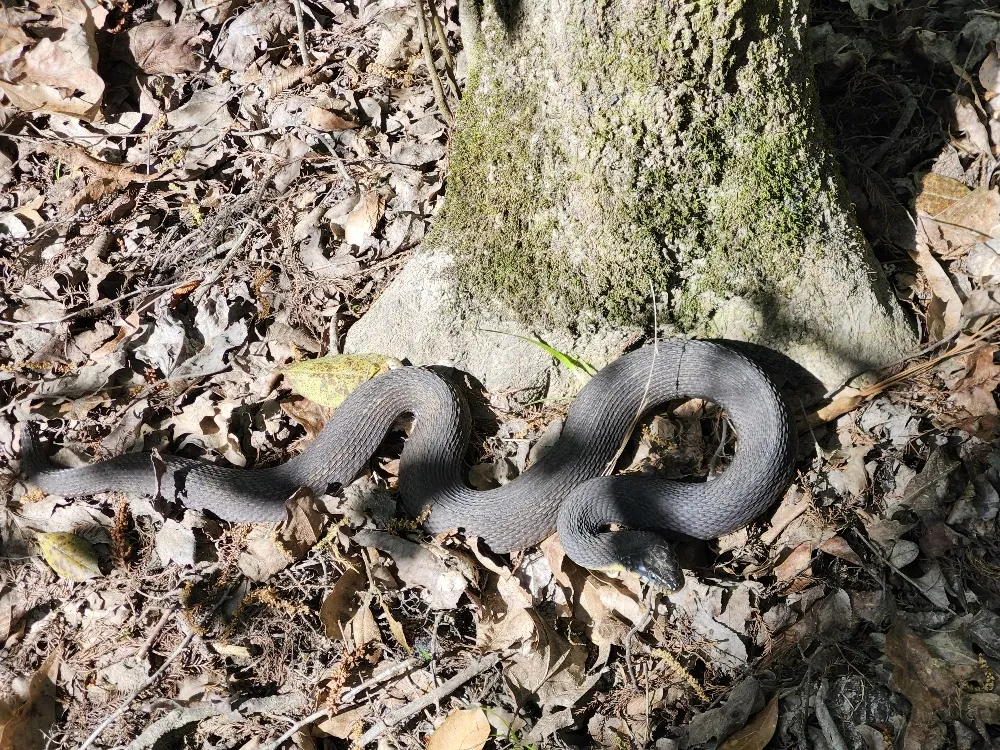
We found a lot of Southern Grape Fern on a rise between channels and observed a Yellow-bellied Watersnake at close range. This area was beautiful. Little Pine Island Bayou is very picturesque, but access is limited until the ground is dry.
We then drove Coe Road/Little Rock Roads to the Old Fire Tower Road. We walked on this dirt road for about a mile. This road is rutted and even after it has dried there are places where it’s still flooded. We maneuvered into the shrubby forest to get around these flooded places.
There are several areas on the west side of the road, where there are extensive moss mats. These mats grow in swampy areas that are flooded among the scattered pine and hardwood trees.
As we walked, we saw in ditches, swales, and other low places, a lot of Tall Inkberry Holly (like Gallberry Holly), Red Bay, Loblolly Pine (there are still many pine plantations in this part of LRU), Willow Oaks, Water Oaks, American Holly, Sweetleaf, and American Hornbeam (Musclewood, Blue Beech, Ironwood). The area was not level but had many swales and was uneven.
We visited a pitcher plant bog just off of Old Fire Tower Road. All four types of carnivorous plants found in Texas were in this bog including blooming Pale Pitcher Plant (Sarrecenia alata), Small Butterwort (Pinguicula pumila, both white and purple blossums), bladderwort (probably Zig Zag Bladderwort, Utricularia sublate), and non-blooming sundews (probably Annual Sundew, Drosera annua or Small Sundew, Drosera brevifolia).
The soil was a moist sandy-loam and there were Tall Inkberry Holly and other shrubs that surrounded the bog. Pitcher plants extend for 100-200 feet in the grassy vegetation (probably sedges).
This pitcher plant bog needs to be burned to reduce shrub shading. If this doesn’t occur, then the pitcher plant bog and its vegetation will disappear.
All in all, this was a great visit to the LRU of BTNP.
Photos courtesy of Brandt Mannchen.