By Brandt Mannchen
I visited two Harris County Parks recently that are close together. I did this because I’d either never been to the park (Dennis Johnston) or I hadn’t been in over 10 years (John Pundt). They are as different as night and day and yet both have something of interest and to say for themselves and certainly deserve a visit by Sierrans and others in Harris County or nearby.
I had never been to Dennis Johnston Park. It was named after a longtime Harris County Parks employee who administered and coordinated park issues between the four County Precincts.
It’s surrounded by urbanization including the Grand Parkway, Hardy Toll Road, Riley Fuzzell Road, and a powerline right-of-way. About half of this park is mowed or has operation and maintenance facilities and a community center on it.
But about half of this 41-acre park is wooded and the landscape slopes down like a natural detention basin. There is a fishing pond, butterfly garden, various trails (asphalt and gravel) including the Spring Creek Greenway, and restroom facilities (for those in need).

The butterfly garden was nice with clean beds, good butterfly plantings, and great signs which informed you about what plants are important (food for caterpillars and adults) for what butterflies. Precinct 3 County Commissioner Tom Ramsey I’m sure is proud of this feature of Dennis Johnston Park.
The fishing pond is stocked periodically with rainbow trout and the rest of the year it has enough sunfish, bass, and catfish to tickle the fancy of any fisher. The pond has a gravel walkway and a short pier so that it’s easily accessible to anyone.
I enjoyed seeing the trees that grow in this park. The trees included a large Sugarberry grove where the gravel trail is located, Sweetgum, Water Oak, Loblolly Pine, Yaupon Holly, American Hornbeam, Pecan, Cherry Laurel, American Elderberry, Winged Elm, American Elm, and Green Ash. Vines and briars were pervasive and included Trumpet Vine, Crossvine, Greenbriar species, Poison Ivy, and blackberry species.
I saw several late winter and early spring blooming wildflowers and included violets, buttercups, Crow Poison, and wood sorrel. Inland Sea Oats and Switch Cane were found next to ephemeral streams or ditches in the park.
Birds make Dennis Johnston Park their home. This was verified by the Eastern Phoebe, Northern Cardinal, Yellow-rumped Warbler, Mourning Dove, and Eastern Bluebird that I saw.
Unfortunately, two problems that I see at most city and county parks were much in evidence: non-native invasive plant species (exotic plants) and soil erosion.
The ditches and ephemeral streams were heavily eroded to the point where concrete structures were torn loose from where they had been installed. A better program of stream protection, maintenance, and erosion control is needed.
The exotic plants that I saw were numerous and consisted mostly of Japanese or Glossy Privet and Chinese or European Privet. A focused and consistent exotic plant removal program would go far in making this small park a better place to visit and more beneficial for wildlife.
I next traveled about 3 miles to visit John Pundt Park. I visited this park in the 2000’s and hadn’t been back since. My vague memory was that it was on Spring Creek and the soil was very sandy. My memory proved accurate and I delighted in seeing this more natural park which is over 10 times larger (428 acres) than Dennis Johnston Park.
This is a park that many trail users enjoy including hikers, mountain bikers, and equestrians. Pundt Park is wilder and is located along Spring Creek which means lovely views of this stream from high banks and on natural sandbars that are a normal feature.
There’s a very large, fenced in, dog park and it was well used when I visited. The trail I hiked is called the “Red Bay Trail” and it lived up to its name. It had some of the most extensive groves of Red Bay that I’ve seen anywhere. It was evident that hot summers and cold winters had killed some Red Bays but there were still plenty to see and smell. After all, Red Bay leaves are a key part of “Gumbo”!
The Spring Creek Greenway trail system goes through Pundt Park and is asphalted. There also is a canoe put-in site. I think floating on Spring Creek would be a treat.
The forest in Pundt Park includes Red Maple, Eastern Red Cedar, Coral Bean, Water Oak, Southern Magnolia, grape vine species, Post Oak, American Hornbeam, Water Oak, American Holly, Yaupon Holly, Loblolly Pine, Sebastion Bush, Sweetgum, Trumpet Vine, American Sycamore, Cherry Laurel, Laurel Greenbriar, Resurrection Fern, Dwarf Palmetto, Sugarberry, Winged Elm, River Birch, Whtie Oak, Eastern hop Hornbeam, Southern Red Oak, and Willow Oak.
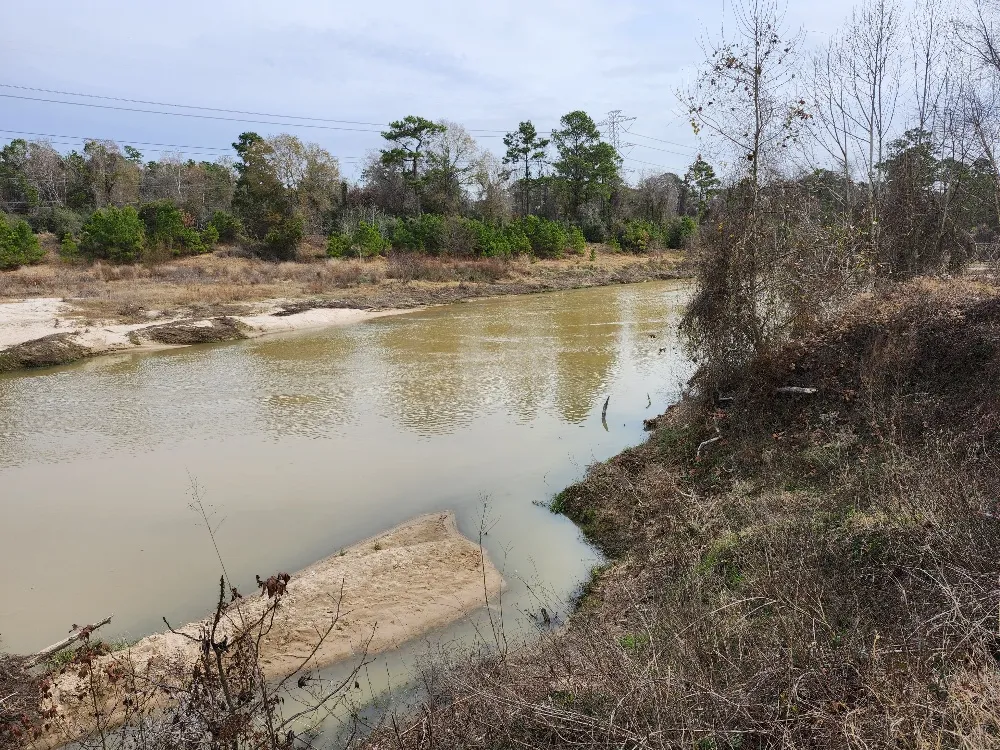
It was very pleasant walking on the sandbars at Spring Creek. I saw a perfect image of a Great Egret standing on the opposite bank of the creek looking majestic and alone. Like it posed just for me!
The exotic plant problem seems less extensive in the uplands, but near Spring Creek there were heavy growths of Japanese Climbing Fern which thankfully had been killed by our recent winter freezes. I don’t like cold weather, but thank heavens when it reduces our exotic plant problem in our natural parks.
I enjoyed visiting both parks and invite you to do so soon. It’s great to have the diversity of park features that we have in Harris County and particularly for me, some wild country to view, enjoy, and take care of.