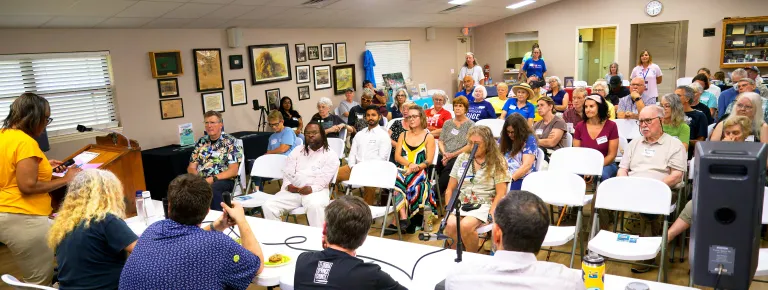
Audience listens to moderator, Alachua County Commissioner-elect Tina Certain, and the panelists at the Our Water | Our Future | Our Voice.
Photo Credit: Chuck Ross
By Sarah Younger, Sierra Club Suwannee–St. Johns Group
Water is not a partisan issue. It is a matter of survival. Yet the decisions that determine whether Floridians have enough clean, safe, affordable water are profoundly political. That was the message I hoped people would take away from our October 10 North Florida Water Summit, Our Water | Our Future | Our Voice, held in Alachua.
As one of the organizers, I was encouraged to see residents, scientists, conservation advocates, and community leaders come together to discuss something that connects every one of us: the water beneath our feet.
Presented by the Sierra Club Suwannee–St. Johns Group in partnership with the League of Women Voters of Alachua County, the Summit wasn't simply about understanding the science. It was about understanding who makes the decisions that affect our water - and recognizing that we have the power to change those decisions.
The Science Tells a Story We Cannot Ignore
Our moderator, Tina Certain, guided a lively conversation that connected groundwater science, development, pollution, and public policy.
Ryan Smart of the Florida Springs Council brought the perspective of someone working on the front lines of springs protection. Our beloved springs are not simply beautiful places to swim and paddle. They are windows into the health of the Floridan Aquifer, the underground source of drinking water for millions of Floridians. Declining spring flows and nitrate pollution are warnings that our water resources need greater protection.
Dr. Cohen of the University of Florida brought the science of our water system into focus. One of the most memorable lessons was the interconnectedness of our aquifer, wetlands, springs, and rivers. What happens on the land doesn't stay on the land. Water moves through our porous limestone, carrying the consequences of the decisions we make aboveground. In a year of prolonged drought and stressed groundwater levels, understanding these relationships is more important than ever.
Data Centers: Who Pays the Price for Progress?
One of the most timely discussions involved the rapid push to develop large-scale data centers in Florida.
Urban planner Michael Hill helped connect the dots between land-use decisions and the enormous demands that industrial development can place on communities. Data centers may promise investment and economic growth, but they also raise serious questions about electricity demand, water consumption, infrastructure costs, and the relatively small number of permanent jobs they may provide.
The questions are straightforward: How much water will these facilities require? Who will pay for the infrastructure? And who benefits when a community's limited resources are committed to private industry?
For North Florida, these questions are particularly urgent. We are already experiencing the consequences of excessive groundwater withdrawals, declining spring flows, and drought. Adding new, potentially water-intensive industries without fully understanding their cumulative impacts could place even greater stress on our aquifer.
Michael's planning perspective reinforced an important principle: communities must have a meaningful voice before development decisions are made, not simply an opportunity to object after the deals are nearly done.
Our Water Is on the Ballot
What struck me most about the Summit was how clearly the science led us back to public policy.
Florida's water management districts decide who receives permits to withdraw groundwater and how much they can take. State agencies oversee water quality and environmental protections. Local governments decide where development will occur and what conditions will be required.
And who appoints the governing boards of our water management districts? Florida's governor.
These appointments matter. They influence whether environmental protection is treated as a public responsibility or an obstacle to economic development. They help determine whether water policy reflects sound science, long-term sustainability, and the public interest.
Florida is approaching a consequential election. We have an opportunity to ask candidates where they stand on protecting our springs, safeguarding our drinking water, managing groundwater withdrawals, and holding polluters accountable.
We can demand leaders who recognize that clean water is not an unlimited commodity to be allocated to the highest bidder. It is a public resource essential to our health, our economy, and the future of Wild Florida.
I am grateful to our panelists, moderator, partner organizations, volunteers, and everyone who participated. The conversations we started must continue in our communities, at public hearings, and in the voting booth.
One of the Summit's central questions was summed it up with a simple answer:
“Who controls our water? We do - at the ballot box, when we elect our governor. Our water. Our future. Our voice.”
And now, our vote.