| October 2025 |
By Joyce Blumenshine
The current U.S. EPA draft permit will allow Marquis Energy LLC to inject up to 1.5 million metric tons of carbon dioxide from their Hennepin ethanol plant into the ground per year, over a period of six years. That amount is three times greater that the CO2 injection done annually by the ADM, Decatur, CCS project, and is more than the current Marquis ethanol production would need. The ADM wells were reported to be 5,000 ft. deep, while Marquis’ is expected to be approximately 3,094 feet below ground. EPA refers to studies showing there is about 963 feet of rock, including a 404-foot-thick confining zone composed of impermeable shale and carbonates below the underground aquifer and that will protect underground water resources. Heart of Illinois Sierra questions if the shale and carbonates are impermeable across the entire area that will be capping the injected CO2, which is stated in some documentation could extend 29 miles.
Existing CO2 injection monitoring wells in Illinois have failed. After being the highly praised success for CCS CO2 deep well injection, the ADM monitoring wells at Decatur were found to be leaking with CO2 moving out of the predicted ranges. EPA belatedly issued a violation notice in 2024 after finding the situation years after the company knew they had well problems. The company failed to notify the agency even though their permit required such notification.
Many of the towns in Putnam County and locations across the Illinois River in Bureau County rely on groundwater wells. EPA has concluded that the CO2 injection well materials, intended operation of the well, and underlying geology are appropriate for carbon sequestration and will prevent endangerment of underground drinking water sources. While area groundwater wells are at a much higher underground level than the CO2 injection, many Putnam County residents, Heart of IL Sierra Club, and other groups have substantial questions regarding the project. The area has had measurable seismic events as recently as 2023, when a 3.6 magnitude tremor happened about 2.9 miles underground.
U.S. EPA plans include the requirement for Marquis to monitor the wells in the current permit (injection well and monitoring wells) for twelve years after the injection is closed. Many concerns relate to this very short monitoring period and the known conditions of the area that could have impacts from the new CO2 injection, including the presence of a closed site that was used by the J&L waste injection well for highly corrosive steel plant ‘pickling liquor’ for steel cleaning processes. Other concerns include that this permit is just the first in what will be a series of Class VI wells for the Marquis products expansions.
It is expected that a notice will be required to be attached to all private property deeds with land located over the Marquis CO2 Area of Review. These notices will be in perpetuity with the property and will indicate that hazardous wastes are located beneath the land. The Area of Review is defined by U.S. EPA as the region surrounding the geologic sequestration project where USDWs (Underground Source of Drinking Water) may be endangered by the injection activity. The Marquis Area of Review covers almost all of Putnam County; the west edge of part of LaSalle County; the top western edge of Marshall County; under the Illinois River and north and west into Bureau County.
Marquis announced their Sustainable Aviation Fuel division in 2022, with plans to produce 120 million gallons per year. In 2022 they also announced an 873 acre Hydrogen Hub Expansion plan. These product expansions, in addition to the existing company ethanol production, are expected to increase the need for CO2 injection and likely additional injection wells in the future. The current U.S. EPA permit for one injection well is expected to be operational for 6 years, followed by what is only 12 years of post-closure monitoring. Well deterioration or other underground problems may not develop in as short a time as 12 years and underground conditions may not show problems for a length of time, providing concerns for a much longer monitoring time after well closure. U.S. EPA is being requested to extend the monitoring to 50 years.
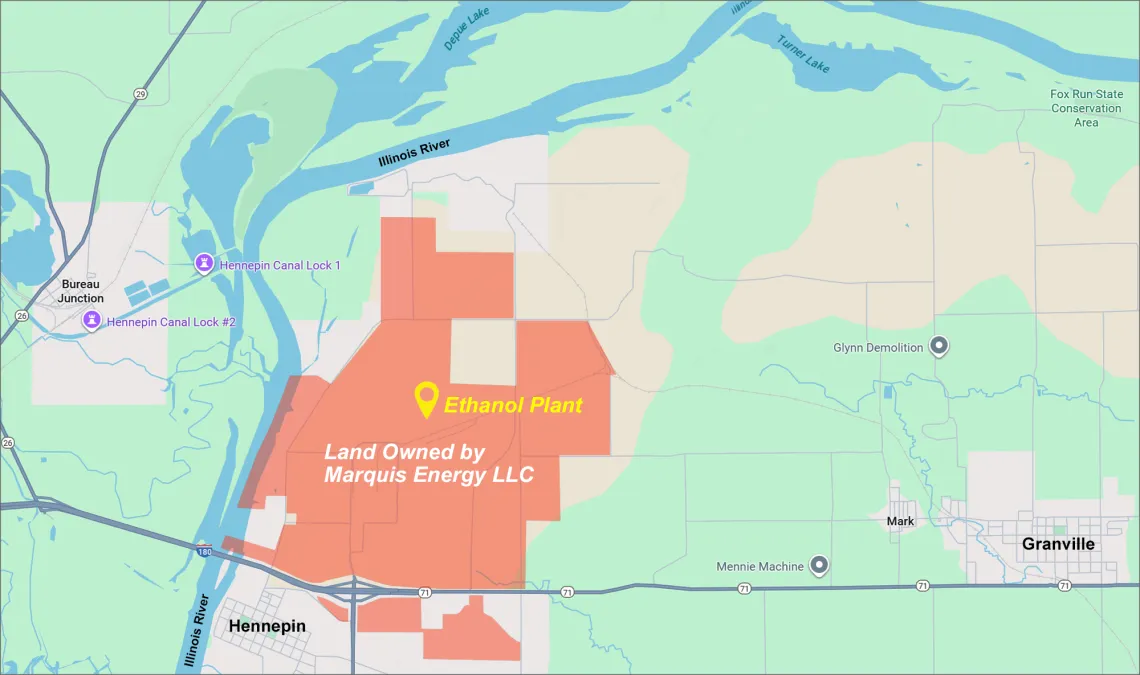
Marquis owns 3,500 acres within and below a curve of the Illinois River and acquired riverfront property and a river docking facility. The company has the largest dry-mill ethanol facility in the world, generating more than 495 million gallons annually. It is a multi-generational, private family-owned business, with a diverse portfolio of companies and team members in the United States, Europe and Asia.