On a brisk summer morning, I put out my kayak for a quiet daybreak paddle. Before I can even push off, a dainty damselfly has landed on the rim of my cockpit– her neon blue body, transparent black wings erect above her thorax, and impossibly bulgy blue eyes staring right at me from the sides of her tiny head. She perches there as if joining the ride, but is likely beginning her morning hunt. Damselflies are predators, often waiting for prey to land on the same blade of grass, or perhaps on the same kayak cockpit. As I begin to paddle, she sits there for a moment, until her comedic eyes spot a tiny jumping spider startled by the change in scenery. She plucks it up and is gone.
Coming back to dock after my paddle, I’m buzzed by a dragonfly, a much larger cousin of the damselfly. This dragonfly is perhaps three times the size of the earlier damselfly, and it lands on the tip of my kayak, its thick black thorax testing the surface, transparent wings open parallel to the water, and blue compound eyes looking everywhere at once. I could hear it buzzing as it passed by my head to land. A second dragonfly buzzed by, perhaps a mate, and the two flew away, dancing and darting.
In Part 1 of the Summer Insect Series, the star subject was the spectacular firefly. In Part 2, I will look at another summer favorite, dragonflies and damselflies. A dragon and a damsel fly into a sandbar….
Dragonflies and damselflies are easy to confuse, because they share more than fairy tale names. Both are from the insect family Odonata, but dragonflies are larger and hunt larger insects, including damselflies. Damselflies are smaller, and hunt smaller insects, including mosquitos and midges. Dragonflies do not breathe fire, but are more aggressive hunters than damselflies, and are superior fliers. All four wings beat independently, allowing them to fly in any direction or to hover, much like a mythical dragon might. And yes, damselflies are more dainty. I guess the names are fitting.
It is thought that Odonata are descendants to the first creatures ever to fly the skies, before other insects, flying dinosaurs, or birds. The largest insect ever to live was in fact a “giant dragonfly” the size of a crow, not something that I want landing on the tip of my kayak! Odonata have hardly changed in over 200 million years. They still lay their eggs in the water, and their larvae actively hunting underwater for up to two years before climbing up a marshgrass stem to molt and fly away in their adult dragonfly form. Lightning bugs, on the other hand, which appeared much later in insect evolution, lay their eggs in dry leaf piles or shallow holes in the ground. Once molted into adults, lightning bugs don’t eat at all, they just glow, mate, lay eggs, and die. The life of a dragonfly or damselfly is much longer, and perhaps more interesting.
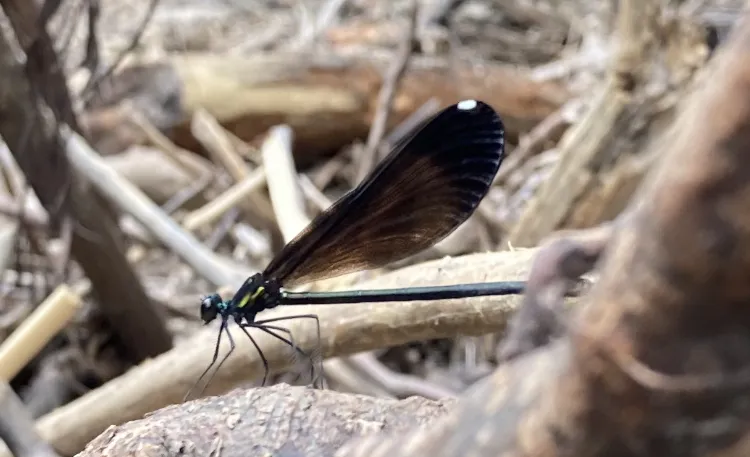
But once again, I realized that I could not name even one of the nearly 100 Odonata species in Indiana, so I will share some of the catchy names I learned, in case you can’t name any either: Halloween pennant, orange meadowhawk, black saddlebags, and widowskimmer. Fragile forktail, seepage dancer, bluefronted dancer, and azure bluet. Beautiful. Creatures that first appeared on this earth more than 200 million years ago deserve such artistic names. But they are only names that we give them. I wonder what they call us?
The most satisfying tidbit I learned in my research was Odonata’s role in mosquito control. One dragonfly can eat up to 100 mosquitoes a day, making them likely to be an even better form of mosquito control for your yard than a mosquito fog! Which takes me back to Part 1 of this blog series: declining insect numbers worldwide. The main factors causing Odonata’s declining numbers are, predictably, habitat loss and pesticides.
Onodata Numbers in Decline
Habitat loss: Odonata require clean fresh water for the first half of their lifecycle. Their eggs are laid in fresh water where the hatched nymph spends the first two years of its lifecycle. Without fresh water, Odonata cannot survive. For that matter, without fresh water neither can humans survive. In Indiana, natural water features such as marshlands continue to shrink, and our waterways remain among the most polluted in the country, as the state government prioritizes development over environmental protections.
Pesticides: As with fireflies, dragonflies and damselflies are affected by pesticides. Pesticides entering waterways weaken or kill Odonata eggs and nymphs, and prey that have been exposed to pesticides pass the toxins on to their predators. In short, pesticides in the environment weaken or kill insects.
How You Can Help
Habitat loss Considering that Indiana has drained nearly all of its wetlands, dragonflies in Indiana today are likely to live near rivers and manmade lakes. Assuming the gentle reader cannot create damselfly habitat by building a lake in your back yard or by buying a house on a river, you may consider connecting with the many nonprofit organizations in Indiana working actively to clean up our rivers, such as the White River Alliance, or in attending the Indiana Water Summit in Indianapolis in August, of which the Sierra Club Hoosier Chapter is a sponsor. One might also consider simply acknowledging the fact that Odonata have been on the world stage for more than 200 million years. They deserve the space they need to survive. They deserve to inherit the earth for another generation.
Pesticides is one of the largest and strongest markets in the world. Farmers, homeowners, the US Forest Service, and the flower industry, to name just a few, buy into the belief that pesticides are necessary in modern life. You, however, do not need to buy into the lie. You have control of what you buy and what industries you support. The best way to help is to evaluate whether you use pesticides in your home or in your life, and if you do, find alternatives. Mosquito fogs can be replaced by citronella candles, conventional produce can be replaced by organic in your grocery cart if affordable, and the purchase of non-organic flowers can be avoided. You might notice this paragraph is an exact copy of text from Part 1 of this blog series, because pesticide prevalence and their effects on environmental health are consistent and global. This part of the story doesn’t change. But YOU can change.
To end this blog, I decided to create my own fairy tale Odonata, an as-yet undiscovered damselfly, perhaps first identified along a meandering creek feeding into the Muskatatuck River. Odonata are widely varied in color, some pure black, and others with striped wings and neon bodies and eyes. Mine would be a creature that conjures both fairytale whimsy and hope. My damselfly would be called the reverie rainbow damsel. What would you name yours?
Jennifer Ehara
Winding Waters Group Executive Committee
and Hoosier Chapter Sierra Club Communications Team