By Mark Shahinian
The San Francisco Public Utilities Commission (SFPUC) has, for years, over-projected its water needs and used those over-projections to starve the environment of water. Today the Sierra Club SF Bay Chapter is asking a judge to put a stop to that cycle. The Sierra Club has filed a petition asking a judge to invalidate the San Francisco Public Utility Commission’s 2025 Urban Water Management Plan (UWMP).
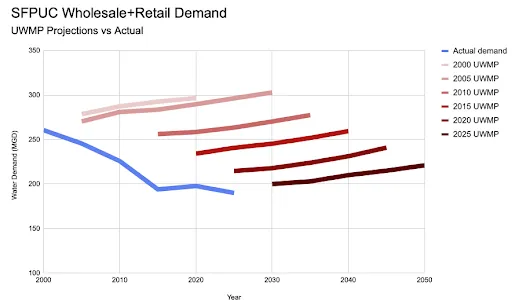
This flawed demand forecast is a big reason the SFPUC argues it can take more and more water from the Bay-Delta and rivers, even if its customers don’t end up using that water. The plan’s demand forecast is not supported by the utility’s own records, by facts, or by logic. The graph below shows the SFPUC pattern of over-projection that the Sierra Club is seeking to change:
The SFPUC uses two sets of books
When it comes to demand forecasts, the SFPUC keeps two sets of books. It has one demand forecast that shows ever-increasing demand for water. That’s the one that guides its operations and causes it to hoard water behind its dams (including Hetch Hetchy) just in case its fanciful forecasts ever materialize. This forecast means in dry years, little water flows downstream to feed the ecosystem the Tuolumne river sustains. At the same time, the SFPUC’s finance team has an entirely different forecast that it uses to predict what it will charge customers for water in the next decade. The finance forecast, presented last February, shows roughly flat water demand.
It’s not against the law to have two different forecasts. It is against the law to have an alternative forecast that your state-mandated UWMP water demand report neither acknowledges, nor explains.
An agency does not get to choose an audience and then choose a number to match it without disclosure. The California state agencies that set future water policies, bondholders, and ratepayers read these documents. They are all entitled to a detailed explanation in the UWMP of how and why the SFPUC uses two sets of numbers.
The assumptions run up the score
To arrive at its inflated demand forecast—SFPUC water deliveries have declined 28% in the past 25 years, but the forecast somehow arrives at a 13% increase over the next 25 years—the SFPUC has used a set of assumptions that willfully ignore facts and logic. These assumptions are not supported by evidence and push the demand model they are using to achieve the higher demand the SFPUC wants to show:
The model assumes San Francisco reaches 100 percent housing occupancy by 2030. The city has never reached 100 percent occupancy, as “vacant” includes second homes and homes up for sale or rent. Census data put occupancy near 88.5 percent in 2024, and the occupancy trend has been down, not up.
- The model assumes new multifamily units use as much water as old ones. However, the SFPUC’s own data show new multifamily units use ~25 percent less water.
- The model assumes conservation programs stop producing savings in 2030 or 2035, and so savings from conservation programs are less than 1% of water use by 2050. Yet the agency has no plan to shut those programs down.
- The model assumes water and wastewater rates never outpace inflation after the mid-2030s. Yet the agency has plans for a large capital buildout in exactly that time frame that would push up costs.
Every one of these choices pushes projected demand up. Not one pushes it down. That is not forecasting – that is using your assumptions to run up the demand numbers. The inflated numbers end up costing both the environment and ratepayers.
Who pays for the gap
Inflated demand numbers underpin the SFPUC’s argument that it cannot spare water for the San Francisco Bay Delta. They are the numbers the utility uses to starve the ecosystem of water. The SFPUC’s water planners think over-projecting demand keeps water users safe. In fact, they’re just using the environment as their buffer.
Ratepayers are also on the hook. The SFPUC is building a $400 million headquarters for its water department while customer rates climb 25 percent between 2026 and 2028. An inflated demand forecast gives planners permission to keep spending. The bill arrives as a rate increase.
What we are asking for
We are asking the court to force the SFPUC to set the plan aside and revise it. We want a demand forecast supported by facts. We want a straight explanation of how two forecasts from the same agency, published months apart, reached quite different conclusions. We have raised all of this with the Commission in writing and in person. We raised it more than once. The Commission adopted the plan anyway, so unfortunately we are left legal action as our only remaining option.
We are not asking a court to stop water deliveries or threaten San Francisco’s water supplies. We are asking for a defensible, transparent demand number so that we can all properly plan for ecosystem health and for a future of affordable water.