 The Magazine of The Sierra Club
Lessons in Granite
The school of hard knocks, as taught on the walls of Yosemite
The way I remember it, my father and I were at the Yosemite Grocery Store, shopping for our traditional rock-climbing tacos — a ceremonial repast we hadn't shared in more than a year. I was already eating tortilla chips, walking the aisles with bag in hand, and we were trying to settle on a first climb for the next morning. Shouldn't it be something short? Shouldn't my father, after all this time away and such a hard year of work, and after letting himself get so out of shape, ease back slowly? Yeah, sure, perhaps.
Or perhaps not. Maybe a man on the comeback trail should start boldly, with something inspiring. He truly was a natural athlete, after all, and past comebacks had been pretty sudden — he'd always been able to drop everything, drive to the mountains, and muster whatever it took. So how about the East Buttress of Middle Cathedral Rock? Sure, we both knew that such a long climb could be exhausting, and that the East Buttress terminates at a ledge covered with loose rocks.
There'd been more than a few injuries and fatalities over the years, when those rocks had been dislodged by an errant foot or rope and come tumbling down the climbing route. But we'd both done the climb more than once, and such a long day, on familiar terrain, with a great view of El Capitan — what a great way to be together! How better to rescue what we were both so scared of losing — the rare closeness we'd once had as climbing partners.
After paying the cashier, and walking into the still heat of a Yosemite summer night — the dry smells of pine and wood smoke — we simply agreed on the standard East Buttress precaution: We'd wake up in the wee hours, make sure we were the first party to the base, and if anyone beat us there, we'd pick another destination, so we didn't risk getting killed by the mistakes of others.
I recall a vague sense of dread, but I don't think it had anything to do with our choice of climb. It had more to do with a coming change I could just barely feel. Five years earlier, my father had taught me everything he knew about ropes and carabiners and chocks and all the rest; he'd even taught me the joy of Sierra granite and blue skies, the immense freedom of a long day's scramble.
For him, climbing had been a kind of dream life, an escape from work and pressure and his own sadnesses and into a world of high adventure. He'd given that escape to me, but because I was a young man with a lot of time on my hands, it had become more than an escape: It had become the first great obsession of my life, the means by which I'd started figuring out who I was. And he'd happily come along for the ride — several summers running, we'd been each other's best climbing partner.
It was almost a picture of good father-son fortune. One weekend after another, we'd spent all those hours laughing and talking in the car, and cooking our tacos, and sleeping under the stars, and scrambling up cliffs. But over the last couple of years, while I'd climbed harder and harder, my father had stopped. Work, self-doubt, wondering if he'd be able to afford retirement — I don't really know what took him down, or why he stayed down so long. I doubt I ever will. But I do know that we missed each other.
I was busy fulfilling the dream he'd taught me to have — climbing El Capitan — and he was struggling with things I probably won't understand until I get to that age myself. And now, 25 years old and with El Capitan behind me, I'd started graduate school, I'd moved to a beach town, and I wasn't even sure how climbing fit in. But if I was no longer a climber, if Yosemite wasn't at the very center of my life, who exactly was I?
Such a mundane question, and it only mattered that weekend because my father was at last mustering the will to crawl out of the hole he'd been in, and climbing was the obvious way to do it. He wanted to come charging back, seize the man he'd once been, and restore all the optimism and confidence he'd once taken home from every trip to the mountains. I wanted that for him, too, but I was also afraid of something I couldn't name.
On our weekend trips, we rarely slept in Camp Four, the storied Yosemite climbers' campground, because you had to spend hours in line for a site, and because my father had a secret sleeping spot in the woods that had never failed us. So we cooked on the tailgate of the truck, and melted cheese on our tortillas, and watched the stars shine over the black shadowed mass of Half Dome. A ranger ambled by, perhaps walking to his cabin at the end of his shift; we imagined his days to have the serenity of a gardener in Westchester County, and we reckoned we'd love his job and the excuse to drift among these trees year after year, free of obligation, taking lunch on some silent boulder in the forest.
Even this conversation was an attempt to revive old patterns, old pleasures, projecting our shared fantasy: how this guy had gone to some Ivy League school, rowed first oar on the varsity heavyweight boat, got accepted to a big law school, and then just bailed (the rejection of caste being essential to the form). "Somehow," Dad mused, "his ex-wife's parents had always known there was something peculiar about dear Ted.
"'Like the time,'" he continued, mimicking the complaining remembrance of an ex-mother-in-law, "'He just walked off for three days during a family trip to Yellowstone. We thought he'd been killed by a grizzly or deserted our daughter. But he'd just seen fit to visit a rather remote lake. No explanation!'" He never quite apologized, either, Dad and I figured, only spending the year breathing deeply and looking up at the jag of sky that Yosemite Valley describes.
I remember my father's deep chuckles and satisfied breathing. Maybe he really could rescue himself this way. And although something was amiss in my own heart, and although this blarney about the ranger made me half-panicked with anxiety even as it made me laugh, I was happy to share a fun night with my father. I love his banter. I just wasn't sure it meant the same thing to him that it meant to me.
After a youth of radical politics, he'd become a successful lawyer and reliable family man; I was a much more marginal character, and I'd already burned much of my best youthful energy in the wilderness. Which is perhaps why I reacted the way I did to the last thing my father said before we drove off to sleep. A group of young climbers had gathered around a nearby pickup: a portly Frenchman who had ropes fixed on El Capitan's monstrous Dawn Wall, a Californian whose partner had failed to show, and two aspiring young Colorado longhairs, here hoping to join the search-and-rescue team.
"These boys will never be happier than they are now," Dad said wistfully, as he started our truck's engine. "Their lives can never be finer than this: freedom, anticipation, beautifully young and strong and free. They don't have to be anywhere else, nobody's telling them they got to come home. Emerson was right, the Golden Age is now. You know what I mean?"
I woke up first and, knowing that any sleep at all was a blessing to my father, I took a long walk into the meadow below El Capitan. Duck pairs flapped from tree to tree, and fine white clouds glazed the sky — the thickening air of an oncoming northern storm. Far up-valley, Yosemite Falls plunged out of the mist as if pouring from a hole in the sky: a fierce, torrential roar that spread eventually into a widening cloud in the high winds, then pooled in a tight canyon before pouring again — a ropy jet of power.
Up on El Cap, Horsetail Falls fell free in watery gray fans, and then blew sideways in cut sheets of glass. That wall is so huge, I'm always shocked at how far back I have to lean to see the top. Only a few months earlier, my friend Stephen Ross had phoned from Caltech, full of excitement about an El Cap route called Zenyatta Mondatta.
A charming 32-year-old atomic physicist full of enthusiasm for puff pastry, big walls, abalone diving, fixing his old BMW, and whatever you were enthusiastic about, Stephen was five foot six with a shock of blond hair; he'd remove his eyeglasses to clean them, shrink into himself as his blue eyes receded from the lens magnification, then leap forward again when the glasses were replaced and say something like, "I'm not sure I want to marry an astrophysicist." A brilliant teacher, too — the kind of guy who could make very arcane science feel perfectly accessible. (He had once explained his work to me as "building a clock that will count backwards if time reverses in the universe.")
Stephen had climbed El Capitan once before, but was unhappy in his life and looking for another grand adventure. Just two weeks before his planned weeklong sojourn on that vertical wall, he called once again, this time with bad news: Some guy had just died on Zenyatta Mondatta. Climbing by himself, with ropes, he'd fallen — pulled out some gear, actually broke a carabiner. His rope had then slipped behind a piece of rock and cut, sending him 300 feet to the ground, where his fiancee and friends found him the next day.
The death scared Stephen so badly he decided not to do Zenyatta Mondatta after all. Maybe he'd try a different El Cap route, something less monumental. A few days later, he called again. He was "feeling too mortal," as he put it, and he thought he wouldn't climb El Cap at all. Maybe he'd just do some short stuff. Sounded sensible to me. It was the direction I wanted to go myself: back down from all the risk, find a way to make climbing something I did just for fun. The next phone call, three days later, was from Stephen's climbing partner: "I have some strange news," she said. "Stephen died yesterday."
The haunting part, at least as I returned to wake my father and get us going toward the East Buttress, was the exact nature of the accident. Stephen had died on a climb called Beverly's Tower, which my father and I had once tried. Not 15 feet off the ground, I'd been stumped by a move that scared me beyond all rational explanation. So I'd fumbled around with my gear, I'd retreated and returned and retreated again. I'd told my father the climb was well within my abilities, and he'd reassured me that he knew that perfectly well, and then he'd said, "But who cares? Why don't we just go get some ice cream instead."
That's the kind of father I had, thank God. In teaching me to climb, he'd always insisted that a big part of courage was knowing when to turn back, and he illustrated the point in parables about guys who listened carefully to their inner voices and either (a) skied an extra ten miles rather than crossing that loose snow slope, and thus avoided the avalanche that killed ten people, or (b) suffered a partner's absolute fury and disappointment by refusing to do some climb, just because intuition told him not to.
And then my father was practicing what he preached, or encouraging me to practice it. So I agreed, and backed off Beverly's Tower, and we ate ice cream by a river. I later learned that Stephen got to exactly the same spot, took what should've been a minor fall, and somehow flipped on the way down. His head hit the rock and he died.
The biggest risk in Yosemite rock-climbing is the chance that you'll slip and lose your grip. If you're climbing second, this isn't much of a danger: An attentive leader, keeping the rope taut from somewhere above, will catch you in a matter of a few feet. If you're the leader, however, you'll fall more than twice the distance you've climbed from the last piece of gear you affixed to the rock. And that can easily put you on the ground, if you're not careful.
Even higher up, where a ground fall is unlikely, 30-foot falls are not at all uncommon. If you don't hit anything on the way down, you just dangle unharmed at the end of the rope; if you catch a ledge, it can be awful. As a result, leading is more stressful, more tiring, than going second — but it's also more rewarding.
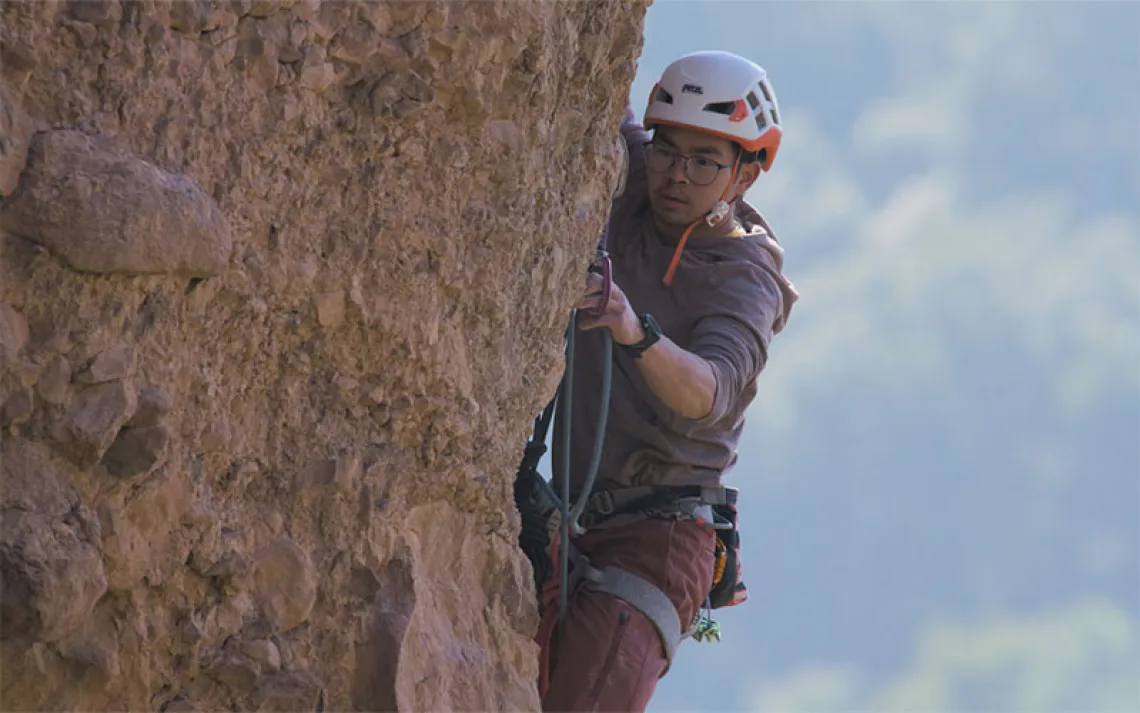
My father insisted on swapping leads on the East Buttress. He had his eyes on the prize now, on the way he was going to recover his strength, and he didn't want to be the tagalong; he wanted to be my climbing partner, doing his share of the work, just like the old days. And he was: We meandered up the East Buttress's lower cracks, in plain view of El Capitan.
At every ledge, the leader handed the gear to the follower, and we moved upward. He led smoothly and calmly, and we both marveled at the forgotten familiarity of the sight — one of us rising from below to greet the other. Perhaps it wasn't gone after all, my father wondered aloud. Perhaps we could still do this together! Feeling better and better, he opened our lunch on a small ledge and dared to dream: "Do you think I could ever do El Cap, son?"
Such a vulnerable and secure thing to ask your boy; such a sign of how good we had it. He'd never wanted anything to do with oedipal rivalry. He'd always just wanted to make sure I felt that I'd won, so I could get whatever strength sons got from winning, and so that we could carry on being friends. So he asked: "Honestly, son, tell me. What would it take?"
He eventually did climb El Capitan — years later, at age 64, and not with me — and I now know that I was hearing, on the East Buttress, the first stirring of the ambition by which he guided himself from midlife malaise to one of the happiest adventures of his life. But the question made me extremely tense: Although plenty of people climb El Cap without making a big deal out of it, I'd found it very hard, even after a year of training and at the peak of my physical powers.
I felt a resistance, an impulse to say: I don't know, Dad, I don't know if you should really try that. It's easy enough to fill in some of the blanks in what I was saying — the son's desire to feel that he's actually better than his father. Oh no, Pop, you could never climb El Cap. That's the difference between us. I wanted the whole conversation to go away, but was afraid of saying so.
Two crows soared in wild drafts along the wall, rose and fell, launched into the sky, then fell again. Across the valley, I could just make out Horsetail Falls, blowing into the sky in a waving horizontal spray. I told my father he could absolutely climb El Cap, and that he'd just have to train hard for a year. He'd have to do a lot of climbs like this one, until they became routine. "Any chance you'd do it with me?" he asked.
I laughed and smiled and became even more anxious. Climbing onward, we organized gear carefully, moved with deliberation — as if in training. Like a carpenter taking perfect care of his tools, my father placed protection with an experienced hand, built good anchors, and moved quickly. The rock felt clean and frictive; holds secure, feet sticking. The sky clouded over, a few raindrops here and there, but my father actually slowed instead of hurrying, demonstrating good judgment, knowing that this was precisely the time to be careful.
And at the end of the day, both of us very tired, I sat on a tree that protruded from a steep gully, and he began leading the very last rope-length to the summit. He placed gear, he drew out rope, he took care. He was astonished by how well he'd climbed, and so was I. Moving steadily higher, he laughed out loud: "I'm not saying I'm great," he called down with a laugh, "but I'm not saying I'm too bad, either."
"What are you saying?"
"What I'm saying is that I'm doing all right.
"You're doing all right?"
"Hell, yes." He leaned back from the wall and called across the valley, "Trapped inside a dying animal!" He beat his chest and smiled in the spring wind. "What did Yeats call an aging man? ÔA paltry thing, a tattered coat upon a stick.' F---ing Yeats! An old man is a paltry thing!"
Eventually, he moved out of sight above me, and my attention drifted to El Capitan again, to the elegance of that monstrous wall. And then I heard a sound of rock striking rock. I glanced up, saw nothing at first. My father said something inaudible, then shouted, "ROCK!"
Dad had done the unspeakable — he'd been careless on a rock-covered ledge — and now a chunk of stone the size of a melon was tumbling into the chute 60 feet above, falling toward me, skipping from one side of the chute to the next. It was going to brain me, and there was nowhere to hide. Then it shattered against the wall five feet above and to my left and I turned my head and threw myself to the right as a baseball-size chunk slammed into my jaw.
Twice, my father yelled my name. He couldn't see me.
I put my hand to my chin and felt wetness. The hand came away bloody.
My father called down again: "Did it hit you?"
I said that it had.
"Where?" he asked, audibly scared.
"In the face."
He began crying out in fear.
"I'm all right," I yelled back. "Just get me on belay."
"What?"
"I want to climb up to the top with you."
He obeyed, and soon I was moving upwards, albeit slowly. Drops of blood fell to the rock from my chin. I felt dizzy, but I knew I had to focus. I'll never forget the look of terror on my father's face as I emerged into his view; he expected the worst. He knew a rock that size couldn't have hit my face without destroying it, or my head without causing brain damage. He assumed I'd been mistaken about being all right.
I only had a flesh wound — the meat torn open, but no serious damage — and we stood there a long time, holding each other and crying. We cried a lot. I could easily have been killed, and it would have been his fault, and that would have been the end of both our lives. But I was fine, so it wasn't.
I probably should've seen a doctor for the cut; it took almost a week to close, and I still have a scar. But my father and I hiked out to his car with no discussion of the accident, and by the time we were driving back to Berkeley, the bleeding had slowed and we'd reached an implicit agreement not to talk about it any further. I wanted to forget as badly as he did, so I just pressed a clean T-shirt into the wound and watched the foothills unfold to the Central Valley.
Later I did make a kind of psychic use of the accident, but it was never at my father's expense. I'd done much stupider things many times in the mountains, and I, too, had been lucky enough not to pay a dear price. I also didn't have years of filial resentment waiting for an outlet; I didn't need a reason to blame my father for anything.
I just needed a reason to let go of the climber I'd been, and of the fantastically happy years my father had given me. I needed a way to bow out of my father's return to climbing, and for a while, the rock-fall gave me that. How could we in good conscience get on a rope together again, after such a close call?
But the truth is, I would've bowed out of climbing anyway. And I also think I'll be back. I don't know when, exactly, but every time I visit the high country, and press my hand against Sierra granite, I feel something waiting for me, some source of strength and joy that won't go away. And if my father's still interested, when I feel ready to tie on a rope again, he'll be the first guy I call.