Bacteria to the Rescue
Can microscopic creatures help get rid of humanity’s huge pile of plastic?
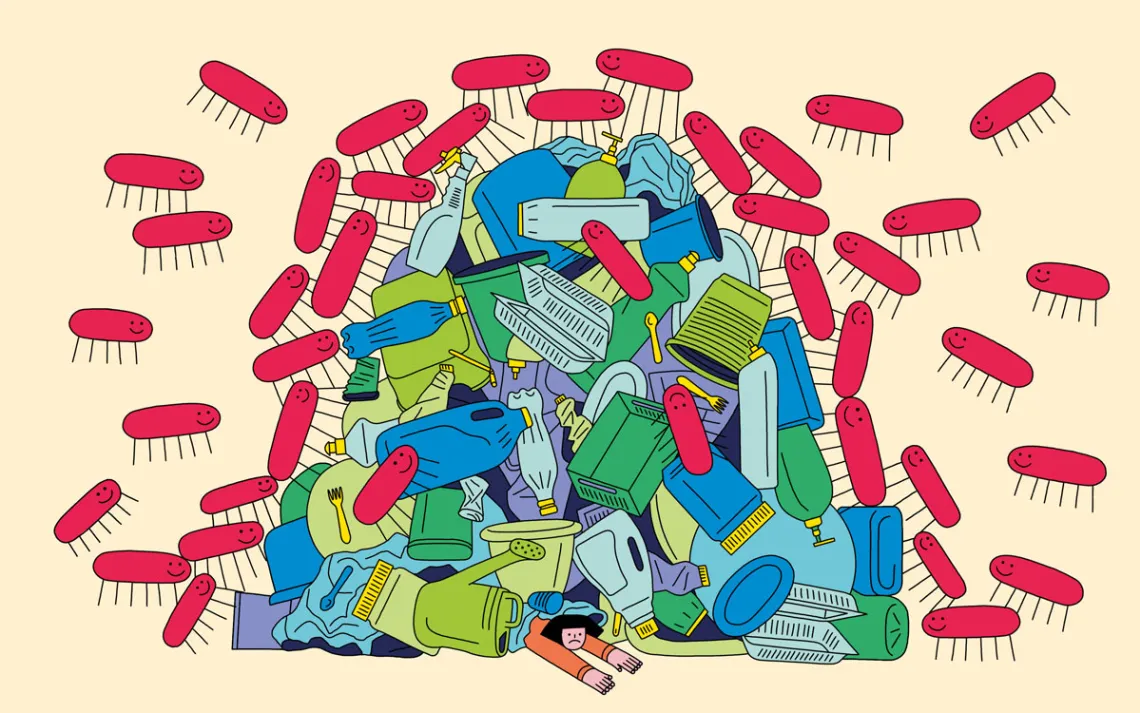
Illustration by Cristina Spanò
When you recycle a plastic bottle, it may seem like that bottle will get reused in some form forever. The recycling symbol is a triangle made of continuous arrows, after all. Glass and aluminum can be recycled endlessly, but plastic has a limit. A water bottle might get turned into the fabric of a shoe. But when the shoe gets worn out, it can’t be recycled again. It’s trash. Almost all the plastic ever created is still with us, polluting our planet. What if we had a better way to recycle it? Nature might offer one solution.
Meet the bacteria
In 2016, Japanese scientists announced that they had discovered tiny bacteria breaking down plastic in a pile of trash. The bacteria, Ideonella sakaiensis, were consuming a kind of plastic called polyethylene terephthalate, or PET. (This is one of the most common plastics—it’s used in food wrappers, clothes, and, yes, water bottles.) Maybe the bacteria could help us solve our growing plastic problem. People were excited by this idea!
Now we know that other bacteria do similar work. In 2024, researchers reported that Comamonas testosteroni seem to munch on PET in wastewater. And in a lab, scientists observed Rhodococcus ruber working its magic on plastic in seawater. Could it help clean up plastic in the ocean?
What they do
Bacteria don’t have mouths, so they can’t actually eat plastic, but they can absorb it. This works similarly to how your stomach digests food. Ideonella sakaiensis makes chemicals called enzymes that liquefy plastic. The bacteria then soak up the resulting goo. They use some of it as energy. What they don’t consume comes back out as waste. Here’s where the recycling happens: That waste is a material that can be used to form new plastic.
Reality check
This natural process reduces plastic but doesn’t completely get rid of it. The process is also relatively slow. Plus, plastic-loving bacteria are picky. To do their job, they need the right temperature and amount of moisture. Creating those conditions can be difficult outside a lab.
A French company named Carbios found a way of using bacteria to break down a lot of PET at once. It says it can process the equivalent of roughly 12,000 water bottles each day. It’s a good start. But humans make over half a trillion plastic bottles a year. Also, that’s just one company that specializes in one type of plastic. There are at least seven types of plastic, and only certain bacteria can break down each of them.
Today’s bacteria can’t keep up. There is so much cleanup that already needs to happen. And there’s more plastic entering the world every day. The best solution is to stop making and buying plastic.