Cougar Family Goes Viral For Showing Up in the Least Likely of Places
Scientists say the discovery of a litter in Minnesota could indicate a strengthening population of these big cats
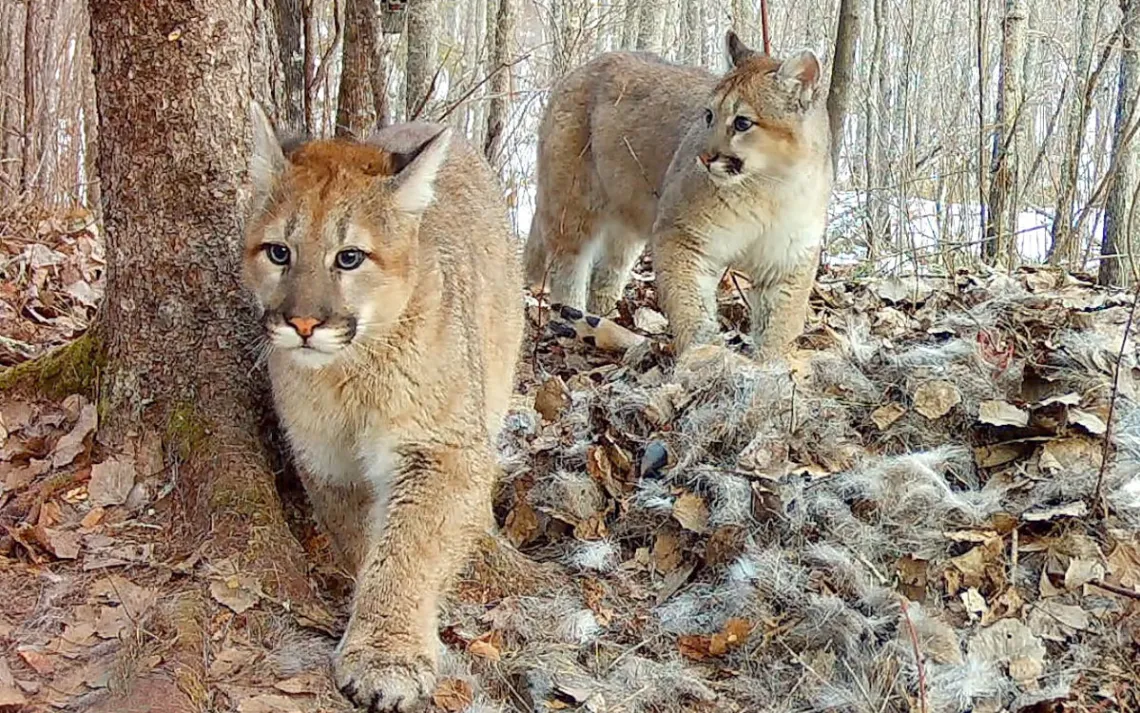
Cougar kittens captured on a wildlife camera near a deer carcass in northern Minnesota. | Photo courtesy of the Voyageurs Wolf Project
One sunny day in late April, Tom Gable decided to go for a walk in the woods in Minnesota’s North Woods. Gable is the project lead for the University of Minnesota’s Voyageurs Wolf Project, which aims to understand the ecology of wolves in northern Minnesota. He planned to check some trail cameras—his team’s primary monitoring tools—that his postdoctoral student had put out a month earlier. It was strategically placed next to a deer carcass that looked to have been killed and stored by some sort of cat.
Gable was expecting to see a bobcat. Instead, squinting at the video footage through the camera screen, he saw something no one in modern history had ever seen in the state of Minnesota: a female mountain lion and her three cubs.
“We were just kind of freaking out, in disbelief,” he said. They hadn’t observed the cougar family on any of their nearly 400 other trail cameras.
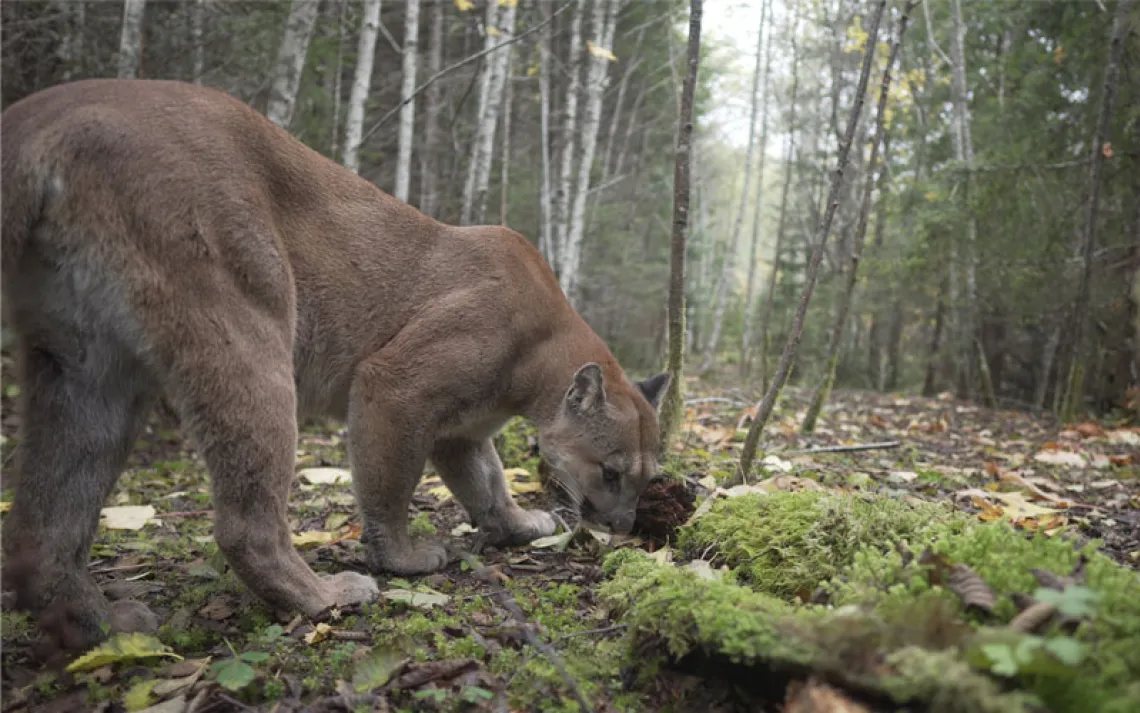
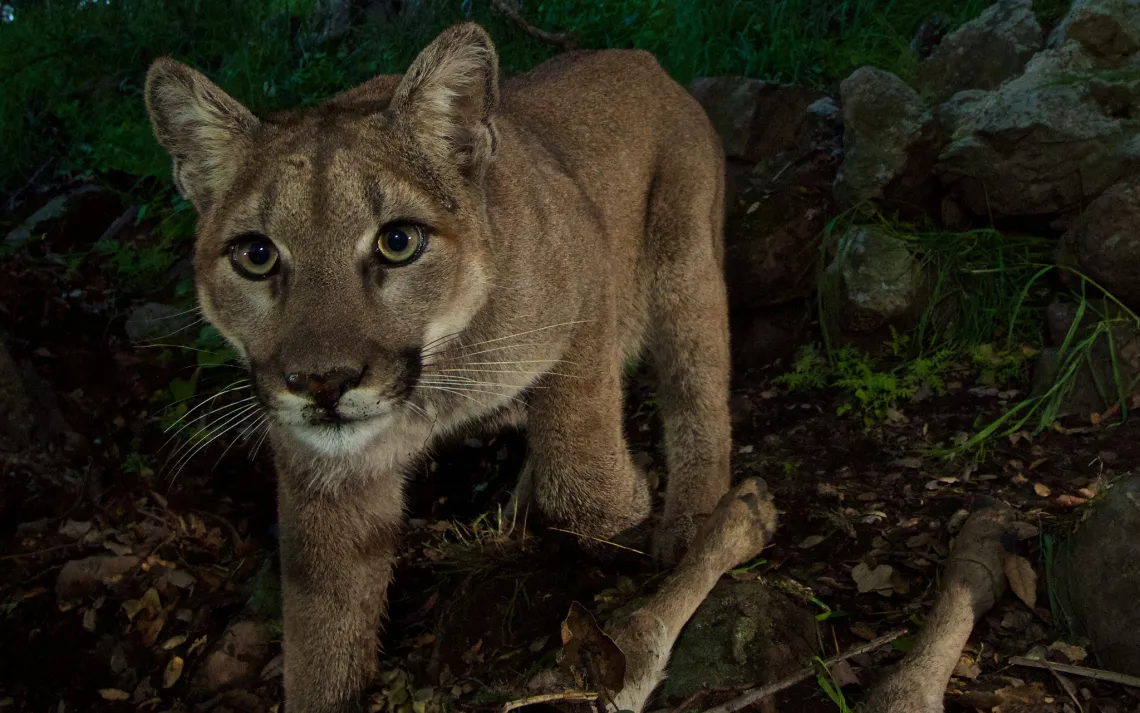
Mountain lions once roamed the entirety of the United States, but they went extinct in most of the country as a result of deliberate eradication campaigns over a century ago. They have since made a comeback, but with the exception of the Florida panther, there isn’t a stable population of the cats east of the Dakotas. Although there have been documented sightings of mountain lions transiting through Minnesota for over 20 years, there hadn’t been any confirmed cub sightings, which would indicate that there was a permanent breeding population in the state. They were considered locally extinct throughout the eastern Midwest until the discovery of mountain lion cubs in Michigan in January.
According to Gable, the trail camera captured over seven hours of high-quality footage of the mountain lion family. The Voyageurs Wolf Project posted the first of the footage to its social media pages at the end of April. It got national attention, with more than 1.5 million views on Facebook and 150,000 on Instagram. Gable says the social media frenzy can be partially credited to the length and quality of the footage. The video captures the family grooming each other, eating from the deer carcass, vocalizing, and playing in high definition.
John Erb, a wildlife research scientist at the Minnesota Department of Natural Resources, was one of the first to see it. “It was a bit of a surreal moment, like ‘Well, today’s the day we finally have the documentation,’” Erb said. “I knew it could come any day. I also knew we might not get it for years.”
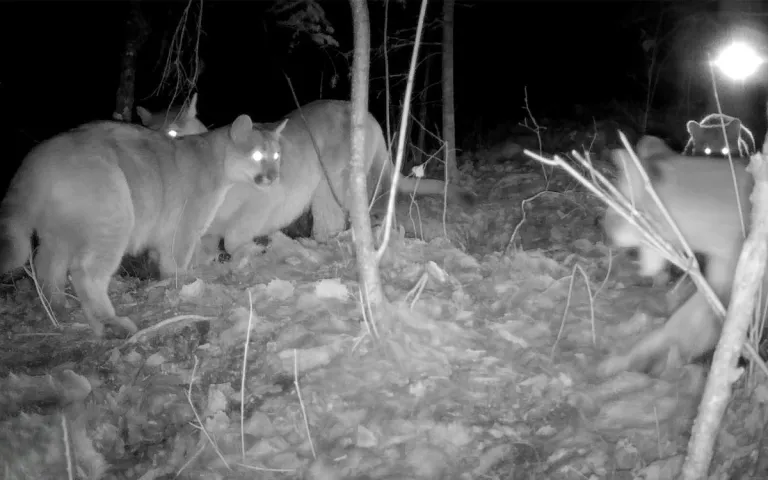
The cougar family captured at night near their deer carcass. | Photo courtesy of the Voyageurs Wolf Project
A 2024 study had predicted only a 30 percent chance that cougars would reproduce in Minnesota in the next 75 years. Stephanie Tucker, a furbearer biologist at the North Dakota Game and Fish Department, said the fact that the mother cougar birthed and raised kittens in the area means that she’s been there for some time and already established a territory. She explained that once a female cougar establishes a territory and has cubs, she usually sticks around. And if any of her offspring are female, they’ll likely stay nearby and have kittens of their own with any males that pass through.
According to a press release from the Minnesota DNR, the cubs were between seven and nine months old in the video footage. Tucker said this means they’ve made it past the most vulnerable stage of their lives. “Now, if something were to happen to that female, like she met an early fate, usually after like eight or 10 months, the cubs are most likely going to survive,” she said.
Mark Elbroch is the director of the puma program at the nonprofit Panthera, which works to conserve wild cat species across the world. He said he was cautiously optimistic about the news. Cougars usually only have litters once every two years, he said, and any females from this litter would likely not be breeding until at least next summer, if they find a suitable male that is. So any growth of the breeding population is going to be slow.
“These things are just difficult to predict,” Elbroch said. “Because it’s just random chance now.”
But together with the sighting in Michigan, Erb says that these apex predators could be gaining a more permanent foothold in the Midwest. Should cougars establish a strong breeding population, he is interested to see how they would exist in the ecosystem. Cougars are generalists, he says, but in the United States they are nowadays distributed mostly in mountainous terrain because it was harder for humans to extirpate them there.
In areas where cougars and wolves share the same territory in the United States, like Yellowstone National Park, cougars occupy more mountainous, forested terrain and hunt smaller prey, and wolves occupy the open valleys and hunt larger prey. But according to Erb, in northern Minnesota, the terrain is all pretty flat, and there are only two main prey items: beavers and deer. That means cougars and wolves would be sharing the same space and competing for the same prey.
Gable noted that wolves typically outcompete cougars in areas where they overlap, like in Yellowstone. Although wolves are smaller than cougars, they have numbers on their side. They’ve been documented attacking and stealing kills from cougars, making it harder for mountain lion populations to grow in places they share. “We don’t know what they're thinking,” Gable said. “But I have absolutely no doubt that wolves in the area know that there is another large predator around.”
Although cougar population growth with wolves may take longer, Elbroch said, the size of the habitat in northern Minnesota and the dense tree cover will make it possible for mountain lions to avoid wolves. He said he hopes a stronger cougar presence in the Midwest could help them spread to other areas with good habitat, like the East Coast. Although there is no breeding population established in the east, there have been a few sightings of dispersing animals in the area: In one famous case, a mountain lion traveled all the way from South Dakota to Connecticut, only to be hit by a car once he arrived.
Gable and his team are working on analyzing genetic samples from the family to determine where the mother came from, and if a male mountain lion they captured on camera a few weeks ago might be the father. In the meantime, Elbroch hopes that people will get excited about having these big cats in the neighborhood.
“We could help bring back a species that we as humans purposefully eliminated from much of its range. We can start to see that recovery in our lifetime,” he said. “I hope [this sighting] really just encourages people to create the circumstances to host more mountain lions in the future.”