 The Magazine of The Sierra Club
The Largest Liquefied Natural Gas Terminal Is One Step Closer to Completion
The Trump administration is fast-tracking a project that will increase emissions and gas prices
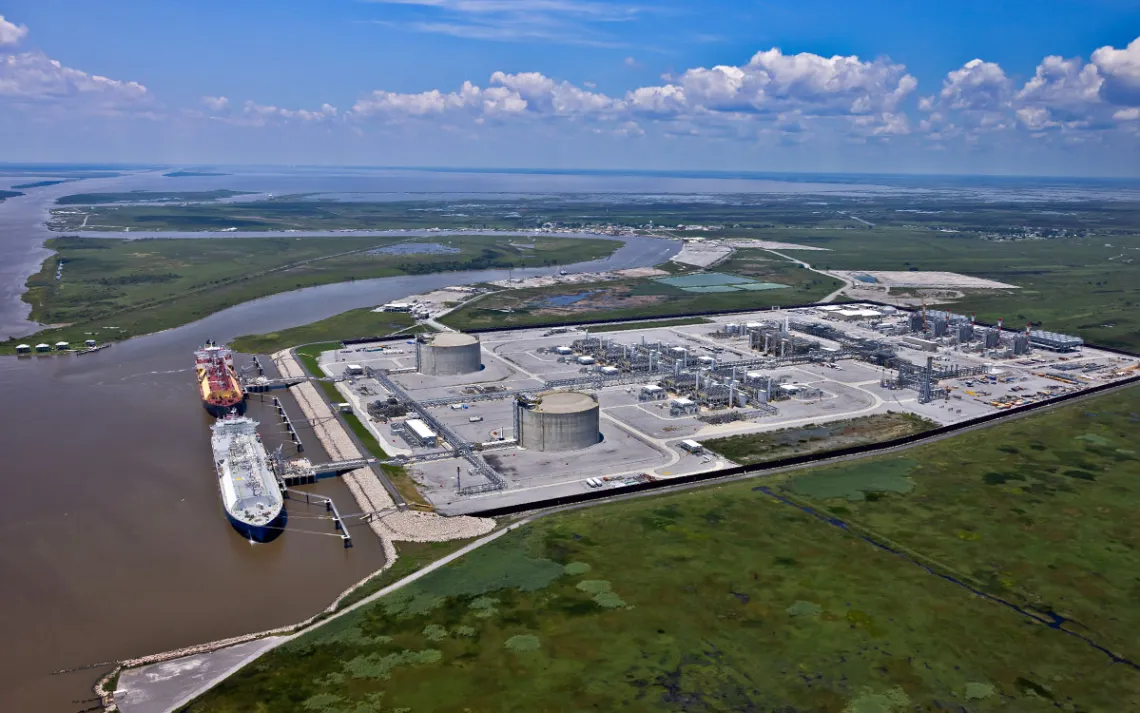
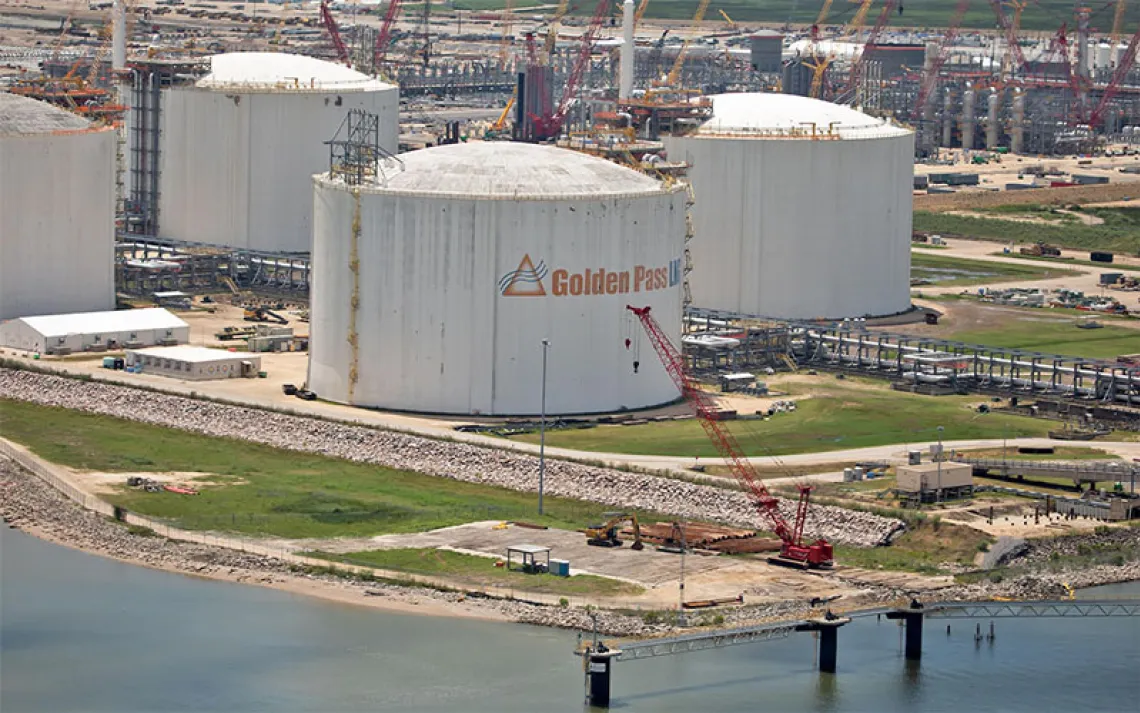
A view of CP1 in the foreground. CP2 will be built behind and next to it. | Photo by Julie Dermansky
The much-contested liquefied natural gas terminal Calcasieu Pass 2, or CP2, is one step closer to completion after the Department of Energy Secretary Chris Wright authorized exports to non-free-trade-agreement countries last month.
Green-lighting CP2 is just part of a flurry of LNG approvals from Wright. This marks his fifth liquefied natural gas approval since President Trump took office in January. Trump pledged to accelerate the rate of US LNG exports, which have already reached astonishing breadth and speed, even as they wreak havoc on surrounding communities, drive up domestic gas prices, and enrich investors abroad.
Venture Global envisions the massive, $28 billion CP2 terminal as a crown jewel of this buildout. The facility would join three existing LNG export terminals in Cameron Parish, Louisiana, and would emit the greenhouse gas equivalent of 51 coal-fired power plants per year.
But while Venture Global has made headlines for its explosive growth, it’s also been increasingly accused of dubious business practices. Even as Wright gave his approval, Louisiana officials were warning operators at CP2’s sister terminal, Calcasieu Pass, that it could be penalized for repeated emissions violations and constant flaring.
“Compliance history is abhorrent”
Just days before Secretary Wright approved CP2 for exports, the Louisiana Department of Environmental Quality (LDEQ) sent a 186-page document to Venture Global’s Calcasieu Pass LNG detailing numerous violations at the facility, along with a warning letter telling the company they must address the issues or face enforcement actions.
The letter details findings from unannounced inspections carried out by the EPA and LDEQ in December and January, before Trump took office. Violations include repeated excess emissions of nitrogen oxide and carbon monoxide, improper flaring, and other issues.
“How can the government continue to approve these permits when Venture Global’s compliance history is abhorrent?” wondered John Allaire, a retired engineer who lives across from Calcasieu Pass LNG, where he has documented its constant flaring. Allaire noted that Calcasieu Pass LNG also has a 165-page compliance order from 2023, which it still has not resolved.
Allaire is keenly aware of Calcasieu Pass LNG’s disregard of permits. His documentation of flaring helped build a case for Louisiana groups who recently filed a 60-day notice of intent to sue Venture Global over Calcasieu Pass LNG due to its repeated violations of the Clean Air Act—namely, discharging air pollutants beyond its permit limits, not reporting those violations, and excess flaring.
Commercial fishers and community members in Cameron Parish worry that CP2, functionally identical to Calcasieu Pass LNG, will only amplify the problems and pollution they’ve seen.
The Federal Energy Regulatory Commission authorized the construction and operation of CP2 LNG in June 2024. After, the Sierra Club and a broad coalition of community and environmental organizations filed a lawsuit against it. In response to a request for rehearing by those groups, in November, FERC set aside its approval to update the project’s cumulative air quality impacts and specified that no construction could occur until the federal agency had completed this analysis and reconsidered the project.
Largest LNG exporter on Earth
Venture Global’s CP2 has, in a sense, benefited from Russia’s invasion of Ukraine.
Once the war began, the EU—and Ukraine—began to turn away from Russian gas, searching for a new source. That allowed US LNG exporters to crack open the European market, and amid EU gas shortage fears, it’s helped turn Russia’s invasion of Ukraine into a tidy profit for US fossil fuel companies. In fact, CP2 has contracted with Ukraine’s largest private energy company, DTEK, to import LNG there, where it can be held in Ukraine’s gas storage tanks, the third-largest on Earth. At least 10 percent of CP2’s export capacity is contracted for Ukrainian DTEK.
Venture Global has also enjoyed a cozy relationship with the Trump administration. In March, Wright and Interior Secretary Doug Burgum visited Venture’s Plaquemines LNG terminal in Southeast Louisiana.
Before a massive American flag, Wright told a crowd of thousands of workers that “Louisiana is going to become a larger exporter of liquefied natural gas than any nation on Earth.” Venture Global alone has invested $75 billion worth of projects into Louisiana and has announced plans to make the Plaquemines terminal the largest in the country.
But while Wright praised Venture Global, evidence continues to mount that terminals like CP2 undermine American stability.
Multiple analyses, including one from the Biden administration in December, have found that LNG exports raise domestic gas prices, which have doubled since Trump’s election in November. And the buildout increasingly looks like a bubble set to burst: The International Energy Agency has found that LNG demand through 2050 can already be met by the projects operating today; the DOE study came to similar conclusions. The planned expansions, besides raising US gas prices, could also pose $2.3 billion in public health costs due to the increased pollution.
And despite the Trump administration’s support, the company’s stocks have plunged since going public in January. That’s partly due to another oil giant, the CEO of TotalEnergies, saying they wouldn’t deal with Venture due to a lack of trust, as Venture has been in adjudication with clients BP and Shell for not delivering on their contracts. That, in turn, has prompted a pending class action lawsuit by investors over securities fraud.
“Venture Global already has a terrible track record of managing and operating LNG export terminals in Louisiana,” said Sage Franz, an organizer with the Sunrise Movement’s New Orleans chapter. Franz said the impacts of Calcasieu Pass LNG have already done enormous damage to South Louisiana’s fishing and shrimping community, but that the company is only interested in maximizing short-term profit before the LNG bubble bursts. “It’s clear this company, from outside the state, has no stake in protecting the natural resources and communities it encroaches upon.”