This Natural Disaster Has Upended Life for Rural Alaskans
Storms like Typhoon Halong will only get worse as fossil fuel emissions continue to rise

A damaged home in Kipnuk, Alaska, on a stream bank after the remnants of Typhoon Halong caused widespread destruction in western Alaska on October 17. | Marc Lester/Anchorage Daily News via AP
Western Alaska has become the testing ground for America’s climate future—one where disasters are not distant hypotheticals but are present, repeated, and compounding. For residents in the region, the costs of climate change are no longer abstract; they’re measured in flooded homes, displaced families, and the reshaping of coastlines.
The most recent case in point is Typhoon Halong, which made landfall on Alaska’s western coast in mid-October. The storm’s surge pushed six and a half feet higher than the typical high tide in some towns. Houses floated off their foundations. Entire boardwalks, the wooden planks that serve as streets in these marshy, lowland villages, were twisted and tossed aside. Residents were rescued from rooftops.
At least 15 villages flooded across the Yukon-Kuskokwim Delta—an area roughly the size of Oregon, where the Yukon and Kuskokwim Rivers meet the Bering Sea. The villages of Kipnuk and Kwigillingok were hardest hit, with 90 percent and 35 percent of buildings destroyed, respectively. One person died, two remain missing, and in what Alaska Governor Mike Dunleavy called the largest humanitarian evacuation in state history, more than 650 people were airlifted to makeshift shelters in sports arenas and convention centers in the state capital, Anchorage, nearly 500 miles away.
In the aftermath, President Trump approved $25 million in federal disaster assistance. The funds will help cover debris removal, temporary housing, and emergency relief for individuals and small businesses—though it’ll cost far more for the estimated 2,000 displaced people to rebuild. And that’s if they want to return at all.
The front line of climate change
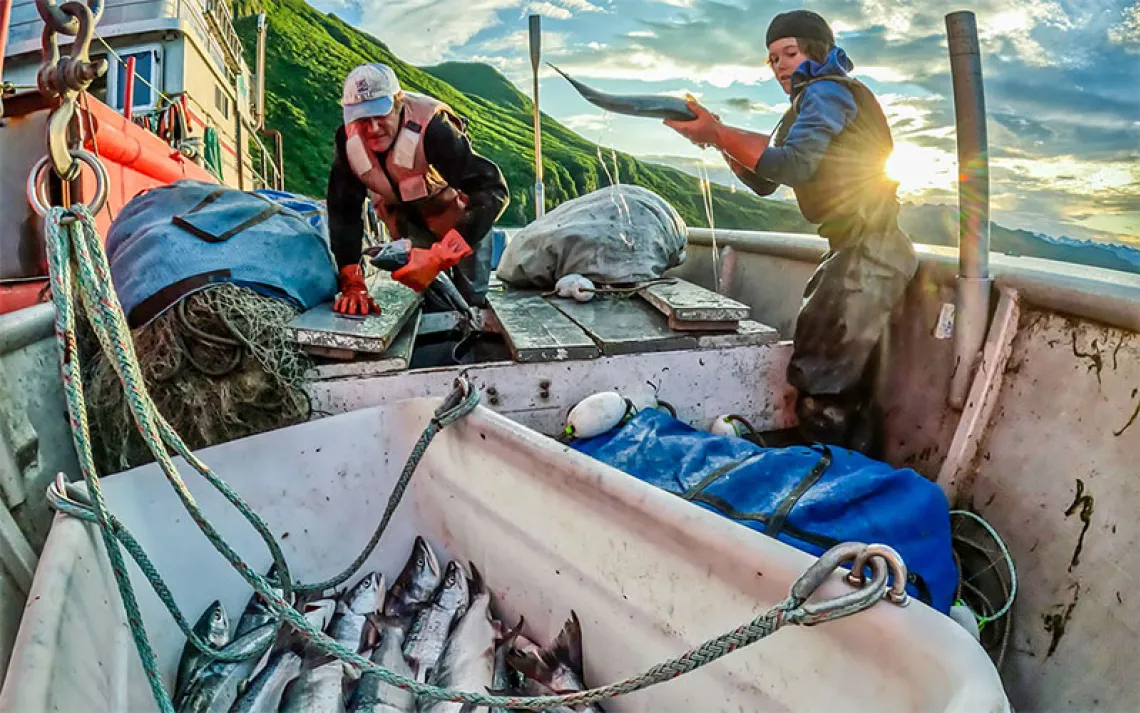
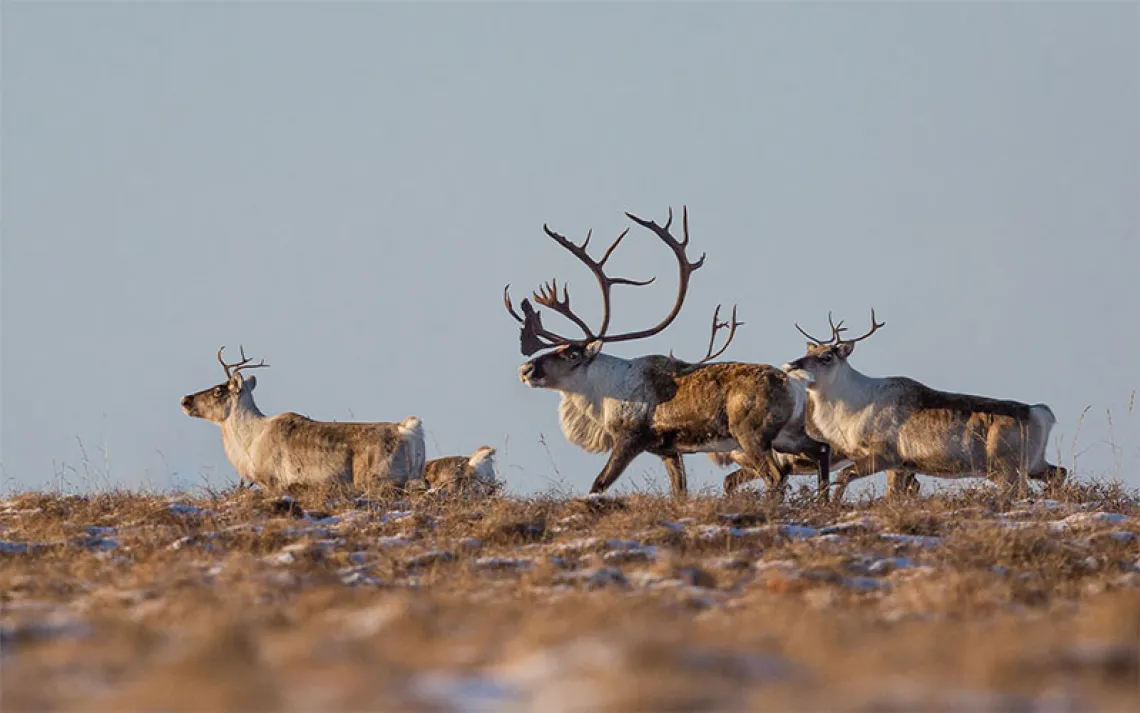
The Yukon–Kuskokwim Delta is one of the most remote regions in North America. Few of the villages are connected by road, and none are connected to the highway system; the only way in or out of the region is by plane or, during warmer months, by boat. Here, life often depends on what nature provides. Many families still live largely off the land and water—fishing for salmon, hunting seals, moose, and migratory birds, and gathering berries and plants during the short summer season. Though these communities contribute very little to global greenhouse gas emissions, they are bearing some of its most immediate consequences of climate change.
The storm underscored what scientists and Alaska Native leaders have warned for decades: Western Alaska is warming nearly four times faster than the global average. Less sea ice now forms each winter to act as a natural buffer against ocean storms. Meanwhile, thawing permafrost—ground consisting of soil, gravel, volcanic ash, and water that had stayed frozen for millennia—is melting and collapsing into something more like pudding. Locals even have a word for it: usteq, meaning “the sinking and crumbling of land.” When the permafrost thaws, it destabilizes everything: Homes lean, fuel tanks crack, rivers shift, and the land itself slides toward the sea. It’s a problem that further complicates rebuilding.
Governor Dunleavy has said that many of the displaced residents will not be able to return for at least 18 months. Winter is closing in quickly—Kipnuk’s temperature highs barely reach the mid-20s now, snow is already falling in some areas, and daylight is shortening by an average of five minutes a day until the Winter Solstice, when the community will see fewer than six hours of daylight.
“Remote Alaska has very little in common with, say, remote Montana,” said Rick Thoman, an Alaska and Arctic climate specialist at the Alaska Center for Climate Assessment and Policy. “All of the infrastructure is stand-alone. There is no electrical network grid there. Running water isn’t available to homes in some communities. Some don’t even get reliable radio reception from regional stations. . . . We can’t just run down to Lowe’s or Home Depot and purchase the supplies.”
Every nail, beam, and sheet of plywood must be flown in on small planes or shipped during the brief summer window when river ice melts and the coast is navigable. Even before the storm, it could take weeks for replacement parts to arrive for something as simple as a broken water pump. Now, with hundreds of homes destroyed and infrastructure wiped out, the logistical hurdles are immense.
A preventable disaster
For many in western Alaska, the recent flooding carries a sense of bitter irony. Local officials had long warned that without reinforcement, homes, boardwalks, power lines, and some hazardous materials could fall into the river. The Biden administration tried to offer support by awarding Kipnuk a $20 million federal grant to build erosion and flood protection along the Kugkaktlik River. The project was aimed at stabilizing the riverbank, safeguarding the village, and proactively preventing this kind of catastrophe.
However, five months ago, the Trump administration canceled a series of environmental grants for Alaska, including the project for Kipnuk. The administration framed the decision as an effort to eliminate “wasteful DEI spending.”
“This canceled grant likely wouldn’t have completed construction in time to mitigate the flooding damage we’re seeing now,” Senator Lisa Murkowski said in a statement. However, “this administration prioritizes lowering costs—but minimizing the impacts of a disaster like this before it occurs is far cheaper than rebuilding afterward, to say nothing of the toll these events take on people’s lives.”
Indeed, the newly approved disaster aid now exceeds the original grant that might have reduced future risk.
Halong is just the latest in a string of powerful Pacific storms to reach Alaska’s western coast. Since 2022, the region has been struck by three ex-typhoons. Thoman said these systems were once rare this far north—there weren’t any between 1980 and 2022.
“Oceans, like the atmosphere, are warming because of increased and accumulating greenhouse gas emissions,” Thoman explained, adding that those warmer temperatures have allowed certain storms to retain strength as they cross the Bering Sea.
The rapid loss of Arctic sea ice and thawing permafrost also reduces natural buffers against storm surge and coastal collapse. Satellite data show that late-summer Arctic ice extent has shrunk by more than 13 percent per decade, a trend driven by the increase of greenhouse gases from oil, gas, and coal. In Alaska, oil and gas extraction alone accounts for about 60 percent of the state’s total greenhouse gas emissions.
And now, over a thousand Americans, primarily from communities that have contributed the least to global emissions, have become climate change refugees.
The road from here
The path forward is agonizingly complex. For now, the focus is on survival. Alaska has airlifted hundreds of evacuees to nearby towns like Bethel (a predominantly Indigenous community hub) and then ultimately onward to Anchorage, where hotels and temporary shelters are providing warm beds and meals.
“Our preference is always to keep people as close to home and in as familiar surroundings as possible, but in this case, there were so many people that just was not possible for everyone to stay in the region, so we brought them to Anchorage,” said Jeremy Zidek, the public information officer at Alaska’s Division of Homeland Security and Emergency Management.
Anchorage city officials say they have identified more than 1,000 hotel rooms to house displaced families through the winter, though the state’s existing housing shortage will make long-term recovery difficult, and the logistics of feeding and caring for entire displaced villages during an Alaskan winter are staggering. Anchorage Mayor Suzanne LaFrance declared a city emergency to free up resources. “We are trying to make sure people have safe, warm places to stay,” she said, “but the scale of this crisis is unprecedented.”
Rebuilding in the delta will be a slow process. “Our focus now is doing the assessments that we can to get a clear picture of what needs to be repaired,” Zidek said. “At this point, we’re taking it day by day.”
At a press conference, Murkowski said, “We are seeing these storms coming . . . certainly on a more frequent basis, and the intensity that we're seeing seems to be accumulating as well, and so the time to act on it is now because it's going to take us some time to get these [erosion mitigation projects] in place.”
For now, entire communities must decide whether to rebuild in the same place they’ve hunted, gathered, and lived for generations—knowing another storm could wipe them out, especially if no mitigation projects pan out—or to move inland and risk losing cultural continuity.
Relocating is also staggeringly expensive. In recent years, a federally supported effort to move just 300 residents from one village, Newtok, nine miles inland to Mertarvik, cost more than $150 million. It was one of the first full-scale climate relocations in the United States, though other communities don't have the same funding availability. There are no easy options.
“They have a very intricate connection to this land,” Zidek said of the Yukon-Kuskokwim Delta locals. “And they want to be close to the food sources that are part of their traditions and their culture.”