 The Magazine of The Sierra Club
The Original Spirit of Memorial Day Is Under Threat
This is what’s at stake as the Trump administration tries to erase the histories of service members
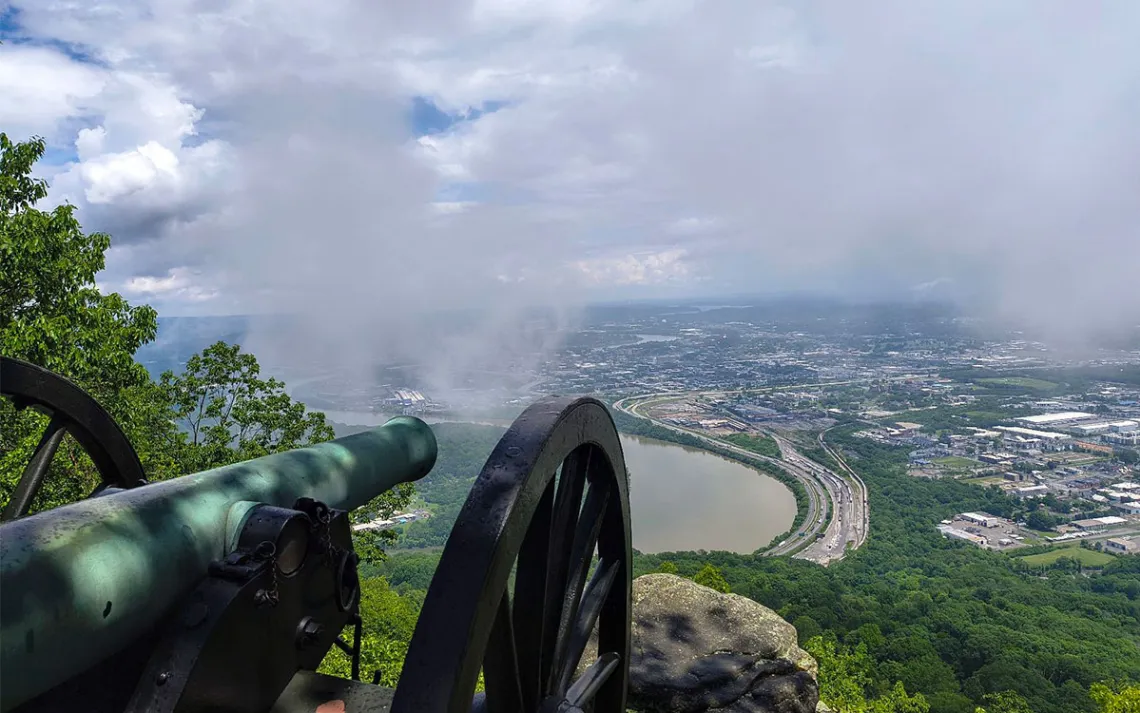
A Confederate cannon at Lookout Mountain Battlefield in Tennessee. | Photo by Sherman Neal II
Like many Black American families, my family's story begins in the South, where a system of racial oppression enslaved Black Americans for generations. However, during the Great Migration, my great-grandparents moved to Chicago. It wasn't until I got stationed in San Diego, California, as a young navy sailor in the early 2000s that I saw my first Confederate flag. It threw me off because California is one of the bluest states. Yet homes and businesses proudly flew the rebel flag in small towns, suburbs, and the backcountry.
What does this have to do with Memorial Day? Like with the Civil War, Confederate sympathizers have tried to erase and rewrite the original spirit of the holiday since its inception. That so many rebel flags fly in a Union state is directly tied to the events that followed the creation of Memorial Day.
The first time folks gathered for Memorial Day was in Charleston, South Carolina, on May 1, 1865. A group of freed slaves and white missionaries organized to honor the Union soldiers buried in unmarked graves at a former planter’s racetrack. Unfortunately, some historians, scholars, and even leaders have forgotten, ignored, or tried to erase this history. This erasure includes attacking diversity, equity, and inclusion (DEI) efforts and programs within governmental agencies, nonprofit organizations, and the private sector.
In March, Defense Secretary Pete Hegseth ordered pages from the Pentagon's website honoring a Black Medal of Honor recipient and a unit comprised of Japanese American service members to be deleted. Following a backlash, the Pentagon claimed it was a mistake and uploaded the pages back to its website. The US Army and Navy came under fire in February 2025 when they removed pages from the military branches’ websites honoring women veterans at the behest of Secretary Hegseth. After public outrage, they reinstated those web pages.
This type of erasure is a direct policy of the Trump administration. Here’s what the Military Times reported after some of the pages were removed.
“On the eve of Black History Month, Defense Secretary Pete Hegseth declared 'Identity Months' dead at the Defense Department and 'that DoD Components and Military Departments will not use official resources, to include man-hours, to host celebrations or events related to cultural awareness months, including National African American/Black History Month, Women’s History Month … Pride Month.'”
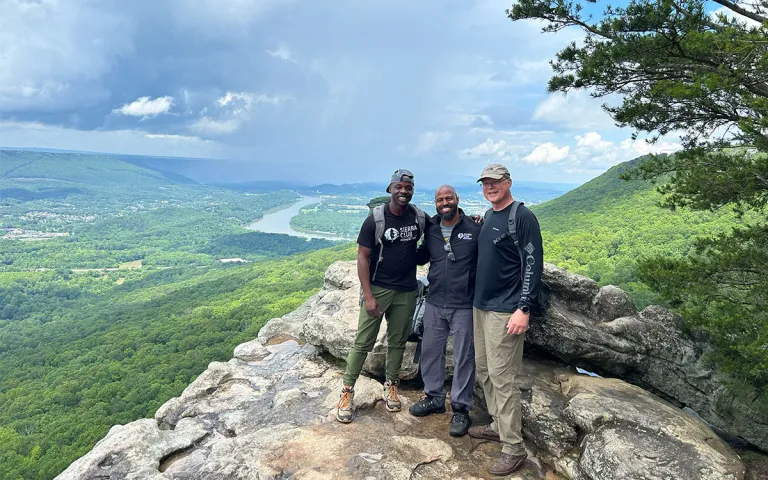
From left, hiking at Lookout Mountain Battlefield in Tennessee: Sherman Neal II, the deputy director of the Sierra Club Military Outdoors program and a US Marine Corps veteran; Lornett Vestal, the senior campaign representative of Sierra Club's Military Outdoors and a naval veteran; and Kris Poppe, a Tennessee Chapter volunteer and army veteran.
The campaign to remove people from history is not new. It started during Reconstruction, after the Civil War. In the Jim Crow era, organizations like the Daughters of the Confederacy fought and advocated for whitewashing the violent acts committed by the Confederacy as a direct rebuke to the newly formed freedoms granted to Black people. The first wave of Confederate monuments arose between 1890 and 1900, well after the Confederacy lost the war, to remind freed Black people of their second-class-citizen status.
The second wave of Confederate monuments and flags were built during the civil rights era from 1954 to 1965. These monuments popped up primarily in the South but can also be seen nationwide. The resurgence of the Confederacy was not in remembrance of our collective Civil War. Instead, it was intended to keep white supremacy alive.
Various elected state legislators and advocacy groups placed many of these Confederate monuments on public lands across the United States. Places like Stone Mountain Park in Georgia and many of our national parks have Confederate monuments in them. The Stone Mountain Action Coalition, an advocacy group in Georgia, once highlighted how state actors lionize the Confederacy in public spaces.
“The Georgia Legislature established the (Stone Mountain) Park and legally required it to serve as a Confederate memorial in defiance of the Supreme Court’s Brown v. Board of Education decision ending school segregation,” the group writes on its website. “The Park is legally required to sell Confederate memorabilia in their gift shop (Walmart, Amazon, and eBay have banned the sale of such items). ”
There’s a difference between understanding history and glorifying it. Stone Mountain Park is a state park that’s privately operated and celebrates the Confederacy—the same Confederacy that declared war on the United States to maintain the enslavement of Black bodies. No Civil War battle took place at this site. Rather, this is a form of rewriting history so that these leaders appear noble and dignified when their actions proved otherwise.
In his second term, President Trump and his administration are championing the renaming of public lands after Confederate generals and soldiers and calling to maintain Confederate monuments across the country.
Trump administration funding cuts and attacks on diversity, equity, and inclusion threaten to erase the history of the Buffalo Soldiers in Houston. Following Trump’s March 2025 executive orders, Arlington National Cemetery is scrubbing its website for any mention of DEI. The removal of materials highlighting the achievements of Black, Latino, and female-identified veterans has prompted concern from a noted Civil War historian and educator, Kevin M. Levin. The Trump administration’s attack on DEI also resulted in the erasure of Indigenous war heroes, from Ira Hayes to Lori Piestewa. The act of removing and erasing the achievements of Black, brown, queer, and female-identified veterans is a dishonor to all who served. That includes the formerly enslaved Black Americans and the white missionaries who helped to establish Memorial Day—their stories, their sacrifices, erased and forgotten, leaving a bitter taste of injustice.
Service members have come from every background and culture, across eras, from the Revolutionary War to the War on Terror. When I was a 17-year-old swearing into the armed forces, like every service member before and after me, I took an oath that I would support and defend the Constitution. We took an oath to protect our country, not a particular president, political party, or faction that warred with the nation to maintain a system of slavery and oppression. The history of the Confederacy has a place in museums and war memorials celebrating its defeat.
Instead of celebrating the Confederacy, our government and political leaders should uplift the commitment to protecting and honoring all citizens, no matter their race, creed, gender, sexuality, or ability.
Having spent the last decade traveling and working across the Deep South, I've appreciated its distinct character. Georgia includes Atlanta, an economic powerhouse and source of Southern pride. Meanwhile, states like Texas and Florida are some of the fastest growing in the nation. The love for this region is understandable, given its natural beauty, culinary delights, vibrant music scene, and diverse cultures stretching from the swamps of southern Arkansas to the mountains of Virginia.
However, the reverence for the Confederacy is unconscionable. Acknowledging this history is crucial. I believe my fellow Southerners would concur that our public spaces should not become monuments to the Confederacy. The Confederacy belongs to the past, a past that the original Memorial Day should have firmly laid to rest.