 The Magazine of The Sierra Club
Running Has a Waste Problem
Fortunately, sustainable alternatives like reusable cups are picking up speed
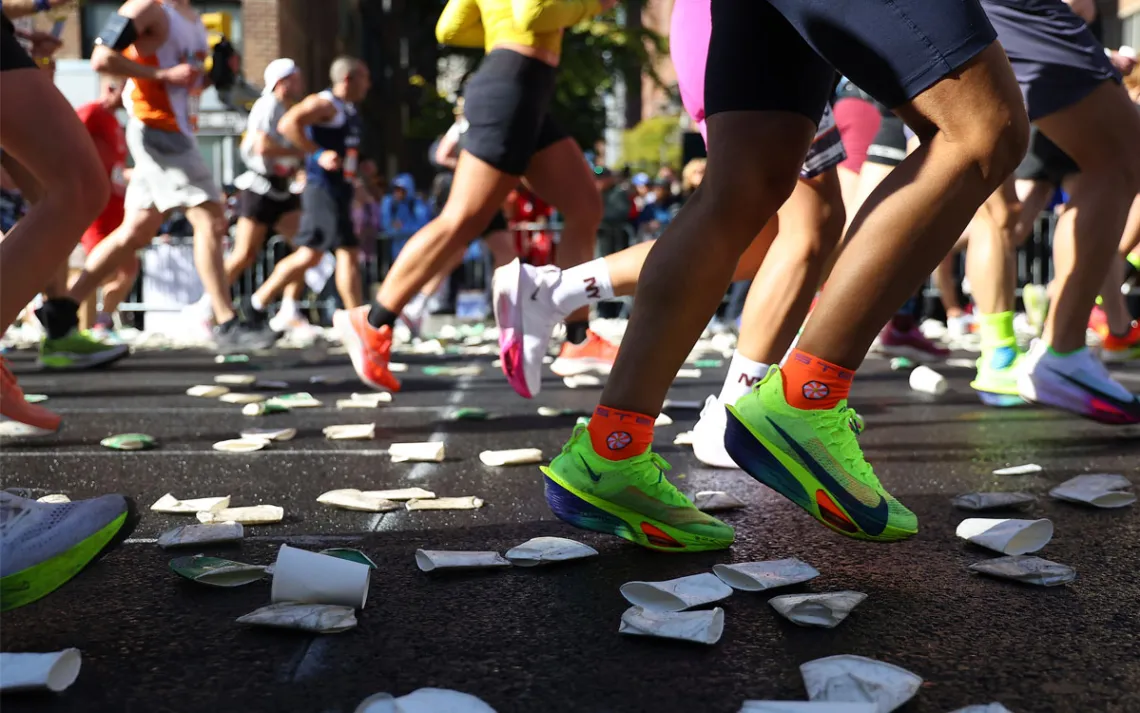
Photo by Gordon Donovan/NurPhoto via AP
Genevieve Belmonte ran her first full marathon last spring, joining tens of thousands of runners on the Champs-Élysées for the Paris Marathon. She had run shorter races before and was well accustomed to the typical flow of the on-course aid stations: Grab a small, disposable paper or plastic cup from a folding table or the outstretched hand of a volunteer, chug down the contents, and toss the cup somewhere along the route.
At this race, however, things looked a little different. The 2026 Paris Marathon was the first major road marathon to eliminate single-use cups along the course, tackling a long-standing waste problem in running. A midsize race of 9,000 runners includes an estimated 150,000 disposable cups, and Paris drew nearly 60,000 participants this year. These cups are often made from virgin materials, and most standard paper cups are lined with fossil-fuel-derived plastics, which decompose slowly in landfills and release microplastics into the environment.
Instead, Paris runners were provided with a hydration vest and a HydraPak SpeedCup: a collapsible cup, with a small finger loop, that can squish down to fit into a pocket, sports bra, or waistband and be refilled at stations along the course. Belmonte said she was skeptical about the cupless nature of the race at first but ultimately wasn’t bothered by the change. She also noted that the course was much cleaner without crushed cups strewn about, and the hoselike refill spouts were fairly easy to use.
“It’s kind of like a soda machine,” says Jennifer Krupey, vice president of marketing and e-commerce at HydraPak. Runners choose a spout, press their cup against it, and can refill in just two seconds.
The trail-running community inspired this new approach to hydration, says Krupey. Trail runners have always carried their own hydration for long stretches without aid stations, and road-race organizers took note. Companies like WaterMonster and Culligan have begun making refill stations with many spouts and dispensers to be utilized during races.
Their work is part of a larger push toward sustainability in the running world. Kat Phelan is a board member with the Council for Responsible Sport, formed in 2007 to measure the social and environmental impacts of major athletic events. “We're all very passionate about the world we live in and the sports that we play,” said Phelan of the organization, whose main focus is a certification program. Sporting events can earn a tiered certification by amassing credits across different categories. The council looks at waste—supply chains, the materials of disposable products, waste streams, and whether participants can opt out of T-shirts and medals, for example—but also at the implications of bringing thousands of athletes into public spaces, the transportation and carbon emissions involved in getting them there, and the impact on the community during and after the event.
New York City is one such place where events can have a very high impact. Nearly 60,000 runners flocked to the city for the 2025 TCS New York City Marathon, one of the Abbott World Marathon Majors. The marathon is one of more than 60 races put on by the nonprofit organization New York Road Runners every year. “We're steeped in tradition and quality and having incredible runner experience,” says Aly Criscuolo, head of sustainability and corporate social responsibility. That reputation can be a challenge for sustainability efforts. There is less room to test new approaches, like the elimination of single-use cups. “It has to be 100 percent quality and 100 percent sustainable.”
The organization debuted water refill stations on the course at the Maybelline Women’s Half in April, but runners could still grab compostable cups, which were collected and brought to a local farm afterward. Criscuolo said that it gave people the opportunity to test out a new system, and the feedback was overwhelmingly positive. “We really wanted to make sure that it was seamless on the runner and not too much of a change to normal operations.” At a few events last year, New York Road Runners also worked with Cup Zero, a company that provides reusable cups at aid stations. After runners toss them along the course, the cups are collected and brought back to a facility to be washed. At this point, said Criscuolo, it’s all about seeing what works. “With such a huge operation, we need to diversify, test a lot of things, and have a lot of options.”
Trail runners have always carried their own hydration for long stretches without aid stations, and road-race organizers took note.
Eliminating disposable cups is still contentious among runners.
“I could see if somebody was going for time, how it could be an issue,” said Belmonte. Instead of slowing down and grabbing a cup from the outstretched hand of a volunteer, runners at the Paris Marathon had to stop, fill their cup, replace the lid, and keep going. That time can be precious for highly competitive runners—a few lost seconds could make a difference. Elite runners aiming for a sub-2:50 were the only exception in Paris; they could grab prefilled, reusable water bottles and drop them off at designated locations along the course. Although the brief stop-and-go didn’t feel like a big deal to Belmonte, she could tell from some facial expressions that not everyone was a fan of the system.
Sustainabililty advocates like Krupey believe runners will adjust and come around to the idea. "If everyone switches to that model," she said, "then everyone's PRs [personal records] are going to be on the same baseline."
Muir, who wears skirts made of runner trash during road races to make a point, knows better than anyone that every second counts. She’s a sustainability advocate, professional runner, and founder of the environmental nonprofit Racing for Sustainability, working with some of the biggest races in the world and supporting smaller races with their sustainability efforts.
Muir has made it a goal to show runners that it’s possible to reach your time goals without creating more waste. She ran a 2:54 marathon in London this year, refilling her bottle the whole way. She said the average time spent at a refill station at the Bank of America Chicago 13.1 was nine seconds—and if that nine seconds can keep you hydrated for a longer stretch, it might even save you time. Racing for Sustainability is trying to show that these changes can help the runner experience and make events safer, especially with record-high temperatures making proper hydration more important than ever.
The research backs up Muir’s outlook. Crowd-dynamics expert Marcel Altenberg conducted a study with HydraPak using data from the 2024 and 2025 La Jolla Half Marathons, which used WaterMonster refill stations. They found that the system could serve 250 runners per minute and that it lowered wait times for water—and each spout use meant two fewer volunteers were needed per aid station.
Many in the industry are hopeful that change is possible. “I think they demonstrated that this refill model can work,” said Krupey, referring to the Paris Marathon. “Was it without hiccups? No. I think it demonstrated that at large-scale races, refill can be executed and effective.” Races (and their waste) are continuing to grow as running experiences a boom in popularity; more than 1.1 million people applied in the public ballot for the 2026 TCS London Marathon, nearly doubling the applications for 2024. Phelan thinks that sport will always be one of the greatest areas for change, including sustainability. “It's about making a positive shift in something that they already love and making it even better without taking away from the elements that they love.”
Muir also feels hopeful about the future. She sees her work in sustainability as similar to her work as a runner. “There's a lot of moments where it feels difficult to keep going. You're not sure you can make it. You're not sure it's going to come together.” She believes that running—a sport full of people who want to push themselves to accomplish things—naturally lends itself to people who believe that the world can progress in a positive way. “I really feel like the two can go hand in hand.”