 The Magazine of The Sierra Club
“There Will Be Impacts”: Brazil's COP30 Preparations Are Already Harming Critical Ecosystems
Local experts worry that infrastructure is coming online too quickly, threatening hundreds of plant and animal species
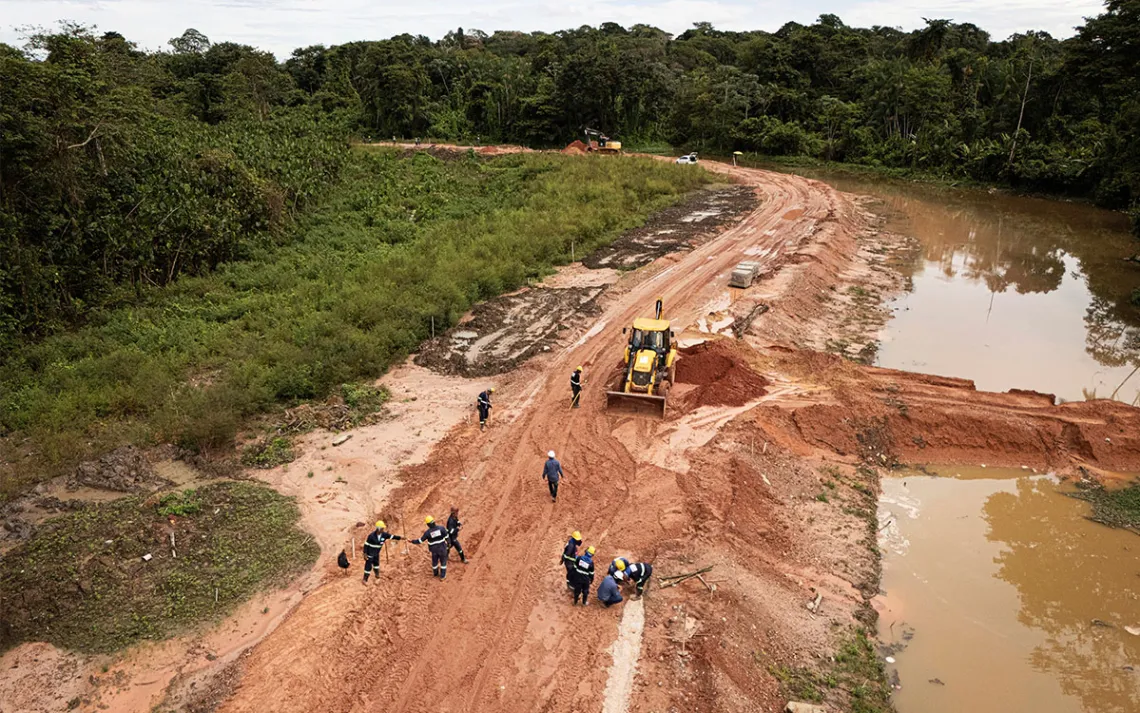
Workers construct an expressway called Avenida Liberdade ("Freedom Avenue") ahead of COP30 in Belém, Brazil, on March 18, 2025. | Photo by Jorge Saenz/AP
Avenida Liberdade (“Freedom Avenue”) took one of its first victims months before its planned completion.
A construction worker was using a tractor to fell trees just outside Belém, a major metropolitan area in Brazil’s Amazon rainforest, to make way for the new expressway when the machine ran over an armadillo. The ground-dwelling mammal’s camouflaging, tile-shaped bony plates and ability to curl into a tight ball offer it protection from the jaguars, maned wolves, and crocodiles that usually cross its path. But these defenses were no match for the heavy machinery churning up its habitat that day.
Once the high-speed highway is complete, vehicles traveling on it will bring a slew of new threats to the flora and fauna that call this 8.3-mile stretch of forest home. In November, Belém will host COP30, the United Nations’ annual global climate summit that will host some 50,000 to 60,000 world leaders, scientists, representatives of NGOs, and members of civil society over 12 days. The construction of this four-lane thoroughfare, complete with wide shoulders and bike lanes on either side, is meant to alleviate the already heavily congested traffic entering and exiting the city ahead of the upcoming international climate summit. It is among dozens of similar infrastructure projects in progress now.
“When these projects are in some way presented as being for COP30, it becomes very difficult for civil society—especially those who are most impacted by what’s happening—to question or oppose them.”
These projects have left experts and environmentalists perplexed and concerned. Hosting COP30 in the heart of a region whose protection is crucial to mitigating global climate change is an opportunity to create a legacy of conservation. Instead, the development preceding the event could cause more harm than good, leaving a trail of destruction in the world’s largest rainforest.
When the UN chose Belém to host COP30 in 2023, concerns from experts and local nonprofits related to its preparedness abounded. The city, located in the southeastern corner of the Amazon in the state of Pará, already struggles to provide its 1.3 million residents with basic necessities (more than 59 percent of the population does not have access to the city’s sewage system, according to Brazilian census agency IBGE). With six months to go before the event, the city is still so severely lacking in accommodations that some hotels have waitlists of 1,000 people per bed. The Federal Revenue Agency building, public schools, and cruise ships are being transformed into temporary lodgings.
In an attempt to improve conditions for visitors during COP30, at least 38 infrastructure projects in Belém have been planned specifically for the summit, including new lodging, improvements to the city’s sewage system, and expansions of some of its roadways. And experts are worried about as many as 60 additional projects happening in and around the Amazonian city. Several, like Avenida Liberdade, are not directly linked to the planning of COP30, but because of the upcoming event, officials gave them a boost in resources or, sometimes even more significantly, in importance.
“The COP ends up acting as a major catalyst for projects in the city, which is what is happening with Avenida Liberdade,” said Tiago Santos, a geographer at the Federal Institute of Pará (IFPA) and member of the COP30 Observatory, a group of some 40 researchers monitoring the environmental and social impacts of the megaevent. “When these projects are in some way presented as being for COP30, it becomes very difficult for civil society—especially those who are most impacted by what’s happening—to question or oppose them.”
Avenida Liberdade, Santos said, is one of the most environmentally concerning projects that officials are pushing to completion ahead of the climate summit, a worrying speed for such a large project, particularly because of the need to carefully study its potential effects on the environment and how to properly carry out mitigation methods. While plans for the road started in 2020, construction began in June 2024, and the governor of Pará, Helder Barbalho, has promised it will be ready by November.
The expressway will make its way through several municipalities, slicing through the Belém Metropolitan Environmental Protection Area (APA) along the way. The conservation unit is meant to protect biodiversity in an area just over 18,500 acres, while allowing limited, sustainable use of natural resources under specific rules laid out by the Pará state government.
According to the environmental impact study of Avenida Liberdade, the highway will cross the Murutucu and Aurá rivers, as well as the Pau Grande creek, all tributaries of the Guamá river in the APA. It will also run about 500 yards from the Utinga State Park, which alone is home to roughly 151 plant and 330 animal species. For the fauna in the area, that could mean collisions with vehicles. It’s a problem on high-speed roadways across Brazil, including the BR-262—also known as the Highway of Death—which registers 3,000 animal deaths a year.
Pará’s state secretary of infrastructure and logistics, Adler Silveira, said just two months after construction of the road started last year that Avenida Liberdade would be “completely fenced in to protect the native vegetation, maintaining the preservation of the surrounding ecosystem, preventing users from accessing regions bordering the highway.”
But isolating sections of the forest like this can modify the border of where it grows, making it harder for flora, and the fauna that depend on it, to survive. Another concern not listed in the environmental impact study is the new highway’s proximity to the Federal Rural University of Amazônia (UFRA). Clearing for the portion of the highway that will run some 100 feet behind the UFRA campus took off early this year, causing concern for employees like Ana Sílvia Ribeiro, who teaches veterinary medicine and treats animals at the public institution’s Wildlife Triage and Rehabilitation Center.
Ribeiro remembers five pregnant sloths being transferred to other areas of the forest when the trees they were living in were set to come down to make way for the highway. Many of the animals treated at the rehab center—mammals, birds, reptiles, and aquatic species among them—are released back into the wild once they’ve recovered from their injuries, but the presence of the construction site has already made Ribeiro and her colleagues rethink reintroducing them into the rainforest in areas that they once considered safe.
For now, releases near the university have been suspended. Ribeiro and her colleagues now rely on the government’s environmental agents to pick up the rehabilitated animals and release them in sometimes distant areas of the rainforest, depending on the environmental and ecosystem needs of the species.
The soon-to-be-inaugurated expressway has also led the veterinary team to worry that the rehab center will receive more injured patients due to collisions with vehicles. Experts say one of the best ways to keep animals off roads are aerial, terrestrial, and arboreal fauna passages. These are built with the specifications of each region’s wildlife in mind and use strategically placed fencing that can’t be broken, climbed over, or dug under to guide animals for safe crossing. (Silveira, who did not respond to requests for comment, had previously said there would be 34 fauna passages along Avenida Liberdade, but provided no specifics about them.)
Fernanda Abra, a biologist specializing in the ecology of roads and a cofounder of environmental consultancy firm ViaFauna, said that while collisions are a major concern when it comes to roads and animals, so is the fragmentation of their habitats, which can leave them without access to areas necessary to hunt, forage, and breed.
“When individuals of a species stop crossing the area where a highway is built, we see a fragmentation effect and population isolation,” Abra said. “It’s especially a problem with animals that are strictly arboreal, like howler monkeys and spider monkeys, which need connection at the forest-canopy level to move around.”
Avenida Liberdade will run about 500 yards from the Utinga State Park, which alone is home to roughly 151 plant and 330 animal species.
Since construction of Avenida Liberdade began, Ribeiro has already noticed some strange movements from the animal populations living around UFRA, including monkeys, coati, and armadillos—like the one killed by the tree-felling tractor.
“It’s something we shouldn’t be seeing and that we’ll have to monitor closely,” she said. “The armadillos should be deeper in the forest, but they’ve moved to its border and are more exposed.”
That visibility could also make armadillos more vulnerable to poachers and traffickers who are already roaming the region in search of sought-after species, many of which are endangered.
For Ribeiro, the crux of the issue, and what has led to this series of trickle-down worries, is a lack of transparency. While government documents about projects like Avenida Liberdade are made available to the public, they are light on details. “We knew trees would be cleared for construction of the road, but not when the process would start and stop,” she said. And there has been no opportunity for dialogue in order to better understand them.
“We know Belém needs to be expanded and needs to be updated, but not like this,” said Ribeiro. “Why not take the time to talk with the people who work with the forest every day? We could find a better way, and one that takes less of a toll. Because no matter what, we know there will be impacts.”