
What Comes Next After Texas Hill Country’s Deadly Flood?
The long road to recovery will be complicated as federal officials dismantle emergency management policy
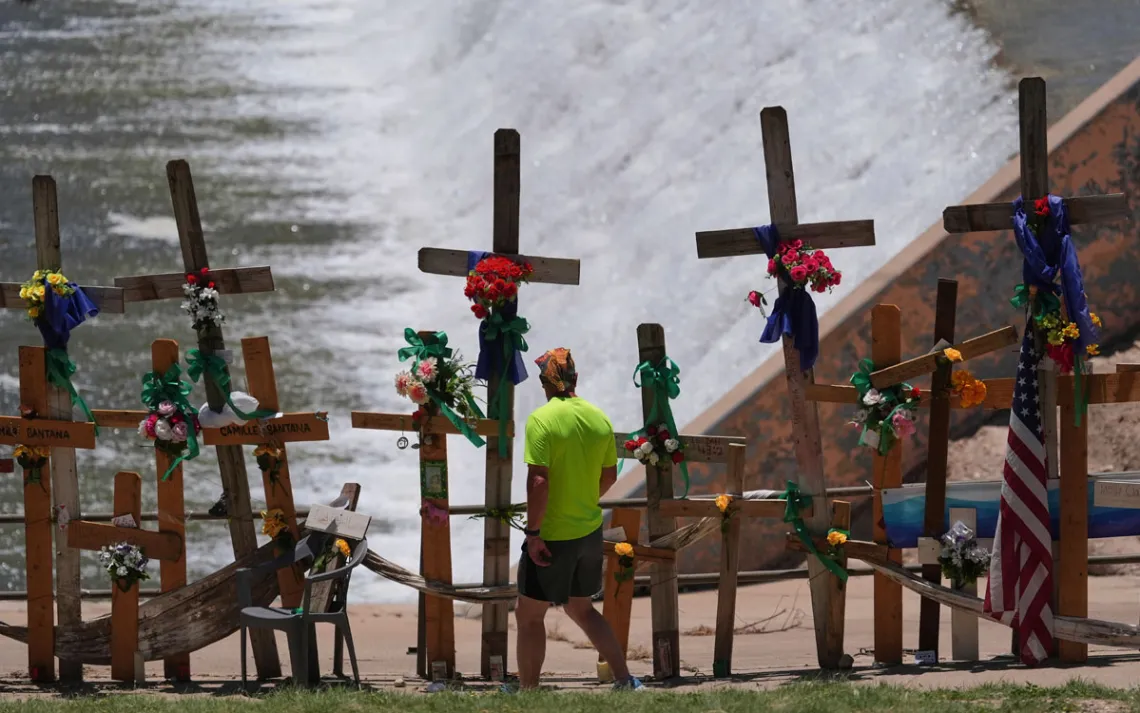
A memorial along the Guadalupe River in Texas on July 31, 2025. | Eric Gay/AP Photo
As the July 4 central Texas floodwaters receded, the horrors started to set in. Landowners in the rural, hilly region along the Guadalupe River began finding human limbs ripped apart by the violent waters. At a public hearing convened by the state legislature, neighbors recounted driving on dangerous roads to help evacuate and rescue people as they waited for help.
By the end of the month, the official death toll of the floods climbed to 138 people—higher than that of Hurricane Harvey, a Category 4 storm that devastated Houston and southeast Texas in 2017. At least 27 girls, sent off to summer camp on the banks of the Guadalupe, were swept away by the rising floodwaters. Some parents still haven’t recovered the bodies of their missing children.
Now, Hill Country residents face the monumental task of rebuilding their homes and returning to some semblance of normal. It will take months, if not years, for the destruction left in the wake of the floods to fade away. But the process may be an indicator of what’s to come, as the current administration reduces the Federal Emergency Management Agency’s capacity and hints at pushing the entire response and recovery process onto local governments.
So far, hundreds of FEMA employees have been fired over the past year, and others have been offered reassignments to Immigration and Customs Enforcement, which is ramping up violent raids in communities across the country. In late August, dozens of FEMA employees were suspended after signing a letter that criticized the administration’s approach to disaster recovery and funding.
More than a month after the floods, the lack of boots on the ground is noticeable, disaster recovery advocates say. Kristi Noem, the secretary of Homeland Security, delayed search-and-rescue teams from deploying to Texas for three days as she personally reviewed funding requests. Emergency call centers were unstaffed, and survivors’ calls went unanswered.
“One thing we used to see after disasters is that FEMA would go door to door in a disaster declaration area and check on survivors, and make sure they’ve applied for aid on time, and they get information about appeals,” Brittanny Gomez, an attorney with Texas RioGrande Legal Aid, said. “But FEMA is no longer doing that.” In rural areas, where cell service is spotty on good days, this has been crucial to getting survivors connected to help.
Further complicating matters, FEMA recently shuttered two of its seven disaster recovery centers, where survivors could go to find in-person help with aid applications and other assistance programs like housing and rental assistance.
“It’s concerning to me that foot traffic was low enough that FEMA’s like, ‘It’s not worth keeping this open,’” she said. It’s not necessarily an indicator that people don’t need help, but rather that there might be difficulties in accessing the centers, she added. In the outskirts of Travis County, for example, survivors told TRLA that they couldn’t find reliable transportation to the recovery center in Leander, a northwest Austin suburb. That center closed in mid-August, nearly three weeks before the aid application deadline.
During previous disasters, FEMA’s long-standing partnership with the American Bar Association provided legal aid lawyers like Gomez with some level of transparency and access to the agency’s regional staff. In March, the agency paused the partnership and froze all funding for the program, which had allowed pro bono lawyers to help survivors navigate the complex FEMA aid process. “You were able to get on weekly calls with FEMA reps and regional liaisons and ask them, ‘What’s going on? We’re hearing disaster recovery centers are closing,’” Gomez said. Now, legal aid staff and other advocates are finding out in real time, with their clients, about major changes or updates to FEMA’s programs.
Even disaster survivors who were able to navigate the aid application process might now find themselves stuck in limbo. So far, nearly 8,000 households have applied for aid, according to public data. “They’re registering with FEMA, but those applications aren’t being processed further,” said Maddie Sloan, the director of the disaster recovery and fair housing project at the research and advocacy organization Texas Appleseed. “Folks aren’t getting a denial letter, but they’re also not getting approved.”
Appleseed created a dashboard that tracks publicly available information on FEMA applications from the region. So far, only 40 percent of applications have been approved. In some counties, like Kerr County, that rate has dipped to 18 percent. “People may not even know if their applications are being processed, but we don’t know why that’s happening,” Sloan said.
This short-term FEMA assistance is typically meant to help homeowners repair homes so that they’re safe to live in—gutting moldy walls and floors, for example. According to Appleseed’s database, most homeowners who applied for aid did not have property insurance. Only 3 percent had a flood insurance policy. More than half reported making less than $60,000 a year.
Cash-strapped households often find themselves taking on debt just to move their belongings to storage while they rip out moldy drywall and flooring themselves, said Zoe Middleton, an associate policy director at the Union of Concerned Scientists.
Those costs don’t begin to factor in more expensive mitigation measures, like elevating homes in flood plains to prevent future floods. Typically, that’s where longer-term funding, like Community Development Block Grants, might help survivors access funds to rebuild homes—funds that Congress appropriates months or even years after a disaster. Recovery funds for disasters in 2023, for example, weren’t approved until late 2024.
These long delays can create conditions ripe for displacement and climate gentrification. In Hawai'i, where devastating wildfires hit in 2023, Honolulu Civil Beat reports that a third of all homeowners before the fire no longer own their properties. “Housing markets move fast, and private investment and capital flow quickly in the intervening time,” Middleton said. If a resident can’t pay their mortgage, private equity firms are poised to swoop in and flip homes, reselling them for a premium. Hill Country residents expressed that fear in the public hearings just weeks after the floods.
“The longer people have to wait for help, and the less help they get, the more likely it is that they will be permanently displaced,” Sloan said.
Under the current administration, it’s also an open question of whether, and how much, long-term federal funding will come down the pipeline at all. In recent months, FEMA has rolled back its hazard-mitigation programs—including funds that were already approved but not yet distributed. Trump has attempted to rescind the Building Resilient Infrastructure and Communities (BRIC) program, which he had signed into law during his first term. That grant, along with the Flood Mitigation Assistance fund, which has been around since the 1990s, funded proactive projects ranging from basic flood control upgrades to property buyouts in flood zones.
According to the Urban Institute, a policy research organization, canceling just these two grants could equate to $3.3 billion of lost funding for climate resilience. The institute’s analysis finds that Texas stands to lose $74 million in BRIC funding that had already been approved. Without federal support, Texas’s entire emergency management system could fall apart at the seams. Local fire departments and emergency management training are funded by federal dollars, for example.
Cities and counties often receive matching funds from FEMA to build crucial infrastructure and climate resilience projects that might otherwise never get built, ranging from drainage improvements to developing hazard mitigation plans. In Kerr County, local officials were denied FEMA grants for upgrading an aging flash flood siren system precisely because they lacked such a plan.
“We need to get every county—big or small—ready for extreme weather,” Middleton said. “There should be reliable mechanisms in place for funding and supporting resilience and mitigation.”
The state’s current Republican governor, Greg Abbott, has not signaled a willingness to expand state funding to support disaster survivors, advocates say. Since 2021, over $177 million of taxpayer funds have been diverted to Operation Lone Star, the governor's push to secure the state’s southern border; he secured another $12 billion in federal reimbursements through the Trump administration’s signature budget bill this year.
In the weeks after the flood, Abbott attended private benefit concerts, posing for photos as he handed flood survivors $25,000 checks.
Abbott has also called a special session to address the flooding, but tied it to passing new district maps that would increase Republicans’ hold on congressional seats. “You see a willingness to use disasters as a political wedge, a way to exert control rather than honor a duty of care,” Middleton said.
In early 2025, the Biden administration’s Department of Housing and Urban Development determined that the state government’s previous allocations of Harvey recovery funds discriminated against communities of color and urban areas impacted by Harvey and favored wealthier, whiter, and rural counties that had sustained less damage during the hurricane.
Abbott’s cozy relationship with Trump may have softened the blow for ordinary Texans, allowing some federal resources to still flow to the state. An analysis by KUOW, in Seattle, found that 10 states with Democratic governors have asked for disaster declarations to access federal aid. Trump has denied six of those requests. Meanwhile, 14 out of 15 Republican governors’ disaster declaration requests have been approved.
In Maryland, flash floods in May destroyed more than 200 homes and damaged public utilities and roads. The administration denied the state’s request for assistance, even as damage estimates topped $15 million.
“It should be an open-and-shut case that everyone gets to recover,” Middleton said. “But we’re really, really far away from that.”