 The Magazine of The Sierra Club
What Will Happen if Republicans Revoke California’s Clean Air Act Waiver?
The move could mean more tailpipe pollution with worsening public health and climate change impacts
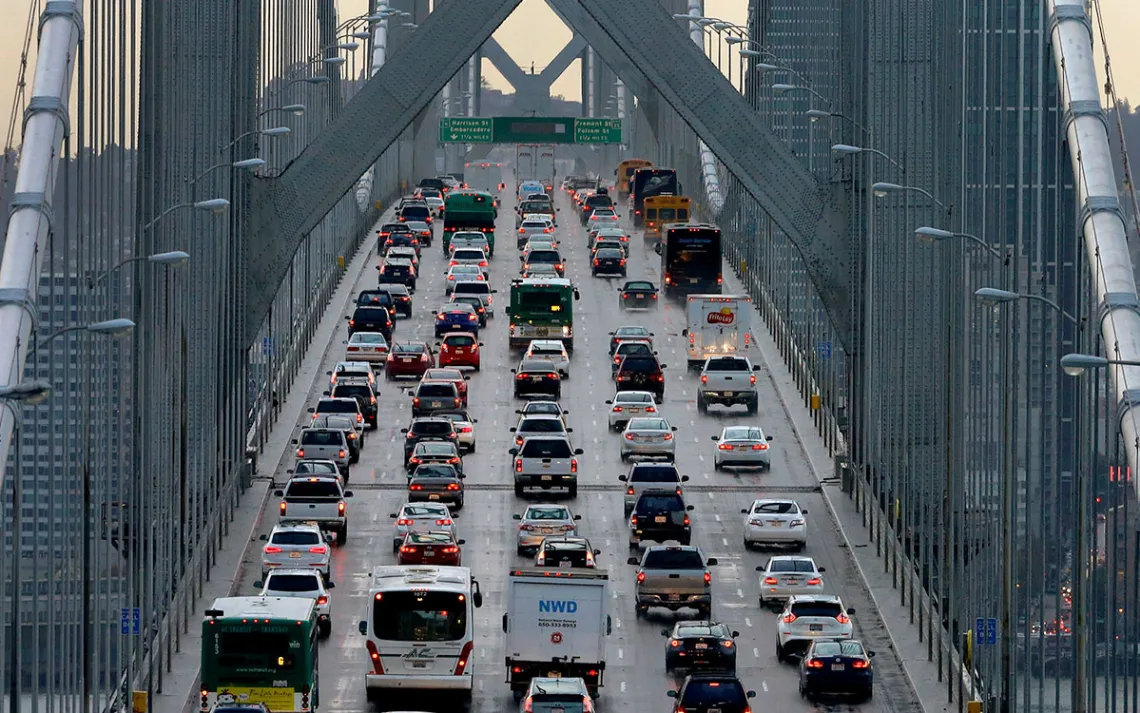
Photo by Ben Margot/AP File
For more than 50 years, the federal Clean Air Act has granted California special authority to set tailpipe standards that are stricter than federal ones, since the Golden State has historically been choked by smog and other toxic air pollution. Under the statute, California can request permission from the Environmental Protection Agency—called a waiver—to do so, and over the decades the state has received over 100 of these waivers to set its own rules for vehicle tailpipe emissions. The waivers have typically not been controversial and Congress has never taken action to challenge them—until now.
Last month, in what experts say is an unprecedented and illegal move, Congress voted to pass resolutions yanking California’s waivers granted by the EPA under the Biden administration. The waivers applied to three rules that the California Air Resources Board had established to curb pollution from cars and trucks and to help accelerate the shift toward zero-emission transportation. The Advanced Clean Cars II and Advanced Clean Trucks rules require manufacturers to sell increasing numbers of zero-emission cars and trucks, reaching 100 percent of all new sales by 2035 for cars and 40 to 75 percent of new sales by 2035 for trucks. The third rule, called Heavy-Duty Omnibus NOx, regulates smog-forming nitrogen oxides from heavy-duty vehicles. The EPA issued waivers for the Clean Cars II and Omnibus NOx rules at the very end of the Biden administration in early January, and for the clean trucks rule in April 2023.
But in February, EPA administrator Lee Zeldin announced that he would be submitting California’s waivers to Congress, claiming they are rules subject to review under the Congressional Review Act. Both the Government Accountability Office and the Senate parliamentarian have refuted that characterization, determining that waivers are not themselves regulations and therefore not reviewable by Congress.
“And yet, Congress took them up as if they were regulations,” Greg Cunningham, vice president for clean energy and climate change at the Conservation Law Foundation, explained. “The Republican majority ignored the parliamentarian’s opinion and shoehorned this into the Congressional Review Act.” That maneuver allowed Congress to vote to revoke the waivers through a simple majority vote, which both the House and Senate have now done. “It’s a very expedited process,” Cunningham said.
“It’s so clear that the oil industry wanted these waivers to go away,” Katherine Garcia, Sierra Club’s Clean Transportation for All director, told Sierra. The Trump administration and Republicans in Congress rallied behind this approach, she said, because they viewed it as a quicker way to nix the waivers.
The alternative would be for the EPA to move to undo the waivers through an administrative process, which is what happened during Trump’s first term. In 2019, the EPA revoked California’s waiver granted under the Obama administration, which allowed the state to implement a program called Advanced Clean Cars. That move to revoke the waiver ultimately was unsuccessful; it was challenged in court and then reinstated under the Biden administration. It also was not a fast process.
“In Trump 1, it took EPA 18 months to rescind the Advanced Clean Car I waiver. In the meantime, the California rules remain in effect. So Zeldin is trying something new,” Ann Carlson, faculty director of the Emmett Institute on Climate Change and the Environment at UCLA Law School, wrote in a blog post.
Speed may not have been the only motivating factor for the new approach. “Administrative actions like EPA’s revocation of California’s waiver under Trump 1 are judicially challengeable,” Cara Horowitz, executive director of the Emmett Institute, told Sierra. “They take time, and are subject to judicial overview.” By contrast, actions taken pursuant to the Congressional Review Act typically cannot be challenged in court.
California has announced that it plans to sue over the revocation of its waivers, arguing that the move to use the CRA to undo them is unlawful. “We won’t stand by as Trump Republicans make America smoggy again,” California Governor Gavin Newsom said in a statement.
California’s expected legal challenge is justified, Cunningham said, because the Congressional Review Act clearly should not have been used to revoke the waivers. “I do think there is a good argument that California can put forth here,” he said.
Following the Senate’s vote on May 22 to pass resolutions rescinding the waivers, California Air Resources Board chair Liane Randolph issued a statement condemning the action, calling it an “assault on states’ rights” and an “attack on clean air.”
Cunningham and Horowitz agreed that the move to block California’s clean vehicle rules undermines states’ rights that Republicans traditionally have supported. “They’re all about states’ rights, until states want to protect their populations from environmental harms. And then the administration steps in to protect industry,” Horowitz said.
“What’s really at stake here,” she added, “is California’s ability and right to protect its population from air pollution of the dirtiest sort. The standards that Congress is attempting to undo here are really essential to cleaning our air in California, to reducing smog and air toxins and other pollutants.”
Revoking the waivers could also have impacts far beyond California. The Clean Air Act allows other states to adopt California’s vehicle emissions standards. Nearly a dozen other states had planned to follow California’s Advanced Clean Cars II policy and encourage more new zero-emission sales. But without California’s waiver, efforts to move toward zero-emission vehicles in these states could be stalled.
Nevertheless, governors from 11 states, including California, have formed a new coalition to continue working toward supporting access to cleaner cars. “The federal government and Congress are putting polluters over people and creating needless chaos for consumers and the market, but our commitment to safeguarding Americans’ fundamental right to clean air is resolute,” they said in a statement.
Overall, California’s clean vehicle regulations that Congress has voted to revoke were expected to have “incredible health, environmental, and economic benefits for Americans,” Garcia said. “These rules took years to develop. They were hard-fought. Without these regulations, we’re concerned that we will continue to feel the effects of health-threatening car and truck pollution for decades to come.”
“More than 131 million people live in counties with unhealthy air, and gas dependent vehicles are the single largest source of that air pollution,” said Will Anderson, policy advocate with Public Citizen’s climate program. “This attack on the Clean Air Act will result in more asthma attacks, heart attacks, strokes, lung cancer, premature births, and premature deaths.”
The unprecedented move to revoke California’s waivers also contradicts the express authority Congress has given the Golden State under the Clean Air Act to address its air quality problem, Horowitz noted. “Stepping back and thinking about what Congress has done big picture, it has undermined the purposes and scope of the Clean Air Act, undermined what Congress itself had intended,” she said.
Should the Trump administration and Republican-controlled Congress succeed in their maneuver to block California’s clean vehicle rules, it will mean there will be more tailpipe pollution and worsening public health and climate change impacts. But it will not necessarily stop the transition toward cleaner, electrified transportation.
“All indications are that automakers are moving in the direction toward electrified vehicles. I think that train has left the station,” Cunningham said. “It’s just a question of how quickly that adoption will take place, and the extent to which the heavily monied oil and gas industry and the many political puppets that it has doing its bidding can continue to fend off progress and put roadblocks in place.”