Why Is the Federal Government Dumping Toxic Chemicals Onto Public Lands?
These spraying programs are creating “virtual dead zones” in wild places
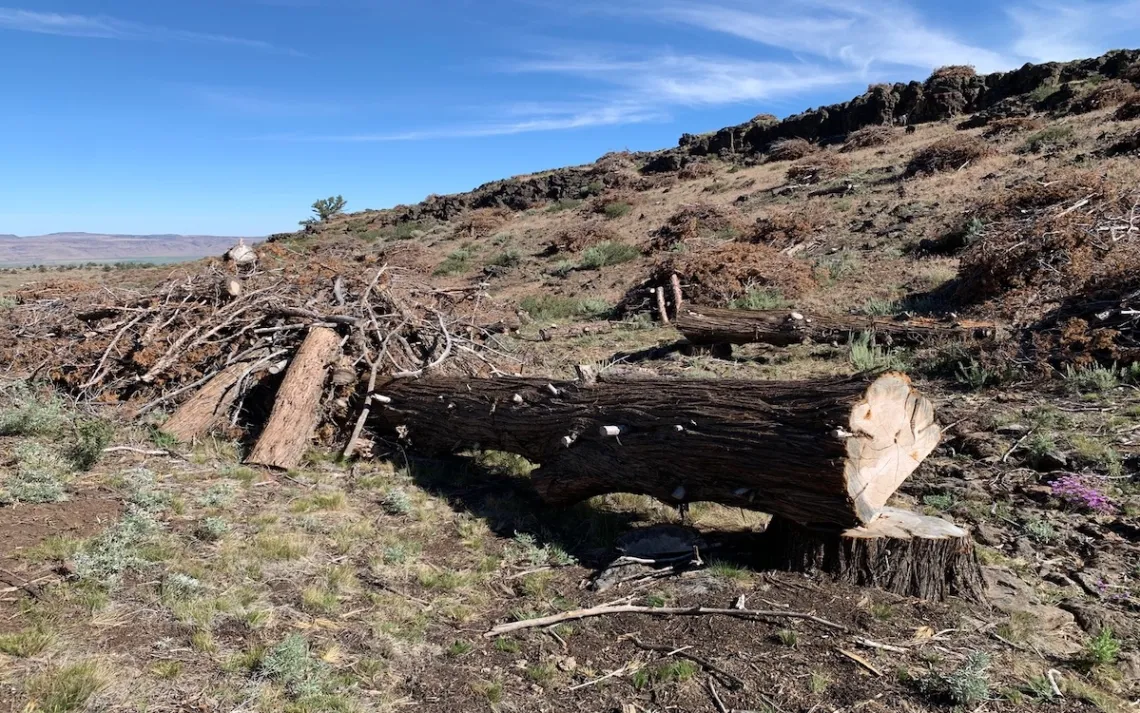
Juniper stands in the Steens and Hart Mountain areas in Oregon. | Photo courtesy of Katie Fite
A few years ago, Lori Ann Burd, environmental health program director at the Center for Biological Diversity, hiked a mountainside in Oregon that should have been alive with insects. The steep slopes blazed with wildflowers—red and pink Indian paintbrush, yellow balsamroot, and purple lupine—but the air was eerily still. Not a single bee or butterfly flitted between the blooms.
The slope was part of Steens Mountain, a remote escarpment in central Oregon surrounded by broad, arid basins. The previous year, federal managers had targeted the area for aerial spraying to prevent a grasshopper outbreak. The cocktail of chemicals used to control insect outbreaks—including diflubenzuron, carbaryl, and malathion—do not distinguish between crop pests and native pollinators. “They don’t affect the flowers,” Burd told me. “So you'll be in a place in the spring with abundant wildflowers and nothing flying to pollinate them.”
The scene was hauntingly reminiscent of Silent Spring, Rachel Carson’s groundbreaking warning about the cascade of ecological consequences that come from the indiscriminate use of “biocides.” More than 60 years after its publication, however, Carson's eloquent warning appears largely unheeded. On millions of acres of federal public lands, herbicides and pesticides are routinely deployed for an expanding list of objectives, from suppressing invasive species to post-fire restoration and vegetation management.
“Dozens of chemicals are used on federal public lands each year for every imaginable reason,” Burd said. “Sometimes they're creating ‘seral’ habitats. Sometimes they're clearing piñon-juniper. Sometimes they're killing grass. Sometimes they're encouraging grass. There's pretty much a chemical for every occasion that the Forest Service or BLM might respond to.”
*
Last month, Mother Jones published an investigation into the US Forest Service's extensive use of glyphosate—better known as Roundup—across California's Lassen and El Dorado National Forests. Roundup, which uses a compound called glyphosate to inhibit enzyme function, has been labeled by the World Health Organization as a probable carcinogen. Reporter Nate Halverson described recently sprayed burn scars as “virtual dead zones,” where little remained except rows of tightly packed conifer seedlings planted after logging and fire.
The article exposed a program that has received relatively little scrutiny amid the Trump administration's broader assault on environmental regulation. Yet the policy itself is far older and more widespread than Halverson’s article acknowledges. Its roots stretch back nearly two decades to the Bush administration. In 2007, the Bureau of Land Management adopted its Vegetation Treatments Using Herbicides Programmatic Environmental Impact Statement, authorizing widespread herbicide use for post-fire restoration, invasive species control, and wildfire fuel reduction. The federal government’s pesticide application programs date to the Dust Bowl of the 1930s and the massive locust outbreaks that decimated croplands across the Midwest. Over the years, the Fed’s pest spraying program became much larger and more coordinated, culminating with the establishment of the USDA’s Animal and Plant Health Inspection Service, or APHIS, in 1972.
That authority has continued to expand dramatically. Over the past year alone, federal agencies have sprayed tens of thousands of gallons of herbicides and pesticides across the mountains, canyons, plateaus, and deserts of the American West.
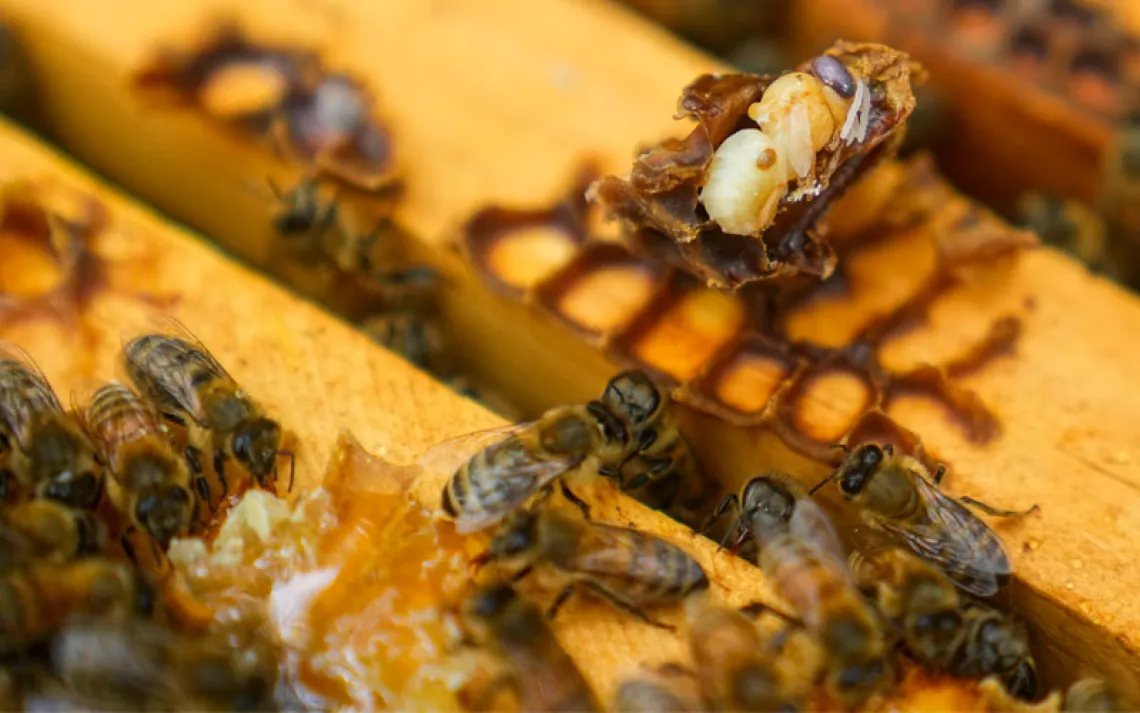
In the case of insects, says Andrew Missel, an attorney with Advocates for the West, the concern is with “broad spectrum” pesticides such as diflubenzuron, which is used frequently to suppress grasshopper outbreaks. “It doesn't just magically affect grasshoppers,” said Missel. “It's an insect growth inhibitor. It affects the larval stages and inhibits growth of the exoskeleton, which is going to affect all insects and some spiders. It is especially bad on Lepidoptera (butterflies and moths) which are big pollinators in these ecosystems.”
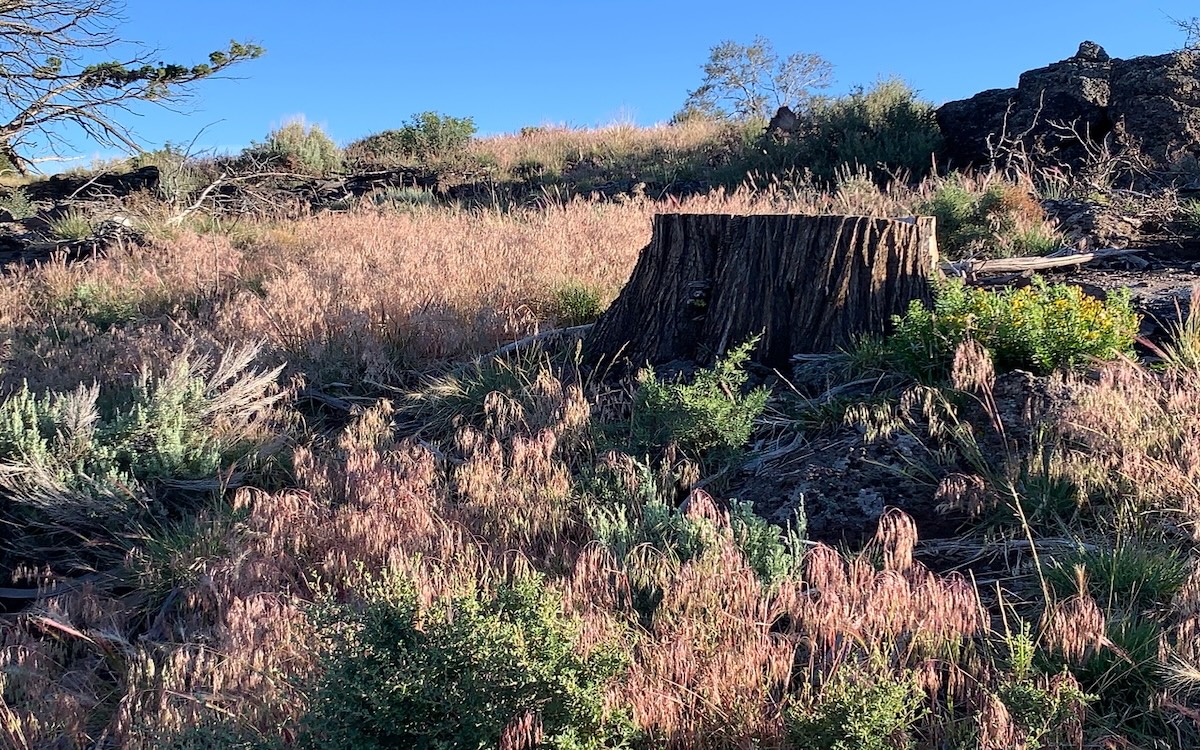
Photo by Katie Fite
Herbicides are also problematic, notably for human health. These days, USFS and BLM are relying on a new suite of weed killers such as Rejuvra and Plateau, both of which are substantially more potent than Roundup.
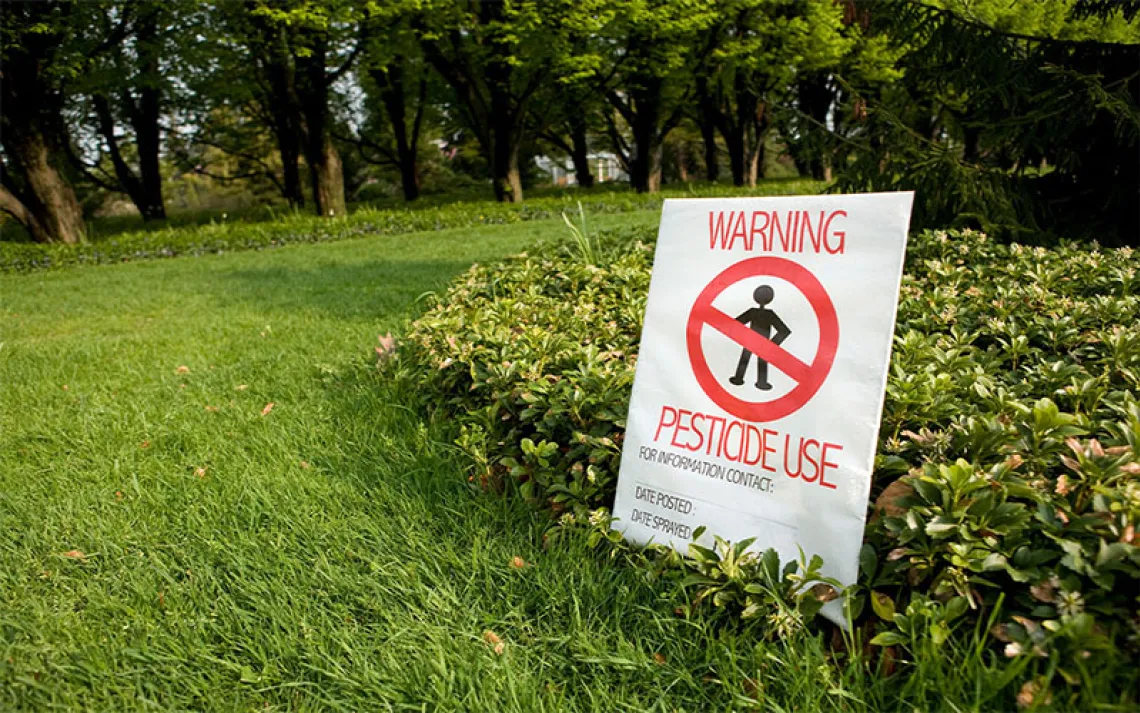
Many of these herbicides and pesticides contain complex mixtures of supposedly “inert” compounds whose full ingredient lists remain shielded as trade secrets. Chemical manufacturers, of course, insist on the safety of these chemicals, however researchers from the nonprofit environmental group Public Employees for Environmental Responsibility, or PEER, found earlier this year that Rejuvra contains polyfluoroalkyl (PFAS) substances, or “forever chemicals.”
Last fall, the BLM aerially applied herbicides across thousands of acres in Oregon's Lakeview District following the Van Meter Fire. Earlier this year, the Forest Service sprayed large areas of California's Butte County by air and ground.
For some residents, the operations revived painful memories. Laura Olsen recalled aerial herbicide spraying in the 1970s to a local CBS affiliate. “They sprayed this whole area with 2,4-D and 2,4,5-T. The cat had kittens. They did not look like kittens. They looked like some kind of alien things. They all died.”
The campaign continues to expand. Later this summer, the BLM plans to spray 16,500 acres near Rock Springs, Wyoming, with another powerful weedkiller called indaziflam to suppress cheatgrass. In Idaho's Lemhi County, the Forest Service and BLM will aerially treat another 8,000 acres in watersheds burned during the 2022 Moose Fire.
Today, large-scale federal spraying programs operate across 17 western and midwestern states, with consequences extending far beyond weeds. Burd recalled another trip, this time into Washington's Blue Mountains, where she searched for an extremely rare butterfly that may already have disappeared from the region. The rugged range also supports one of the Pacific Northwest's largest herds of Rocky Mountain bighorn sheep, whose populations have declined in recent years as lamb survival has plummeted.
“They were literally doing overhead spraying during lambing season,” Burd said. “Bighorns are so skittish, you cannot be flying planes over them while they're lambing.”
If conditions are troubling on federal lands, Burd argues they are even worse on private industrial forests. Washington and Oregon contain private timber holdings that together exceed the size of Maryland, and yet aerial herbicide applications often receive little public scrutiny despite the potential for drift onto neighboring public lands and communities. “It’s a hellish situation, even worse than on federal public land,” Burd said.
She recalled a friend living beside industrial timberland when a spray aircraft passed overhead, releasing a fine mist from its wings. “She was eight months pregnant and had to run down the mountain to get away.”
Katie Fite, public lands director for the Boise-based WildLands Defense, says the federal spraying program has accelerated as wildfire suppression and post-fire restoration have become increasingly well-funded. Flush with hundreds of millions of federal dollars, the Forest Service and BLM now routinely deploy airplanes, helicopters, and drones to distribute herbicides across vast and remote landscapes where fire poses little threat to communities or infrastructure.
“There’s an endless supply of funding to flail around to deal with wildfire,” Fite said. “Just think if all the money spent on all these treatments was spent on finding a real solution to cheatgrass.”
The results, she argues, often become self-perpetuating. In 2019, Fite and I visited Juniper Mountain in Idaho's remote Owyhee Mountains, where the BLM had prescribed the burning of 13,000 acres of mature western juniper forest in an effort to restore sagebrush habitat. When Fite returned this June, she found little evidence of recovering sagebrush. Instead, the mountainside had become dominated by dense growths of invasive cheatgrass. In places, the dry weeds were so thick that she and her dogs could barely move through it.
Now the BLM is spraying herbicides in places to combat the very cheatgrass invasions that have followed its own prescribed burns and chaining and logging projects—all in the name of reducing wildfire risk.
“It’s a truly insane cycle of management,” Fite said. “First you burn entire stands of mature forests to reduce the fire risk. And in doing so you create a hellscape of flammable invasive weeds. Then you spray those weeds with huge quantities of poison to keep them from catching on fire.”
Once cheatgrass and other noxious weeds are established, they are extremely difficult to eliminate, particularly in vast, rugged swaths of public land like Juniper Mountain, says Fite.
“It’s a lot easier to wreck an ecosystem than it is to put it back together, especially when it comes to cheatgrass” she said.
Herbicides are often a temporary solution—especially when landscapes are sprayed once and then ignored. The most effective remedies involve long-term management using a combination of carefully timed prescribed burning to eliminate seeds along with rotational tilling and replanting of native species over successive seasons. “That kind of work takes a lot of time, care, and money,” Fite said.
As for insects, Missel said that an approach called Integrated Pest Management, or IPM, should be followed. The Environmental Protection Agency and the Department of Agriculture define IPM as “a sustainable approach to managing pests by combining biological, cultural, physical, and chemical tools in a way that minimizes economic, health, and environmental risks."
“In other words, instead of [ranchers] saying, ‘Oh my god, there’s a grasshopper outbreak, we need you to come dump a bunch of pesticides,’ land managers should work from the ground up, and figure out what methods could be used to prevent those outbreaks from happening in the first place,” Missel said. “In doing so, they could greatly reduce the amount of pesticides needed.”