Where Have All the Bees Gone?
The mystery surrounding a mass die-off frustrates beekeepers and the bee industry
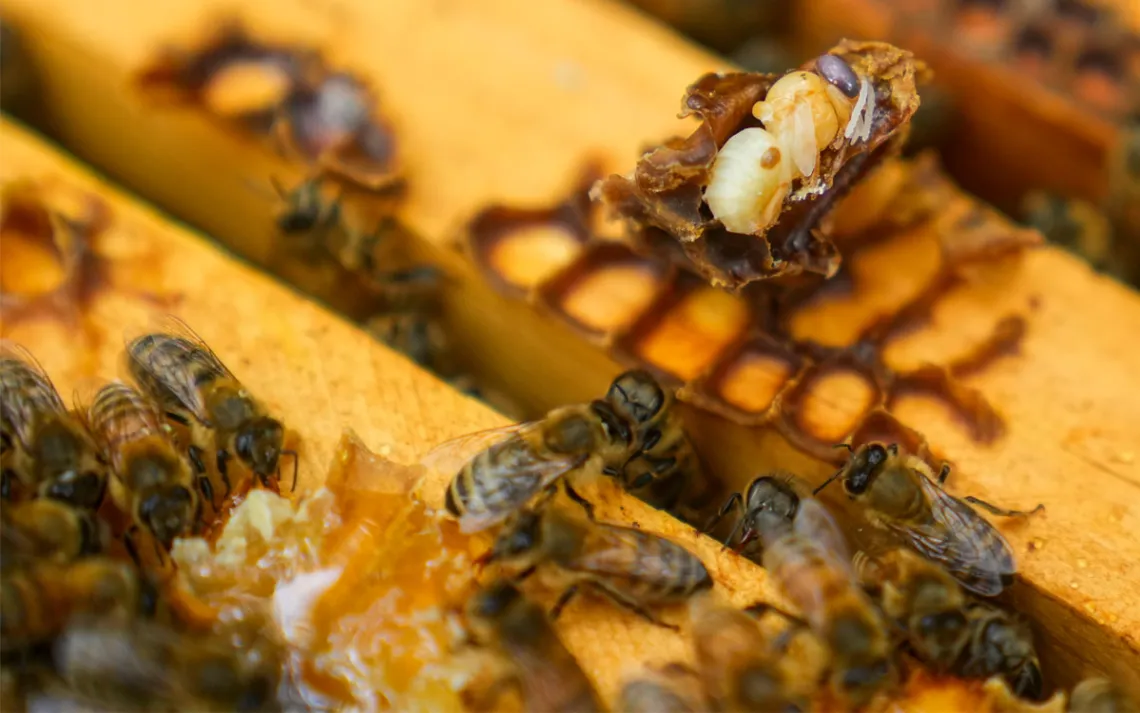
A parasitic varroa mite is visible on a dead bee in 2023 in College Park, Maryland. | Photo courtesy of AP Photo/Julio Cortez
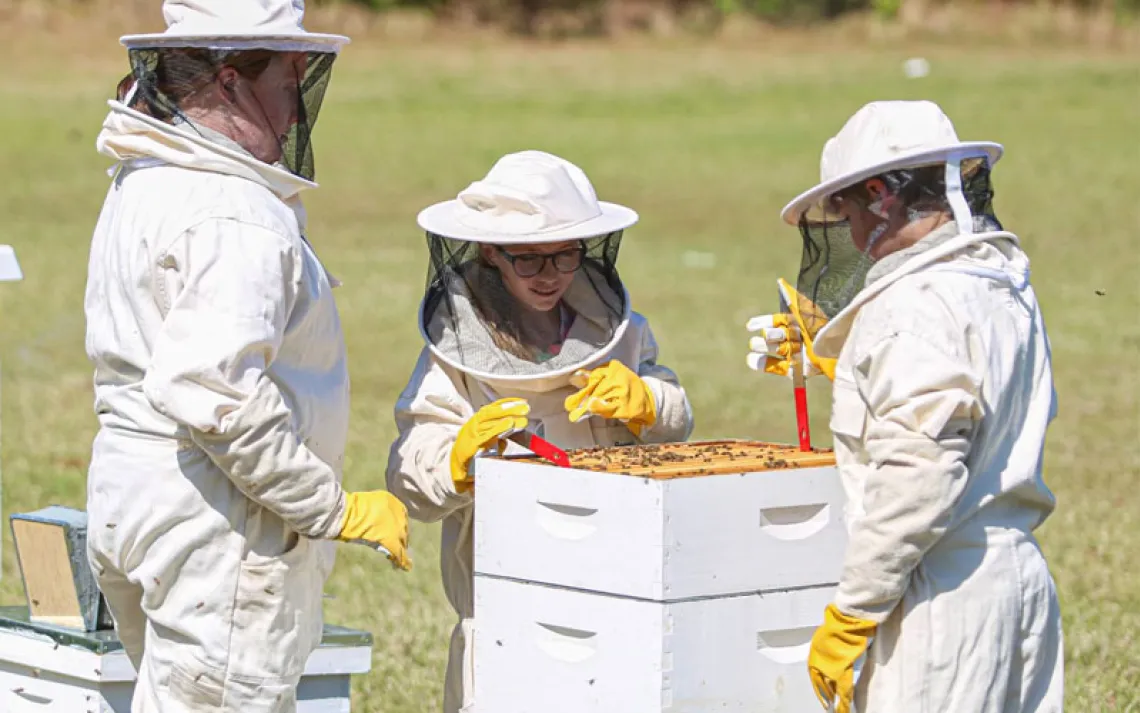
As the weather began to cool toward the end of 2024, Bret Adee, a beekeeper in South Dakota, discovered that his typically busy hives were no longer bustling. He was preparing to send them to California, where his bees help to pollinate almond groves. However, he was shocked to find that nearly three-quarters of his bees were gone.
“It’s heartbreaking,” he said. “You feel like you've thrown your own life away.”
Adee is one of hundreds of beekeepers in the United States who lost over 60 percent of their colonies in late 2024 and early 2025. It was the nation’s worst-ever mass honeybee die-off and the second major population crash in the past two decades. The first took place in 2006–07.
Scientists from the US Department of Agriculture scrambled to find out what went wrong. Last June, the agency declared it had solved the mystery. Colonies had succumbed to viruses that were spread by the parasitic mite Varroa destructor. The harmful viruses included two strains of deformed wing virus that stunt and tatter bees’ wings and shorten their lifespan.
But Sierra has learned from university researchers that the hives were also exposed to a cocktail of agricultural pesticides that may have played an important role in weakening bee health. The USDA has not yet published the pesticide data.
The scientific debate raises larger questions about the role beekeepers might be playing in the collapse, and whether commercial pesticide companies should be held accountable. It also highlights that other factors, such as climate change, are wreaking havoc in hives.
In early 2025, the USDA took samples from 113 colonies—some of which were weak and dying; others were strong—within six large commercial beekeeping operations. Researchers also examined 39 mites from five of the beekeeping operations and found that all were resistant to amitraz—a pesticide widely used by beekeepers to manage the varroa mites. The agency’s researchers concluded that amitraz applications did not effectively control the mites.
“These viruses are responsible for recent honeybee colony collapses and losses across the US,” said a USDA press statement from June 2025.
“Amitraz has been suspected of losing efficacy after decades of heavy use, and our results strengthen this claim,” wrote the USDA researchers in a study that was published in February in the journal PLOS Pathogens.
These findings have enraged beekeepers who feel that the USDA was trying to pin the blame on them for poor bee husbandry and for overusing amitraz in ways that contributed to the development of resistance in mites. If beekeepers rely just on amitraz, year after year, then the mites can more quickly develop resistance than if they switch mite treatments with other chemicals and methods. But some beekeepers who didn’t use amitraz or who alternated its use say they also lost many colonies.
Steve Ellis, a commercial beekeeper in Minnesota and president of the Pollinator Stewardship Council, an industry group, said that he finds the USDA statements “misleading and inappropriate.”
Some beekeepers said that they felt the study was too small to be representative of beekeeping across the country. They also feel that the researchers drew premature conclusions because the analysis did not include data from tests on agricultural pesticide residues in bee colonies. Agricultural pesticides such as neonicotinoids can harm bees, analyses show. A few bee professionals have wondered if pesticide poisoning or contamination contributed to the die-off.
Ellis says that he mistrusts explanations that blame varroa mites and viruses. This explanation for poor bee health is touted by agrochemical companies, he said. For example, Bayer Crop Science—a division of Bayer AG, the German chemical and drug giant that produces neonicotinoid pesticides and Roundup—writes that varroa mites are one of the biggest challenges to bee health.
The USDA did not respond to requests to interview its scientists nor answer specific questions about the beekeepers’ concerns.
Although viruses likely killed the bees, the USDA study says, other issues could have contributed to their demise. These include exposure to agrochemicals and poor nutrition (industrial agricultural areas often lack enough flowers for bees for forage, leaving them malnourished, say beekeepers).
The results from the pesticide residue tests were completed several months ago but have yet to be published. But Sierra has learned that the results show that hives were broadly contaminated with a cocktail of pesticides.
Scott McArt, an entomologist at Cornell University, and his team analyzed over 400 samples of bees, wax, and pollen for the USDA. They screened for over 95 different pesticides, including some neonicotinoids and amitraz. Every sample was contaminated with at least one pesticide, he said.
McArt and his team found that wax had an average of 17 different pesticides, pollen had an average of four, and bees had an average of two pesticides. Most of the pesticides were at low levels, says McArt, but a few samples were high enough to directly harm bees.
Healthy bee colonies were contaminated similarly to dead and dying colonies, which suggests that bees were probably not killed by pesticides alone, said McArt. But the bees were likely suffering from chronic exposure to a mixture of pesticides, he noted.
“There's a lot of pesticides in there,” he said. “Sometimes at levels that are not necessarily great for bees.”
McArt’s team also frequently found chemical compounds that are produced when amitraz is broken down. These compounds suggest that amitraz was broadly applied in the hives that were tested and at levels that could enable mites to develop resistance.
“It's definitely higher amitraz levels than we've ever seen in any data set that's come through our facility,” McArt said.
The USDA did not provide an answer about when the pesticide results would be published.
Many bee scientists agree that viruses spread by resistant mites could have ultimately killed the bees. Nonetheless, it’s not clear if viruses and mites are the main problem, some say. These scientists suggest that bees were more vulnerable to infection because they were already weak from poor nutrition or pesticides, for example.
Gloria DeGrandi-Hoffman, an entomologist and systems scientist who retired from the USDA last year, said it is not surprising to find viruses and mites resistant to amitraz in failing colonies. But this explanation for the decline is “too simplistic,” she said. “The question is, What led up to that?”
DeGrandi-Hoffman, now a researcher at Arizona State University, suggests that some combination of factors, such as heat and drought, insufficient food, and agricultural pesticides, could have sapped bee health. In this weakened state, bees are more vulnerable to mites and viruses, she said
Research shows that pesticides at levels considered low risk combined with other problems, such as poor nutrition, can interact to harm bee survival.
DeGrandi-Hoffman points out that beekeepers in the United States often lose around 30 percent of their colonies each year. This suggests that bees are regularly under stress. Without fixing the underlying problems, bees remain vulnerable and numbers could come tumbling down again, she said.
Richard Coy, a commercial beekeeper in Mississippi and vice president of the industry group the American Beekeeping Federation, is worried that this year, bees are not much healthier than they were last year. He suspects that many bees are suffering from poor nutrition. Coy feeds his bees with supplementary sugary liquids, but they're not as nutritious as foraged pollen and nectar, he said. It’s also an added expense in an industry that is already struggling to stay afloat after having to rebuild bee colonies and contend with income shortfalls from decreased honey production and low honey prices.
Bee-friendly changes to the US industrial agricultural system, such as curbing pesticide use or protecting foraging habitat, will likely be difficult to push through, said Coy. But for the industry, he said, “it’s easy to blame beekeepers.”
Natasha Gilbert is a 2026 Alicia Patterson fellow, and her reporting was supported by the Alicia Patterson Foundation.