By Chris Burger, Chair of National Sierra Club Zero Waste Team
There are a number of ways we could reduce greenhouse gas emissions by addressing the waste crisis. I will focus on 3 of them.
- Reducing the burning of fossil fuels by replacing our extractive economy with a circular economy.
- Curtailing the use of plastic along with increasing the recyclability of plastic, avoiding the use of plastic as a fuel source.
- Reducing Methane (CH4) emissions by banning organics from landfills.
Replacing our extractive economy with a circular economy is key. A circular economy is based on the reuse and regeneration of materials or products, especially as a means of continuing production in a sustainable or environmentally friendly way. Currently we consume resources in a linear fashion. We extract raw material. We process the material. We then use that material within the products we consume (too many times for a one -time use). We finally dispose of the material creating the waste crisis we are facing today. While both extraction and disposal have recognized negative environmental and social impacts of all kinds, what is lost is the fact that providing all these consumer products represents 38% of our total energy use. I call this embedded energy. More than half of that is used to extract and process raw material.
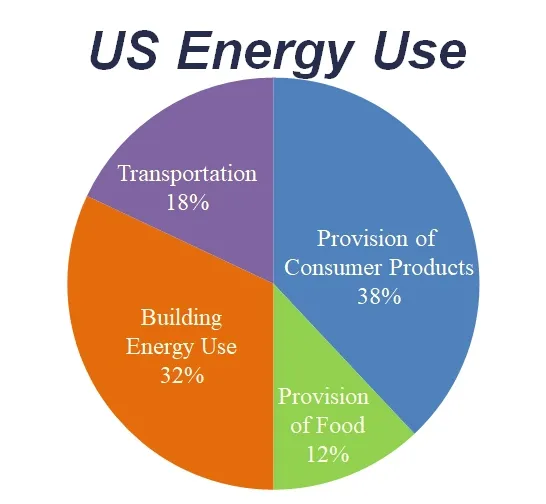
Cutting back on all the “stuff” we consume yields direct energy savings. Cutting back on single use products yields additional savings. Recycling, while using energy in its own right, reduces energy consumption considerably. All told, a reduction of 12% in energy use could be achieved by implementing a circular economy. That is equivalent to all the energy we consume to provide the food that we eat or two thirds of all the energy we use in our transportation sector.
Plastics are a growing waste crisis, and they go hand in hand with fossil fuel production.
Unfortunately, just when we should be striving to reduce plastic production, there is an effort by the petrochemical industry to increase the use of plastic. As fossil fuel use decreases to address climate change, the petrochemical industry is investing heavily in plastics production as an alternative market to continue growing its business. Plastic production has doubled and is projected to triple and quadruple, countering the gains in reducing greenhouse gas emissions from the adoption of alternative energy and electrification in other sectors.
True plastic recycling has dropped off with the loss of the Chinese markets. There is now a concerted effort to capture used plastic to feed incinerators. Note: The definition of incineration in the Sierra Club Zero Waste Policy is temperature-based, to guard against changes in technologies or industry terminology. As a result, technologies such as pyrolysis and gasification are treated similarly to incineration in the policy. Even the so-called “chemical recycling” of plastic results in converting plastic to fuel. All of these technologies simply reintroduce the petrochemical as a carbon fuel, ultimately producing carbon dioxide (CO2) and contributing to climate change.
Finally, we come to landfilling, the method used most to “deal” with our waste. The problem is that, while creating the illusion of “dealing” with our waste, they are nothing more than giant warehouses. They are typically lined to protect our groundwater from the toxic soup (leachate) that is generated, yet there is no evidence that the liners will last longer than the waste they are attempting to contain. It is the air emissions from landfills, however, that affect climate change.
For many years we have included all sorts of organic waste in our landfills. It is estimated that close to 73% of our waste stream is organic. When organic waste breaks down in the absence of air in a landfill, it produces methane and methane is 84 times more potent a greenhouse gas than carbon dioxide. While there have been recent efforts to either flare the methane (reducing the impact by creating CO2 instead) or capturing the methane, these efforts are only about 20 to 25% effective.
In 2022, landfills released 3.7 million metric tons of methane into our atmosphere (or about 311 million metric tons of carbon dioxide equivalent using IPCC’s formula). That’s roughly equivalent to the annual emissions from driving 70 million Internal Combustion Engine (ICE) vehicles or operating 83 coal-fired power plants. The only effective way to prevent methane from being produced in landfills is to ban organics from landfills. Aerobic digesters (composting) are better alternatives for processing organic waste.
While improving the ways we power our buildings and transportation are important, we should not ignore how improving how we address our waste crisis can help in our efforts to address climate change.