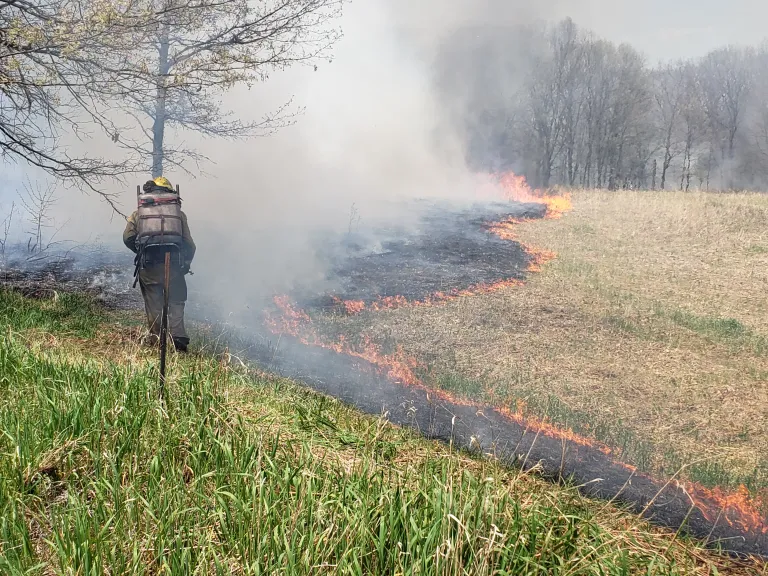
A carefully managed prescribed burn - Six Rivers Conservancy
As a Sierra Club outing leader, I like to mix my hikes with a bit of naturalism and conservation information. I will often take breaks to point out birds and wildflowers, as well as talk about things our local group and chapter are working on. To enrich my mind and my hikes, I like to read, listen to podcasts, participate in club committees, and sometimes go in the field with naturalists.
On Earth Day, I was fortunate to join a hike with the Six Rivers Land Conservancy. Their Conservation and Stewardship Director led a group of members through Bear Creek Nature Park in Rochester, Michigan. The south portion of this park is prairie, and the north portion is an oak-hickory forest. In fact, much of the prairie had been burned just that morning. This was done as a controlled burn, a carefully planned and managed fire used by conservationists to restore natural ecosystems by clearing invasive species, returning nutrients to the soil, and promoting the growth of native plants.
One thing he explained during the hike is that they have a conservation easement only on the wooded portion of the property. Conservation easements are legal restrictions on land that preserve it permanently by limiting it to conservation uses. This property was publicly owned, so the easement was placed on the property to reassure the public that it was protected as permanent parkland. These easements can also be used on private property, which not only protects the property but also gives the owners a break on their property taxes.
At the time this conservation easement was established on the nature park, the southern parkland was mostly fallow farm fields of little ecological value. Since then, the conservancy and Oakland Township have worked together to establish the prairie and remove invasive species like autumn olive. The township has a group of volunteers that performs the burns.
As a side note, I read an interesting article by the Washtenaw County Conservation District recently that mentioned that burns also help reduce tick populations. Ticks carry various diseases, including Lyme disease, and with tick populations booming due to fire suppression and climate change, Lyme disease is shifting from an emerging problem to an established, expanding endemic problem.
There are some simple things you can do to avoid tick bites: wear light-colored clothes so ticks are easier to see; wear long sleeves and long pants in grassy or wooded areas; stay on clear trails and avoid tall grass. When you get home, check your body, clothes, and pets after being outside, and keep pets away from bushes and tall grasses. Shower soon after coming indoors. Also, wash and dry your clothes on high heat after outdoor activities. The dryer dries out and kills the ticks.
This Washtenaw County Conservation District article also had some interesting insights into ecological approaches to tick management that I haven't seen before. It mentioned that practices such as prescribed fire have been shown to reduce existing tick populations, though outcomes can vary depending on habitat type, such as forests versus grasslands, and the season in which the burn is conducted. Another ecosystem-based strategy is to increase natural predation on ticks: ground birds like wild turkeys are known to consume ticks. Opossums also eat ticks, and coyotes eat mice, which are a primary host of ticks. So the next time someone in my neighborhood complains about our resident wild turkey, opossum, and coyote populations, I'm definitely going to point out that fact.
Tick populations depend on different animals at different stages. Mice and other small rodents are a major source of Lyme infection for young ticks, while deer are the primary hosts for many adult ticks and help sustain large tick populations, and birds help spread ticks into new areas and neighborhoods. Roughly speaking, mice drive much of the infection risk, deer drive much of the tick abundance, and birds drive much of the geographic spread.
Of course, birds that prey on rodents, like hawks and owls, help keep tick populations in check, as do other rodent predators like foxes and coyotes. If you feel like this is very complicated, you are right! As author Rachel Carson said, “In nature, nothing exists alone.” This is why it is so important to try to preserve whole ecosystems with all the properly functioning parts.
Come and enjoy the beauty and complexity of nature with us on one of our upcoming hikes. We have outings planned through New Years. (link)
Written by Ken Jacobsen, SEMG Outings Chair