The Newest Legislative Package Could Have a Big Impact on Groceries
The Farm Bill is one of the largest funding packages for America’s food system and private conservation but faces grim odds
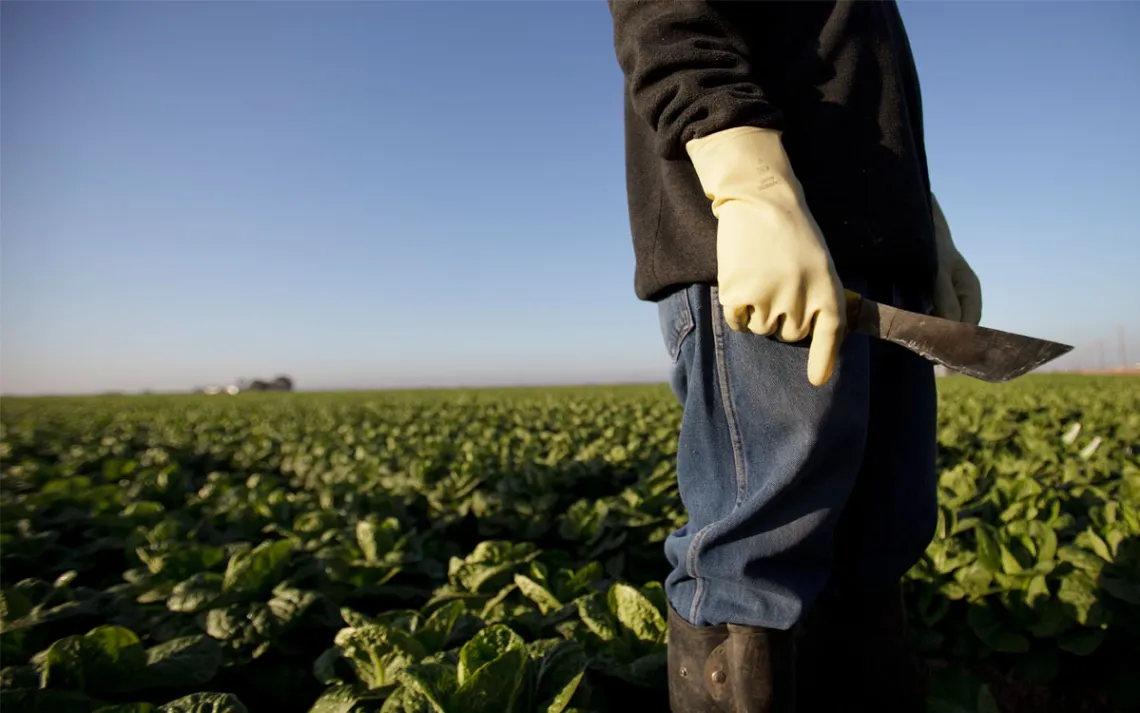
Manuel Soto, a farmworker, in the lettuce fields near Holtville, California. | Photo courtesy of AP Photo/Gregory Bull
The Farm Bill has typically been one of those must-pass spending bills that has garnered broad support. It helps fund America's food systems, provides millions of dollars for conservation programs, and keeps social safety-net programs running. However, in recent years, this rare legislative bright spot has sputtered, and close watchers of this year's bill fear that Congress could, as it did in 2018, fail to pass a bill to keep farmers and businesses afloat.
The 2026 version passed the House by a 224–220 vote, backed by almost all House Republicans and 14 Democrats. Despite providing roughly $1.5 trillion in funding, some say the bill lacks support in the Senate, where it will need 60 votes to pass.
That speculation stems from a letter authored late last month. Hundreds of agricultural and conservation groups released statements or signed on to letters to legislators, noting their disapproval. Much of that disapproval centers on the fact that the proposed Farm Bill doesn’t address the concerns that it’s designed to.
“This is more of the same, current Farm Bill,” said Tom Buller, executive director of the Kansas Rural Center, an organization that works with farmers to build sustainable food and farming systems in the state of Kansas. “The people winning under the current system would see those gains extended under the new bill,” Buller said. “It’s more of the same of the current system, and some things that would get worse.”
A SNAP decision
The proposed legislation is vast. It lays out spending for various programs—farm, rural development, conservation, crop insurance, farm loans, and disaster assistance, among them. But there are some differences from previous versions, and those differences are proving to be sticking points that may slow or prevent its passage.
As it stands, the most friction revolves around cuts to the Supplemental Nutrition Assistance Program (SNAP), which were codified under H.R.1, or the One Big Beautiful Bill Act in 2025. Those cuts reduced SNAP outlays by $187 billion over 10 years. That’s led to 3 million people dropping off the SNAP program, increasing food insecurity for families across the country.
Additionally, H.R.1 shifted much of the financial burdens of the SNAP program—traditionally funded completely by the federal government—to individual states, most of which are cash-strapped. Katie Bergh, a senior policy analyst at the Center on Budget and Policy Priorities, said this could be a death knell for the program.
“For decades, SNAP has been reauthorized as a part of the Farm Bill,” Bergh said. “I don’t think I can overstate how extreme the SNAP cuts are. . . . People are losing access to food assistance at the fastest rate in 30 years.” She added that the legislators opposing the current bill would like to see the cuts instituted in H.R.1 reversed, but in the Farm Bill’s current form, those cuts remain and would be reauthorized for another five years.
How the proposed Farm Bill fails farmers
Another area where some experts say the proposed Farm Bill falls short is in actually helping farmers, who, it seems, are in desperate need of it. A poll, commissioned by Amato Advisors and conducted by Farm Journal in mid-May, found that 78 percent of farmers say that input costs, such as fertilizer and gasoline, are their biggest challenge. Further, more than half of them say that federal policies have directly hurt their operations over the past year. Subsequently, Chapter 12 farm bankruptcies increased by 46 percent year over year during 2025.
Specifically, the proposed legislation supports certain safety net programs and crop insurance, which are often structured around specific crops that are grown by operations with huge amounts of acreage, and could stand to receive more of the potential benefits. Jesse Womack, a policy specialist at the National Sustainable Agriculture Coalition, said that demand for more assistance, cost-sharing, and conservation programs among farmers and swaths of rural America is insufficient, and the bill fails to address the gaps.
“We’re going through a period of time when farm bankruptcies are spiraling in a way we haven’t seen since the 1980s, yet the refrain we’ve been hearing about the Farm Bill from legislators is no new money, no new resources—we’re just going to tinker,” Womack said. “The tinkering picks winners and losers and prioritizes the big and highly mechanized over everyone else. It’s not addressing the affairs in rural America.”
How the bill affects conservation and wildlife protections
The bill also makes changes to several programs and agencies aimed at protecting wildlife and furthering conservation efforts. In February, 113 organizations, including the Sierra Club, sent a letter to chairs and ranking members of the House and Senate Committees on Agriculture. In it, they laid out opposition to 19 portions of the Farm Bill that either hamstring the Environmental Protection Agency’s ability to protect the environment or “erode the stewardship and management of Forest Service lands.”
One proposed change would mandate wildfire suppression in national forests and effectively prohibit managed burns. That could lead to more dangerous and damaging wildfires in the future as it could allow for more fuel to build up over time, said Anna Medema, the deputy legislative director for forests and public lands at Sierra Club. “We’ve started to understand how important it is to have fire across landscapes,” she said, and the proposed change “is not based in science, and it’s not very realistic.”
Additionally, farm bills traditionally have included funding for wildlife conservation programs on private lands too. Proposed changes—such as exempting federal agencies from consulting with each other on land management plans and delaying reviews for pesticides for several years—could harm wildlife protection and conservation measures on private land, conservationists warn.
“The Farm Bill is the largest source of federal funds for wildlife conservation on private lands,” said Dan Moss, senior government relations representative at the conservation nonprofit Defenders of Wildlife. Moss said that “more than two-thirds of the land in the lower 48 states is under private ownership.” Further, those private lands are home to more than 70 percent of the species listed under the Endangered Species Act, and 10 percent of those species are only found on private land. Accordingly, broader changes to funding and government agencies could hurt wildlife almost anywhere.
“It’s a huge concern for species,” said Medema. “As far as it’s being framed, it’s cutting red tape and regulation. But from our perspective, it’s a huge threat to species.”
What’s next?
Despite the bill’s flaws, Butler is optimistic that the bill could be improved. That would require changes to SNAP cuts and funding. Buller also noted that some in the farming sector support its potential passage because it sets clear guidelines for farmers, giving them a sense of predictability.
“It makes it hard for farmers and other people in the food and ag space to make investments not knowing what might change, what things are going to look like next year,” he said. “It lays a foundation for the next five years.”
Industry groups, meanwhile, have expressed support for some of the measures. In recent weeks, Big Ag groups like the American Soybean Association, the National Farmers Union, and the Food Industry Association have weighed in to applaud its passage in the House. “Farmers and ranchers applaud the House of Representatives for passing a new, modernized farm bill,” said Zippy Duvall, president of the American Farm Bureau Federation, in a statement.
There are a few possible outcomes for the bill in the next few weeks. The most likely next step is a Senate vote, which, if passed, would allow the bill to head to President Trump’s desk for signature. However, it could also stall in the upper chamber. In that case, it’s also possible that the 2018 Farm Bill receives, again, another extension. That would also leave SNAP cuts in place, among other things, as those cuts were passed under different legislation.
Womack said that wouldn’t be the worst thing in the world: “There’s no love lost if we end up with an extension instead of a bad Farm Bill.”
Bergh also said that it’s difficult to see a path forward in the Senate without substantial changes. “The last bill, in 2018, passed with an overwhelming majority—it got 87 votes in the Senate,” she said. “That’s not the process we’re seeing now.”