New Road Crossings Help Save World’s Rarest Wolf
Design work is underway on the project in North Carolina’s Alligator River Wildlife Refuge
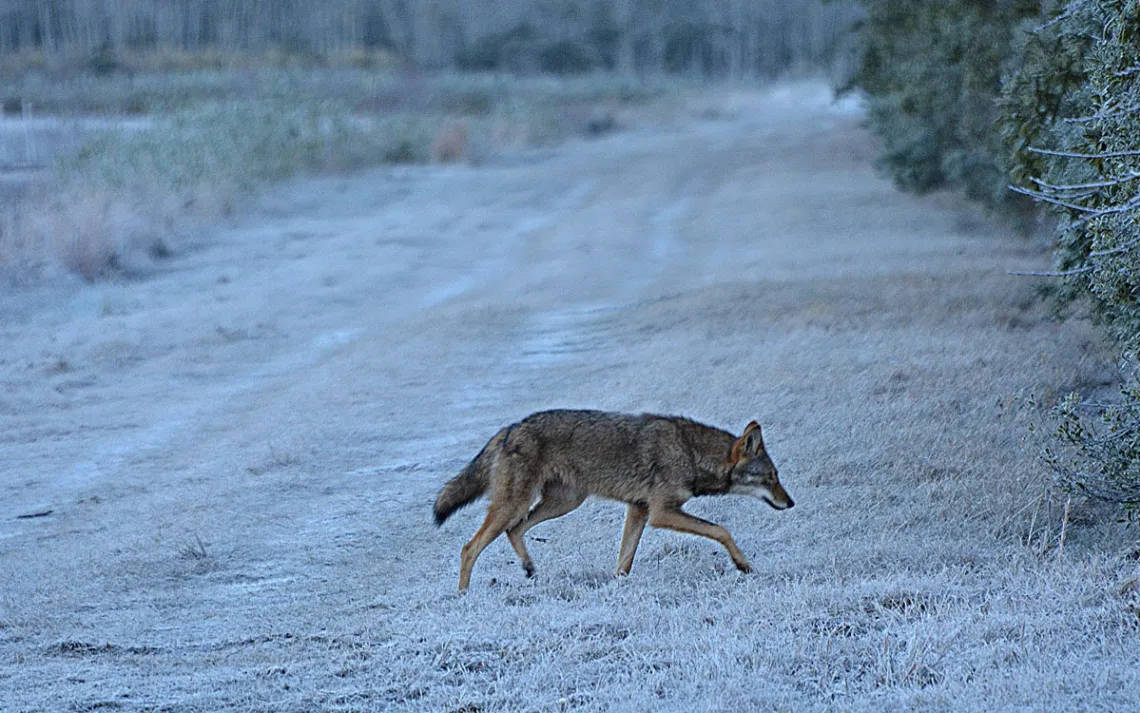
A red wolf crossing a dirt road within the wildlife refuge. | Photo by Ron Sutherland
In September 2023, a male red wolf picked up a scent. He followed it toward a wide-open stretch of asphalt in North Carolina’s Alligator River Wildlife Refuge. Jackpot! He found a dead bear—plenty of food for himself and his family. But as he sniffed around, a vehicle appeared out of nowhere. By the time he realized the danger, it was too late to run. The car struck and killed him. These were the final moments of a red wolf some called “Airplane Ears,” for the way one of his ears veered at an angle.
His plight is hardly an isolated case. The following year, a father with a litter of five newborn pups was hit and killed. And earlier this year, in February, a young female was killed along the same asphalt stretch. In fact, vehicle strikes are the leading cause of death for these critically endangered animals.
As tourists travel Highway 64 on their way to and from North Carolina’s Outer Banks, they zip right through Alligator River Wildlife Refuge, the only home for wild red wolves. Signs warn drivers to watch for the elusive creatures, but accidents still happen. In the span of one year, from 2023 to 2024, around a fifth of the wild population died from vehicle strikes.
“We needed to do something, and do something now,” Ron Sutherland recalled thinking after the male with the distinctive ear was struck in 2023. Sutherland is an environmental scientist with the Wildlands Network, a nonprofit with a mission to reconnect America’s wild landscapes. His specialty is red wolf conservation.
Sutherland was a part of a team of conservationists who managed to secure a $25 million grant in 2025 to design and build wildlife crossings and fencing along the dangerous highway. The goal is to keep red wolves—and other local wildlife—off the roads, preventing car accidents and conserving the ecosystem at the same time.
“It's difficult to get a project that large on the books,” said Emily Weller. She oversees the red wolf recovery program for US Fish and Wildlife Service, which manages threatened and endangered species. The money comes from a US Federal Highway Administration effort, the Wildlife Crossings Pilot program, passed as a part of the Infrastructure and Job Act in 2022.
Getting the grant was a huge win for red wolf conservation. The crossings are a “key piece” of efforts to sustain a wild red wolf population, Weller said. Design and planning work is now underway, with a goal to begin construction by 2028.
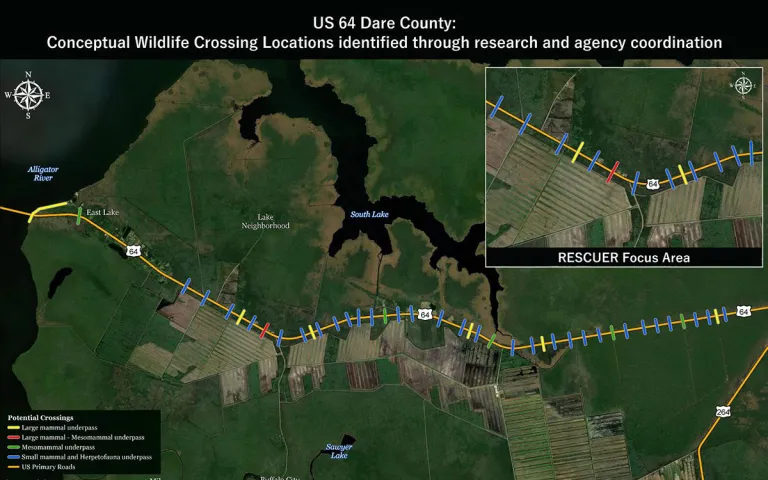
An aerial map of where different types of wildlife crossings will go along Highway 64. | Photo courtesy of US Fish and Wildlife
A series of tragedies
But roads are just one in a series of tragedies that have plagued the wild red wolf population. Long ago, red wolves roamed the entire Southeastern United States. Habitat loss and government-sponsored programs reduced the population until only one small enclave of 17 remained. In 1980, biologists took the last of these animals into human care to save the species. At that point, the red wolf was extinct in the wild.
Beginning in 1987, biologists began releasing red wolves back into the wild. By 2006, their population had climbed to 130. But then it began dropping again. In addition to dying in vehicle collisions, the wolves were getting shot. Sometimes, hunters thought they were killing coyotes. But Sutherland says that misunderstandings about red wolves, including the idea that they kill too many deer and wild turkeys, likely motivated some of the killings. (Sutherland’s research has shown that red wolf populations actually support healthier populations of prey species.)
The Fish and Wildlife Service Red Wolf Recovery Program regularly introduces new red wolves into the wild from breeding programs at a number of different zoos and refuges. They keep track of wild pup births, and then, once the animals are large enough, they trap and collar them to keep an eye on their movements. “It’s not easy work,” said Kim Wheeler, who directs the nonprofit Red Wolf Coalition. “It’s cold; it’s wet; it’s a lot of hours.… They are rock stars in my book.”
Dangerous roads
Sutherland is currently heading up an effort to count and clean up roadkill along the stretch of road where the wildlife crossings will be built. In the first year of the survey, from August 1, 2024, to July 31, 2025, his team removed more than 5,000 dead creatures, including deer, opossums, raccoons, otters, snakes, turtles, frogs, birds, and a baby bear.
The new crossings project will feature several medium- to large-sized crossings for many of these animals but also for red wolves. Meanwhile, fencing will help funnel animals to the crossings, ensuring they use the structures and stay off the roads.
Keeping animals off the road also saves human lives and makes economic sense. From 2022 to 2024, 23 people died and over 2,800 were injured in collisions with wildlife in North Carolina. Across the entire US, wildlife collisions cost more than $10 billion each year. That includes the cost of repairs, medical bills, and lost income.
Marcel Huijser, a road ecologist at Montana State University, has modeled the costs and benefits of building wildlife crossings. The results are clear. “We should be doing this more readily,” he said. In a separate 2025 study, researchers found that it takes only seven years for the savings from prevented accidents to exceed the amount it costs to build a single crossing in an area with moderate to high wildlife activity. That one crossing can be expected to prevent around 1,400 accidents over 70 years.
Wildlife crossings are also extremely effective. After Montana added 41 structures and fencing to a stretch of Highway 93, researchers documented deer, bears, mountain lions, and numerous other species safely crossing an average of 22,648 times each year. In Canada, Banff National Park built fencing, 38 underpasses, and 6 overpasses. These have reduced collisions with elk and deer by more than 96 percent.
In 2023, Huijser and a colleague prepared an in-depth report for the USFWS, identifying where to put crossings and how to design fencing to best support red wolf conservation. In his report, Huijser estimated that building crossings along Highway 64 would reduce red wolf road deaths by around 25 percent. The wolves would still be at risk on other roads in the area, but those could be targeted with future projects. “We know that these types of measures are good for human safety,” he said. “We know they're good for biological conservation.”
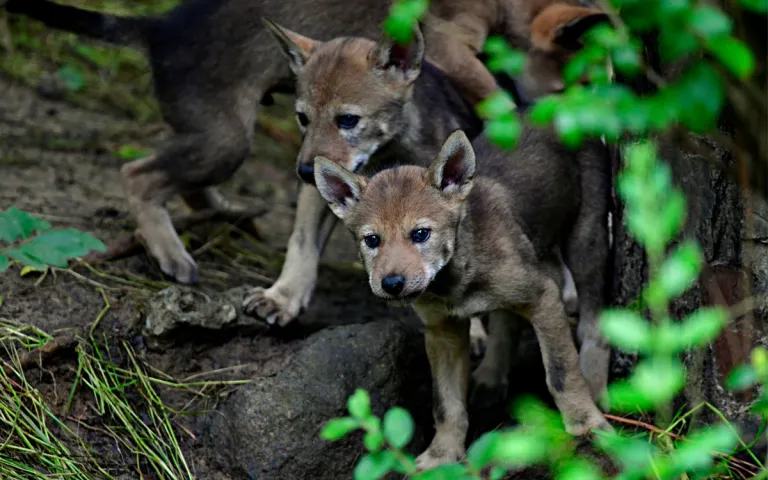
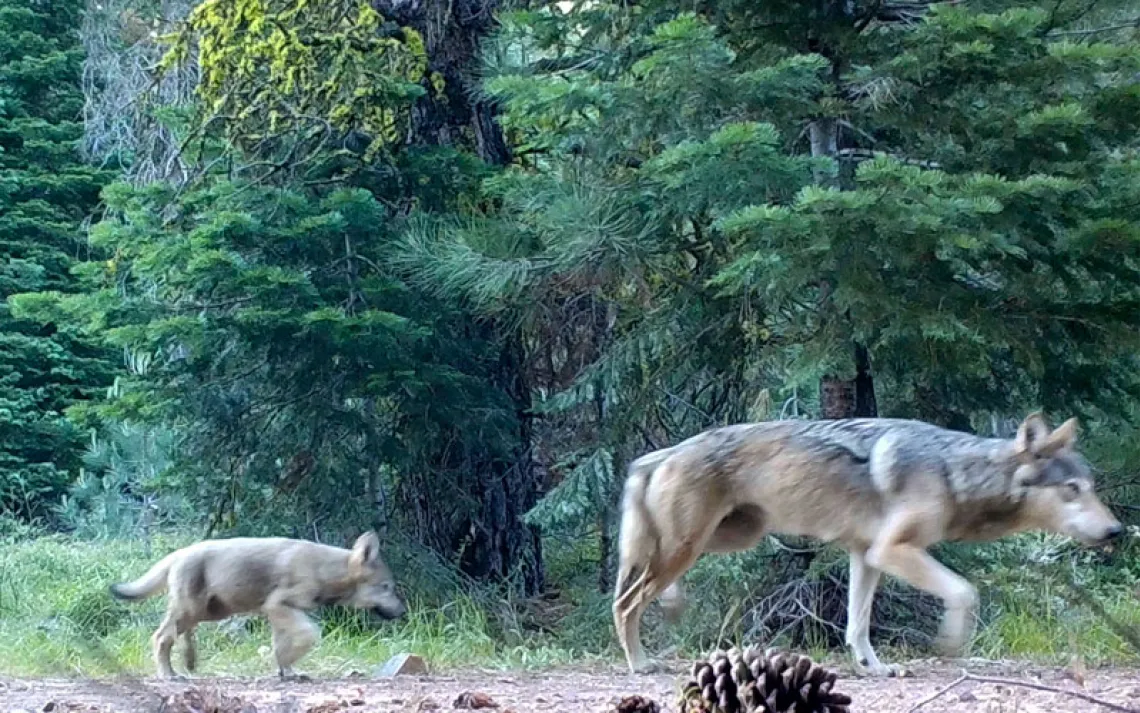
Red wolf puppies look out from the underbrush. | Photo courtesy of Ron Sutherland
Finding the money
However, there is a catch: wildlife crossings are expensive. At the North Carolina Department of Transportation (NC DOT), Marissa Cox headed the effort to secure federal grant money for the crossings. Her agency had aimed to add wildlife crossings as part of an expansion in the early aughts. But when the highway expansion got canceled, so did the plans for the crossings.
Then in 2021, the US government made money available through the first ever Federal Wildlife Crossings Pilot Program. The program was set up to last for five years. This year, Congress is considering three bills with bipartisan support that aim to make the program permanent.
In order to qualify for a grant, the NC DOT had to provide at least 20 percent of the total project cost of $31.25 million. That came to $6.25 million. Sutherland had an idea to get there. “I took things into my own hands and reached out to this philanthropist,” he said. This anonymous donor agreed to provide $2 million but only if Sutherland’s team could pull together another $2 million. Over the course of the summer of 2024, the state agency worked with two conservation groups to raise the money.
“Thousands of people donated,” said Sutherland. “By the end of the summer, we had the $4 million.” The NC DOT would be able to fund the remainder. So Cox sent in their proposal.
In December 2024, the team learned that they’d been awarded the $25 million. For Sutherland, the victory has a deeper meaning. He wants other people to experience wonder at the wildness around them. “I want my kids to be able to show their kids that the wolves are out there,” he said. “I’ve gotten to see the wolves in the wild. I’ve gotten to hear them howling and had tingles go up my spine.”