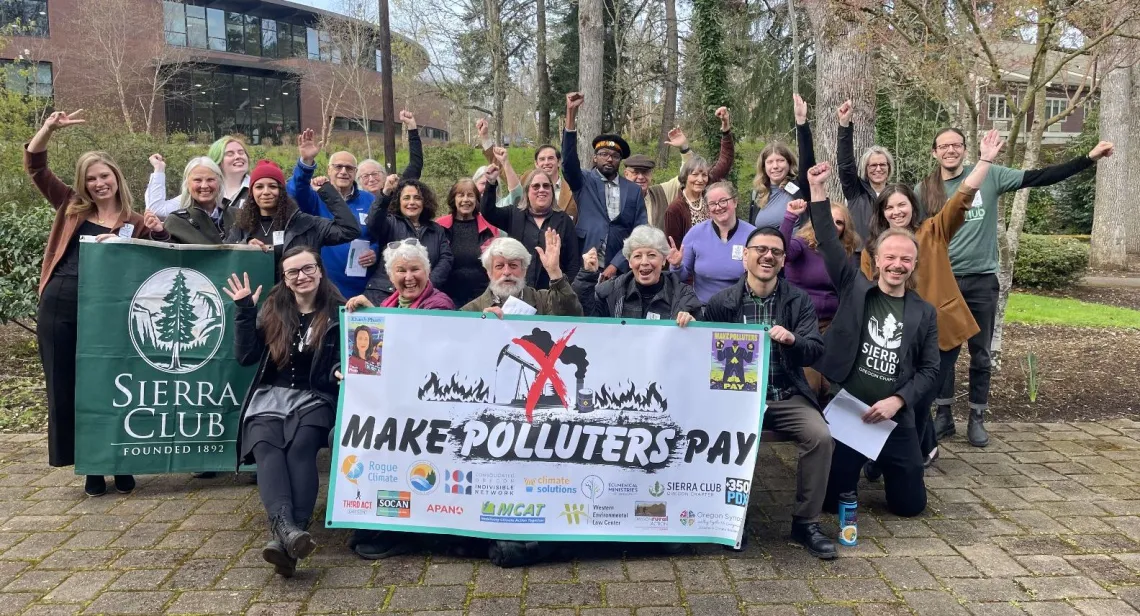
Sierra Club Oregon Salem Advocacy Day, March 2025
By Emily Bowes
Policy Strategist
Sierra Club Oregon
The 2025 Oregon Legislative Session was one of the busiest in state history, with more bills introduced than ever before and major decisions on the table for Oregon’s climate future. Sierra Club Oregon rose to meet the moment: expanding our presence in Salem, deepening our partnerships, and activating our grassroots base.
This year, we boosted our capacity with new staff, increased volunteer involvement, and stronger coordination with our allies across the environmental justice movement.
- In January, we launched our Legislative Engagement Training in collaboration with Rogue Climate to help empower members and supporters to advocate for change in state policy by building lobbying skills.
- In May, we re-launched our in-person Salem Advocacy Day, bringing together dozens of our members from across the state to advocate for climate action, community safety, and environmental justice. By bringing their voice directly to legislators, our members helped stop harmful legislation such as threats to our statewide moratorium on new nuclear waste, and supported the success of people-centered policies such as the POWER Act to make sure Big Tech pays their fair share for data center electrical grid costs.
- In June, we collaborated with amazing partner organizations like Columbia Riverkeeper, Oregon Physicians for Social Responsibility, Oregon Rural Action, Rogue Climate, Verde, and 350PDX to hold a Keep Oregon Nuclear Free lobby day at the state capitol which contributed to the defeat of all nuclear exemption bills introduced this session.
As we look ahead to the 2026 short session (which is only 30 days long!), we’re committed to growing our momentum for environmental justice with even more people power. We need your voice and energy year-round whether by joining our Climate Action Corps, helping identify and support climate champions running for office, or engaging in local campaigns during the interim.
Together, we’re building a stronger, more effective climate movement in Oregon and one that delivers lasting wins for our communities, ecosystems, and future.

Good bills that you helped succeed this session:
- HB 3546: The POWER Act will hold large energy users responsible for paying for their own energy needs. This bill requires state regulators to create new policies to help protect Oregon households from paying for the energy needs of data centers, cryptocurrency, artificial intelligence, and other big tech. It will also require for-profit utilities to identify the costs that these large energy users are adding to the overall grid system and make them pay their fair share. By creating a special category for these customers, regulators will protect Oregonians from covering the cost of these big businesses such as Amazon, Google, and Facebook.
- HB 3179: Fairness & Affordability in Residential (FAIR) Energy Act is a great reform to utility ratemaking to favor energy consumers such as by limiting how often utilities can increase billing rates and banning rate hikes during peak winter months. Disconnections have devastating health impacts on households, so preventing undue and untimely bill increases is essential.
- SB 688: “Performance-based ratemaking” modernizes how electric utilities profit by incentivizing good performance results from the energy grid instead of building new infrastructure, which is historically the only way that private utilities get a “rate of return” or profit..
- HB 2978: This new policy will help reduce wildlife-vehicle collisions by establishing an advisory group under the Oregon Department of Transportation and the Oregon Department of Fish and Wildlife to guide the development of safe wildlife crossings over or under busy roadways. Wildlife crossings are beneficial for ecosystem health, threatened species conservation, and improving rural road safety.
- SB 91: Prohibits fire departments from using firefighting foam with intentionally added PFAS, or per- and poly-fluorinated substances, except as required by the Federal Aviation Administration or other federal law. Growing evidence points to human health effects from PFAS “forever chemicals”, including increased cholesterol levels, changes in liver enzymes, small decreases in infant birth weights, decreased vaccine response in children, increased risk of high blood pressure or preeclampsia in pregnant women, and increased risk of kidney or testicular cancer.
Bad bills that you helped us stop this session:
- HB 2038: Would have directed Oregon State University to study the advantages of nuclear power. This study would have been highly biased in favor of industrialized nuclear development and a waste of state resources.
- HB 2410: This dangerous precedent-setting bill would have exempted Umatilla County from Oregon’s statewide moratorium on new nuclear waste. Amazon operates a large and energy-intensive data center in Umatilla County with plans to build more. Republican Rep. Bobby Levy from Umatilla says she plans to bring this bill back in 2026 so we plan to continue to fight for state protections against this dangerous, polluting, and outrageously expensive form of power production.
- SB 215 & 216: are various attempts to overturn Oregon’s long standing moratorium on nuclear power reactors, even though there is still no national nuclear waste repository.
- HB 3103: Would have undermined protections for Oregon’s state forests by putting clearcuts and logging above fish, wildlife, clean water, recreation and other values that Oregonians cherish for our state forests. This bill would have included halting implementation of the state forest Habitat Conservation Plan (HCP) that we and our forest conservation partners have fought long andhard to establish.
- HB 3119: If enacted this would have delayed Oregon’s clean truck rules for healthier air. Although we helped stop this bill, we are disappointed that the Oregon Department of Environmental Quality extended a delay to the clean trucks rule anyways, citing inaccurate complaints from vehicle engine manufacturers. We intend to continue pushing for enforcement of clean truck regulations as soon as possible, for the sake of public health and air quality across Oregon.
Good bills that unfortunately didn’t pass:
- HB 2025: The 2025 Transportation Funding Package, or any transportation funding package, ultimately failed to pass this session despite broad recognition of Oregon’s urgent transportation funding needs. Sierra Club Oregon supported many aspects of the bill (such as safe routes to school bike & pedestrian infrastructure, a study on free youth transit access, and funding to maintain public transit service levels) and worked with partners to improve its climate and equity provisions, such as working to reduce EV fees and add funding for EV rebates and charging stations. We are saddened that a transportation package couldn’t be passed. Lawmakers must do what it takes to support a transportation system that meets Oregon’s climate goals and serves all communities. We are already out of time to address badly-needed safety improvements, repairs to crumbling roads and bridges, and saving struggling public transit agencies. Whether through a special session or other means, Oregonians and our environment cannot wait any longer for real green transportation investments and reform.
- SB 702: This bill attempted to tackle teen vaping and would have banned flavored tobacco and nicotine products to limit their sale exclusively at liquor stores. Vapes are one of the highest sources of e-waste in Oregon, and e-waste has complex environmental impacts.
- HB 3580: Eelgrass meadows are nurseries for juvenile fish including salmon, herring, and shellfish species that are vitally important to our coastal ecosystem and economy. Passing this bill would have set up a Taskforce to set eelgrass conservation targets, assess monitoring programs, and evaluate policy barriers through a collaborative effort involving agencies, Tribes, scientists, local communities, and others.
- HB 3512: This proposed law aimed at prohibiting the manufacture and use of toxic PFAS chemicals in Oregon starting in 2026. PFAS are widely used, long-lasting chemicals that break down very slowly over time, according to the U.S. National Institute of Health. Due to their widespread use and persistence, many PFAS are found in the blood of people and animals globally and are present at low levels in various food products and the environment.
- HB 3143: Along with Sierra Club Oregon, advocates for agriculture, environmental protection and animal rights asked Oregon lawmakers for $1.5 million to promote coexistence with beavers on private land. We were saddened that this funding did not pass, even though on the bright side, another bill to restrict beaver trapping did pass.
- SB 88: Get the Junk Out of Rates Bill. Utility companies like PGE, Pacific Power, and NW Natural have all increased electric and gas rates by an average of 50% over the past five years. Currently, private utility companies like these can force everyday Oregonians to pay the costs of their political lobbying, trade association member dues, and event advertising and public relations through our gas and electric bills. SB 88 would have changed the rules to prohibit large utility monopolies from forcing us to cover the cost of corporate lobbying, pricey lawyers, and marketing.
- HB 3081: One Stop Shop 2.0 would have helped Oregonians access programs available at the federal, state, and local level to pay for heating, cooling, and other efficiency upgrades in homes and buildings, which reduces peoples’ energy bills. HB 3081 would have built on the existing Energy Hub for Incentive Programs + Projects in Oregon (HIPPO) and provided funding for a real person to staff support for those looking to become more energy efficient and resilient.
- Full Funding for Existing Climate Resilience Programs: We are incredibly disappointed the Legislature adjourned without delivering a single investment in popular, high-impact programs, such as community resilience hubs and heat pump rebates, which will now stall or wind down. Oregonians face another Summer of extreme heat, wildfire, and economic uncertainty, without state-funded programs to help households withstand climate impacts and lower the cost of utilities.
- Rental Home Heat Pump Program, needed $30m - Status: $0
- Community Heat Pump Deployment Program, needed $15m - Status: $0
- Community Resilience Hubs, needed $10m - Status: $0