In our most recent article we focused on adaptations to and preparation for sea level rise. Now, we’re going to focus on the power of advocacy for San Francisco Bay.
Even Small Wins Create Big Change
If you ever wonder whether your voice can make a difference, San Francisco Bay’s history has a clear answer: absolutely yes! The Bay we all depend on exists today because generations of residents refused to accept the idea that our shoreline was disposable. That same persistence is exactly what is reshaping how the Region responds to sea level rise.
Today, San Francisco Bay is undergoing one of the most important planning shifts since the creation of the Bay Conservation and Development Commission (BCDC) in 1965. That transformation is happening because countless small acts of advocacy have built upon each other, year after year.
From a Narrow Shipping Channel to a Beloved Natural Treasure
Only a few decades ago, the Bay was seen primarily as a working waterway, valued for moving goods, not for supporting life. Industrial pollution, wetlands destruction, and massive fill projects progressed for decades. At one point, engineers even seriously studied damming the Golden Gate and turning the Bay into a narrow canal.
Then in 1960, three women, Sylvia McLaughlin, Kay Kerr, and Esther Gulick, met for tea to discuss a shocking Army Corps map showing a future Bay nearly filled by 2020. Their outrage and grassroots organizing sparked a regional movement that transformed public attitudes and political will.
Within a decade, activism stopped the fill, protected what wetlands remained, and created BCDC, the nation’s first coastal management agency. For 60 years, that shift in public mindset has made restoration possible, creating thousands of acres of new marshes and opening miles of shoreline to the public.
All of that began with a handful of people deciding that the San Francisco Bay is important.
A New Era of Rising Tides Brings a New Wave of Advocacy
Fast-forward to today. Sea level rise is accelerating, groundwater is rising with it, and shoreline communities — especially socially vulnerable neighborhoods -– and the Bay’s own wetland habitats, face mounting threats. Once again, the Bay is at risk and needs persistent, informed, unrelenting advocates; and once again, small acts are adding up to create a public movement with momentum.
How Two Small Words Transformed Bay Planning
When regional leaders were developing the Bay Adapt Joint Platform (a consensus-based strategy to guide the region’s response to sea level rise), Sierra Club volunteers and many others pushed hard to ensure the Joint Platform embodied three core principles: the importance of having a living bay, the value of utilizing nature itself to improve our resilience, and the need to make environmental equity central to every decision. Nature and equity. Two words. Easy to overlook. Easy to underestimate.
But those words became leverage.
Because they appeared in the Joint Platform, those words gave shoreline advocates a foothold to insist they also appear in the 2023 legislation that required all shoreline jurisdictions to develop sea level rise adaptation plans. That law tasked BCDC with developing planning guidance, and gave it authority to approve local plans based on consistency with those guidelines. Explicit references to nature and equity in the legislative text may have seemed vague and modest at the time. Yet those “hooks” gave us what we needed to press for real, enforceable nature-based and equity standards in BCDC’s Regional Shoreline Adaptation Plan (RSAP) Guidelines.
And it worked.
In December 2024, BCDC adopted the RSAP, the Bay Area’s first-ever regional standards for sea level rise planning. Until now, the region relied on a patchwork of local efforts, voluntary frameworks, few consistent standards, and limited BCDC oversight.
The RSAP changes that. It sets consistent, regional expectations to:
- Prioritize nature-based solutions wherever possible
- Require meaningful engagement of socially vulnerable communities
- Address groundwater rise and related contamination threats
- Coordinate adaptation across jurisdictional boundaries
This marks a profound shift from a fragmented sea level rise planning approach that was biased toward hardened, engineered infrastructure, to a holistic, resilient, equitable approach grounded in nature, community needs, and regional collaboration. Persistent Bay advocacy successfully transformed BCDC’s approach to the RSAP. What began as a concept of a regional plan that valued the Bay primarily for its aesthetic and recreational benefits, ultimately became a Plan that recognizes, prioritizes, and seeks to preserve the many essential roles Bay ecosystems play in the region’s long-term resilience.
Because of these new standards, sea level rise planning across the region must consider strategies beyond concrete barriers and hardened edges. Nature-based solutions, like wetlands restoration, horizontal levees, habitat migration corridors, and community-centered adaptation must be prioritized, not treated as “nice-to-haves,” but as expected regional practice.
All of that momentum started with two small words, added by persistent volunteers who refused to give up.
Big Advocacy Wins Don’t Happen Overnight. They Build Incrementally
The Bay’s progress has come from years of steady steps, each one enabling the next. Consider how we got here:
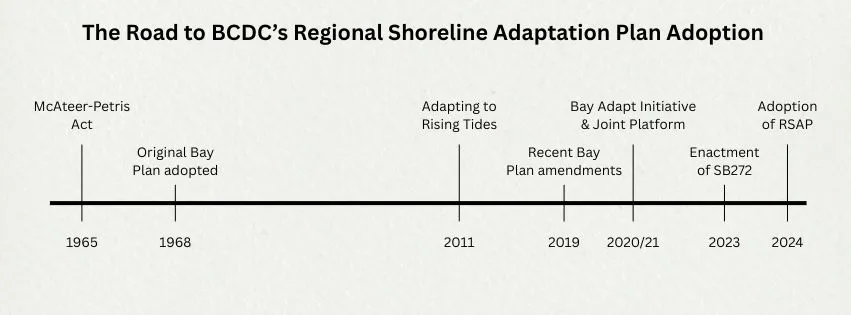
These key steps built necessary momentum to achieve a strong, coordinated sea level rise response. (See below for more detail about each step.)
This is how advocacy works. Not in one big win, but in dozens of smaller ones, each opening the door to the next.
Why Your Voice Matters Now More Than Ever
For the first time, BCDC can set standards beyond the 100-foot shoreline band and help shape how cities plan their future. Developers, urban planners, and decision-makers can no longer shrug off sea level rise with an “I’ll be gone by then” mindset. The region is moving from reactive, piecemeal defenses to a coordinated system of resilient, nature-based adaptation.
But this shift is new and fragile. It only happened because local residents kept showing up: writing letters, speaking at hearings, reviewing documents, joining coalitions, and asking uncomfortable questions.
We’re not done.
The RSAP sets the standards, but cities still need to implement them. And while all cities must create a plan, they will suffer no repercussions from the State if they then ignore it. This is a huge gap that must be corrected. As it is, hundreds of projects, levee upgrades, and shoreline plans will unfold in the coming years. Without watchdogging, education, and public pressure, old habits could easily creep back in. Although local flexibility is necessary, we can’t let it be used as an excuse for sidestepping the values underlying the RSAP standards.
Take Your Place in History
By joining the Sierra Club’s Bay Alive Campaign, you become part of a remarkable lineage of people who refused to let the Bay be diminished, ignored, or sacrificed.
Your voice can help:
- Keep equity and nature at the center of every shoreline plan
- Ensure that cities choose wetlands over walls
- Protect communities from groundwater rise and contamination
- Champion nature-based solutions that grow stronger over time
- Hold agencies accountable to the standards we fought so hard to secure
Every letter. Every survey comment. Every public meeting. Every person who tells a friend why we need to keep the Bay alive.
It all adds up, just like it always has.
This is the power of Bay advocacy.
This is how change happens.
And this is your invitation to help shape the Bay’s future.
Join us. Bay Area scientists are providing the research and tools that advocates need to support the restoration and expansion of wetlands, the protection of existing shoreline habitats, and the implementation of environmental justice policies.
Be the next link in this long, inspiring chain of Bay champions.
Key Steps in the March Toward Holistic, Equitable Sea Level Rise Resilience
BCDC Bay Plan Climate Change Amendments (2011):
Advocates successfully pushed BCDC to recognize the urgency of sea level rise and the essential role of tidal habitats in climate resilience. Unfortunately, while these amendments established a philosophical foundation for integrating sea level rise adaptation into regional shoreline policy and affirmed the need to protect and sustain tidal wetlands as part of long-term community resilience they had no teeth and provided BCDC with no legal authority to insist that these goals be met.
Adapting to Rising Tides (2011):
BCDC, partnering with local, regional, state, and federal agencies, launched one of the Bay Area’s first comprehensive efforts to evaluate how current and future flooding could affect communities, infrastructure, ecosystems, and the regional economy. The project built vital technical capacity across the region and provided the tools needed for informed, science-based sea level rise planning.
BCDC Bay Plan Amendments (2019):
Responding to strong community and environmental advocacy, BCDC adopted landmark amendments recognizing the Bay Area’s environmental justice history and requiring more meaningful public engagement in shoreline planning. These changes also enabled greater use of beneficial Bay fill for habitat restoration, laying important groundwork for large-scale, nature-based resilience projects.
Bay Adapt (2020–2021):
Through sustained public engagement, advocates ensured that the Bay Adapt Guiding Principles, and the resulting Joint Platform, explicitly prioritized working with nature (it is here that “put nature first” was first recognized as an important goal in addressing sea level rise adaptation) and addressing inequities. This regional consensus process became a key policy bridge between earlier voluntary frameworks and the mandatory regional standards to come.
SB 272 (2022–2023):
Building on those principles, advocates helped secure the inclusion of nature and equity in SB 272, the legislation requiring every Bay shoreline jurisdiction to develop a sea level rise adaptation plan. SB 272 also charged BCDC with creating regional guidelines and granted the agency approval authority, making these values part of the law.
RSAP Adoption (2024):
After years of public comments, expert input, community organizing, and inter-agency collaboration, BCDC adopted the Regional Shoreline Adaptation Plan (RSAP) — the Bay Area’s first-ever regional sea level rise standards. The RSAP establishes strong, science-based, equity-centered guidelines for shoreline planning that protect both communities and ecosystems, and it provides a unified framework to guide local action through 2034 and beyond.