Last month, we discussed groundwater rise, mobilization of contaminants, and environmental justice. This month we’ll focus on why the timing and type of sea level rise adaptation matters so much.
There is no stopping sea level rise. It is the result of such large-scale processes that even if we stopped emitting greenhouse gases today and the climate stopped warming, it would take centuries for sea levels to stop rising, but we don’t have that kind of time. We must adapt. Yet, how and when we do so are among the most important choices we still control.
Sea level rise adaptation is a race against time. Space is one of the most important factors in determining which adaptation methods are feasible for any shoreline. As sea levels rise and floodwaters move further inland, our options become more constrained. Which is why it is crucial to begin planning for sea level rise as soon as possible since decisions we make now can either expand our adaptation options over time, or lock communities into approaches that are harder, more expensive, and less effective to change later.
This forward-thinking approach is especially important in land use policy. Every new building, road, parking structure, or other infrastructure placed in vulnerable shoreline areas can take space needed for adaptation strategies and increase the number of people and assets exposed to future flooding, ultimately raising the long-term public cost of protection.
Of course, in many places neighborhoods, roads, utilities, businesses, and public facilities are already in harm’s way. Although six and a half feet of sea level rise by 2100 may sound distant, damaging impacts are already occurring during king tides, storms, and high groundwater conditions.
We tend to think of sea level rise adaptations in two different categories: grey, hardscape solutions and green, nature-based solutions. Grey infrastructure, including seawalls and engineered levees, can be useful, and in some places necessary. It often requires less space, and may even have lower upfront costs. However, it is not a cure-all. Armoring our shoreline can create new problems if done too early or in the wrong places. For example, grey solutions can worsen flooding by blocking stormwater and emergent groundwater from draining back into the Bay, destroy conditions needed to sustain essential shoreline ecosystems, and even become more expensive over time as repairs become necessary, breaches occur, or conditions change and require taller barriers.
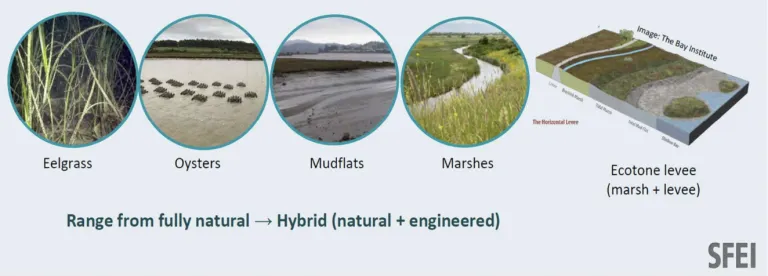
Green infrastructure, also known as natural and nature-based solutions (NNBS), work with natural systems rather than walling them. NNBS are often more resilient because they are not static structures. Healthy marshes, beaches, oyster reefs, eelgrass beds, and transition zones can trap sediment, absorb wave energy, support habitat, and independently adjust as conditions change. When marshes have sufficient space, sediment, and healthy ecological conditions, they can gradually build elevation and migrate inland, allowing them to keep providing protection instead of being squeezed.
Where feasible and well-designed, NNBS protect against flooding while extending the natural resilience functions of the Bay’s wetlands, soils, and water. These approaches are generally more cost effective, resilient, and protective against the “hidden” underground threats discussed in our last article. They can range from fully green strategies, such as marshland restoration or the introduction of eelgrass or oyster beds, to hybrid solutions such as horizontal or ecotone levees that combine engineered flood protection with habitat benefits as depicted in the photo below. Unlike traditional levees, these nature-based levees use a more gradual, vegetated slope toward the Bay, creating a transition zone for marshes and other shoreline habitats to migrate upland as the water rises.
Hard infrastructure should generally be viewed as a strategy of last resort, not the first move. A smarter approach is phased adaptation: make the most of what natural systems can provide now, while planning for more aggressive adaptation in the future. In some places, that may mean restoring and enhancing wetlands, or locating new development and infrastructure away from vulnerable shoreline areas. In others, it may mean combining nature-based features with engineered structures. Either way, the goal is to preserve options, reduce armoring, lower public costs, and extend the life of the Bay ecosystems we depend on.
Of course, fully green solutions are not feasible everywhere. Some shorelines are already too heavily developed, and not every location is suitable for the habitats that create the most benefit. However, even where seawalls or levees are necessary, setting them back from the shoreline and adding nature-based elements on the Bay-side of these structures can reduce wave energy and erosion, as well as extend the life of the infrastructure behind them.
The key is to act now, with an eye toward the future. Now is the time to dedicate natural and under-developed shoreline lands to long-term resilience functions. Now is the time to commit to a phased strategy that can adapt to changing conditions over time in the most cost effective and sustainable way (self-perpetuating natural solutions first, nature-based, hybrid infrastructure next, ever-taller seawalls as last resort). Now is the time to ensure that we keep the Bay alive, for the good of us all.
In our next article in the series, we’ll cover the Regional Shoreline Adaptation Plan, guidelines for local jurisdiction sea level rise plans.
Until then, you can help us keep the Bay alive! Learn how you can take action or join the campaign.