By Vicky Hoover & Kieran Farr
Green SF Now: Grassroots Action in Progress
The Sierra Club's San Francisco Group has launched an exciting new grassroots campaign called Green SF Now. The goal is simple yet transformative: bring more nature into San Francisco—more permeable surfaces, less paving. More green, less gray.
The campaign was inspired by the recently concluded SF v EPA Supreme Court case (see companion article here) as well as the SF Group’s 2024 State Water Boards complaint regarding the SFPUC Mission Creek (Folsom Area) floodwater improvement project. While the City planned to simply replace underground sewer pipes with more “gray infrastructure,” our Sierra Club volunteers led by Kieran Farr envisioned something more ambitious—transforming affected areas into green parks with seasonal creeks that would honor the neighborhood's original watershed. Though initially met with bureaucratic resistance from various city departments, this vision has evolved into a collaborative movement focusing on achievable neighborhood greening projects citywide.
Kieran worked with the Chapter's Water Committee to apply for a Sierra Club Grassroots Network grant to design educational material for tabling purposes and otherwise publicize the idea of greening the City. Green SF Now was born and is now working on several local projects.
The San Francisco Group's Green SF Now team has already held 5 events (learn more at greensfnow.org). Our objective has been to work directly with communities to identify where residents want green infrastructure and where opportunities exist in public spaces all across the city. Recent events at Treat Plaza and the Sunset Dunes Park opening have generated tremendous public interest, with Sierra Club volunteers Kieran Farr, Terry Potente, Vicky Hoover, Elizabeth Creely, Brian Reyes, Mahdi Rahami, Parker Kjellin-Elder and many others helping to engage hundreds of community members who have signed up to support the initiative.
Light Green, Deep Green
Our campaign promotes understanding of the basic concepts of green infrastructure, which comes in two main forms:
Light Green Infrastructure involves surface-level improvements that create more ways for plantings to hold and divert water and can be low-cost enough for anyone to implement. These solutions clean the air, filter water, and reduce toxic runoff during storms. They're less costly to install while providing multiple environmental benefits: reduced flooding, increased humidity and canopy to mitigate urban heat island effects, and enhanced local biodiversity.
Deep Green Infrastructure represents more comprehensive efforts that update waste treatment systems with nature-based solutions and are often City agency capital projects or grant-funded initiatives. While more complex to implement, these improvements address interconnected environmental challenges, including sea level rise, ensure maximum protection of fragile ecosystems, and offer significant opportunities for biodiversity while lasting much longer than traditional “gray” infrastructure.
Benefits Beyond Stormwater
Green infrastructure delivers multiple benefits beyond just managing water:
- Clean Water: By diverting stormwater before it enters treatment facilities, green infrastructure helps prevent untreated sewage from reaching the bay and ocean during heavy rains.
- Aquifer Resilience: Capturing rainfall where it falls recharges local aquifers, providing backup water supplies during emergencies while reducing pressure on the Tuolumne River watershed, supporting endangered salmon populations.
- Biodiversity & Wellbeing: Green spaces restore native ecosystems, expand our inequitably distributed urban tree canopy, and mitigate urban heat islands, creating healthier neighborhoods where people and wildlife can thrive.
- Safe Streets: Features like bulb-outs improve visibility and shorten crossing distances, while planted medians and bioswales create protected spaces for walking and biking, naturally calming traffic.
The Land Challenge
Finding space for green infrastructure in San Francisco requires creative thinking. There are three potential sources: private property, publicly owned parcels, and shared public right-of-way spaces. Each of these needs political will and grassroots advocacy to succeed.
The most promising progress has been with the publicly owned parcels of the San Francisco Unified School District, which has large continuous acreage and limited internal funds of its own for groundworks. School grounds provide excellent opportunities for permeable surfaces that can absorb stormwater while creating educational green spaces for students.
But schoolyards alone won’t get us to our campaign goal of 60 acres of Green Infrastructure in two years – which is where your help comes into play! We need to find more space in the city for this critical green infrastructure. Where should we put it?
Connections to State Initiatives
Green SF Now perfectly aligns with California's 30x30 initiative—conserving 30 percent of our lands and waters by 2030. One of the principal 30x30 goals is to give disadvantaged urban communities greater access to nature and promote urban wildlife habitats through more green areas and connecting corridors.
The Sierra Club's statewide 30x30 task force is excited about the San Francisco project and hopes to inspire similar actions in other urban areas across California. By restoring native ecosystems in urban environments, Green SF Now demonstrates how cities can contribute to larger conservation goals while improving quality of life for residents.
How You Can Help
We need your involvement to reach our goal of 60 new acres of permeable surface in two years. Here's how you can help:
- Visit greensfnow.org to learn more about the campaign and upcoming events,
- Sign up for our email list to stay informed,
- Find areas in your neighborhood that would be a good fit for greening projects, and
- Advocate for green infrastructure in your community.
Together, we can transform San Francisco's relationship with water, restoring natural processes that clean our Bay while creating more livable neighborhoods for everyone.
Vicky Hoover is a longtime Sierra Club volunteer and 30x30 task force member. Kieran Farr is a member of the Sierra Club San Francisco Group Executive Committee.
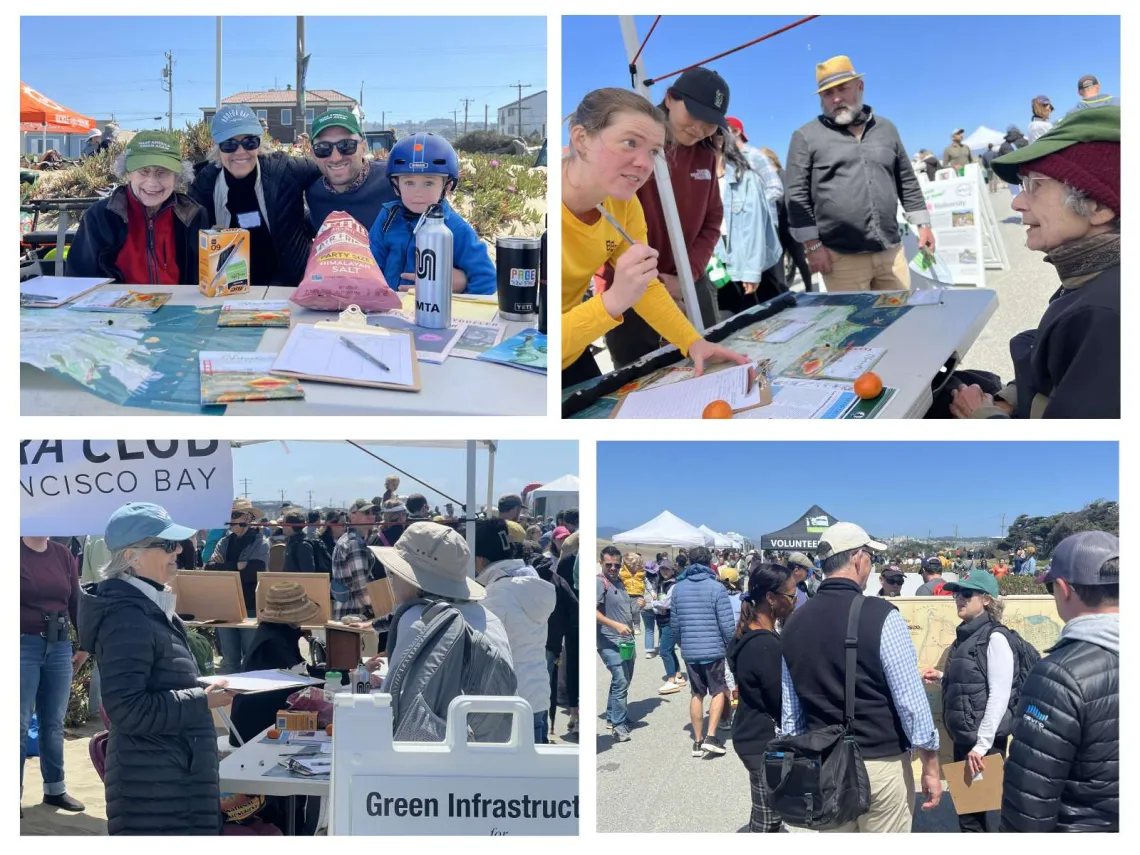
Upper-Left: Volunteers Vicky Hoover, Terry Potente, Kieran Farr, and 4 year old Max tabling at Sunset Dunes opening celebration Saturday, April 12, 2025
Upper-Right: Vicky registers a new member to join the Green SF Now and Bay Alive campaign mailing list
Lower-Left: Terry chats with a community member who wanted to learn more
Lower-Right: Volunteer Elizabeth Creely discusses the history of the west-side watershed and the importance of Green Infrastructure with Scott Sampson, Executive Director of the California Academy of Sciences
Photos courtesy of Kieran Farr.