By Kieran Farr
Water Pollution in the Bay: A Growing Crisis
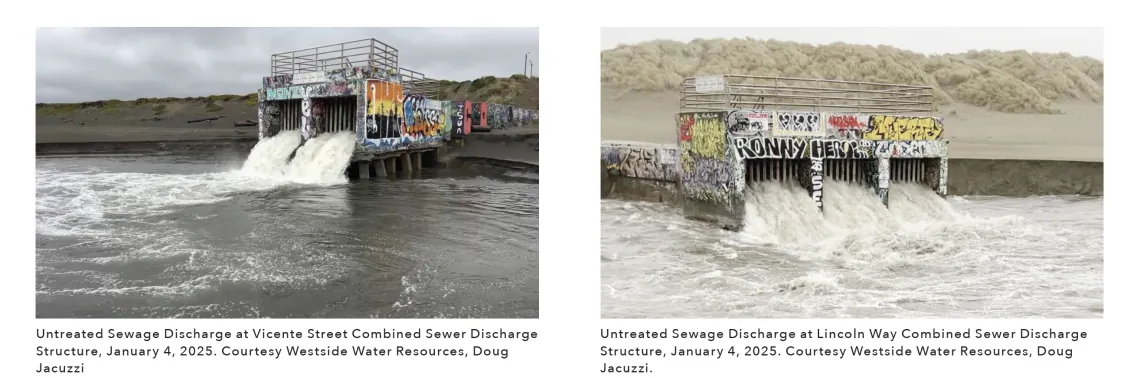
The waters of San Francisco Bay are in crisis. Regular algae blooms, persistent contamination, and combined sewer overflows have created a steady state of pollution that threatens ecosystems, recreation, and public health. San Francisco's outdated combined sewer system—unique among California coastal cities—mixes stormwater with wastewater during heavy rains, overwhelming the system and regularly sending untreated sewage directly into the Bay and Pacific Ocean.
This system, dating back to the 19th century, has replaced what was once a rich network of natural waterways. Beneath the streets of San Francisco once flowed creeks, lagoons, and acres of tidal wetlands that served as natural filters. Freshwater flowed – or seeped – from crevices in the most surprising of places. On the west side of the city, the vast expanse of natural sand dunes soaked water up into deep underground aquifers. These waterways were systematically buried during the city's development and transformed into underground sewers that now fail during heavy storms.
San Francisco v. EPA: A Controversial Legal Battle
The City’s aging combined sewer infrastructure – and the increasing cost to maintain it – forced San Francisco into an odd position on the wrong side of clean water advocacy. This recently culminated in March 2025. In a 5-4 decision, the Supreme Court ruled in favor of San Francisco in its case against the EPA, significantly limiting the federal government's ability to enforce water quality standards nationwide.
The case began when San Francisco challenged EPA regulations to avoid penalties for discharging sewage into the Bay and Pacific Ocean from its combined sewer system. The city argued that the Clean Water Act doesn't authorize the EPA to include broad "end-result" requirements in permits—essentially fighting for less oversight of its pollution.
The legal battle created unusual divisions. As Scott Webb, former Vice Chair of the Sierra Club San Francisco Bay Chapter, lamented in a CNN interview, "We're setting a playbook for a lot of other polluters. It's shocking that it's coming from San Francisco." The city allied with oil and gas industries, the National Mining Association, American Petroleum Institute, and American Chemistry Council, hoping to reduce their environmental compliance obligations. In response, a grassroots movement, led by the Sierra Club, the Resource Renewal Institute, and the Surfrider Foundation, built a coalition of close to 50 community groups, hundreds of San Francisco residents providing testimony, and the longest closed session in response to the public engagement in recent memory.
Led by Supervisor Melgar, the Board of Supervisors voted 8-2 urging David Chiu to resolve the suit quickly, warning that a Supreme Court ruling in the City's favor could "greatly harm water quality nationwide." Supervisor Myrna Melgar expressed concern: "I'm very nervous about going to the court. We run the risk of having it apply to everybody." Mayor Breed, David Chiu, and Dennis Herrera decided to go forward with suing the EPA.
The Supreme Court Decision and Its Impact
The Supreme Court's conservative majority ruled that the Clean Water Act doesn't authorize the EPA to include "end-result" provisions in permits. Instead, the Court determined it's the EPA's responsibility to specify exactly what steps permit holders must take to ensure water quality standards are met.
As Sierra Club Chief Appellate Counsel Sanjay Narayan noted after the ruling, "SCOTUS's decision ignores the basic reality of how water bodies and water pollution work, and could stymie the ability of the EPA to implement the Clean Water Act, a bedrock environmental law that has kept water safe for the last 50 years."
The implications are serious. "Because the EPA is not allowed to include health-based standards when regulating water pollution, it'll need to know everything about what might be discharged before a clean-water permit can be issued—making the permitting process delayed and incredibly expensive," Narayan continued. "The result is likely to be a new system where the public is regularly subjected to unsafe water quality."
From Setback to Green Action
While the Supreme Court decision represents a significant setback for clean water protections nationwide, it also creates an opportunity for grassroots action. Cities across America, including San Francisco, can voluntarily implement so-called “Green Infrastructure” solutions that reduce pollution without waiting for federal mandates.
Green infrastructure represents more comprehensive efforts that update waste treatment systems with nature-based solutions. While sometimes more costly to implement up-front, these improvements address interconnected environmental challenges, including sea level rise, and ensure maximum protection of fragile, natural ecosystems while lasting much longer than traditionally engineered stormwater projects.
The Sierra Club San Francisco Group has been at the forefront of Green Infrastructure advocacy, raising a formal complaint in 2024 with the California State Regional Water Quality Control Board about the lack of green infrastructure solutions for stormwater flooding mitigation projects in the Mission Creek watershed.
Finding Allies Within the System
Not all of San Francisco's Public Utilities Commission (SFPUC) is resistant to change. Despite the SFPUC’s poor reputation for protecting the environment, there is a Green Infrastructure team dedicated to implementing nature-based solutions for water management. In fact, the SFPUC has budgeted $100 million to capture 60 acres of watershed with green infrastructure. The challenge? They can't spend the money fast enough due to the complexities of urban land use, interdepartmental coordination, and lack of political support. They need our help.
This is where initiatives like the Sierra Club San Francisco Group's Green SF Now campaign (featured in a companion article here) become crucial—grassroots efforts that push for implementation of green infrastructure solutions regardless of court rulings or federal requirements.
By transforming our concrete cityscape into a more permeable, living system that mimics natural processes, we can achieve cleaner water while creating healthier, more resilient communities.
When the courts fail to protect our water, we must take action in our communities. Together, we can transform the Bay Area’s relationship with water, restoring natural processes that clean our Bay while creating more livable neighborhoods for everyone.
Kieran Farr is a member of the Sierra Club San Francisco Group Executive Committee.