 The Magazine of The Sierra Club
Green From the Ground Up
From siting to size to solar, how one activist grappled with the decisions that went into building his ecofriendly home
THE GREENEST I EVER LIVED was back before I gave the environment a thought. I was a broke young writer sharing a sublet in Manhattan, and to say I lived frugally--well, here's the proof. One afternoon thieves broke into the apartment. They found my roommate asleep, tied him up, and then relieved him of his early-generation Betamax and a few other tools of his trade (he was a movie critic). From me, they stole the cardboard box where I kept my dirty clothes, which they used to carry out my roommate's stereo. He survived, and I found another cardboard box.
I don't live that way anymore. I have a wife, a child, a dog, a car (a hybrid), a video player of my own, and a house. Somewhere in a drawer I also have a certificate announcing that said house was the greenest structure of its size built in Vermont in 2002. But what I'm trying to say, right at the start, is that such a prize doesn't necessarily mean much. There are many ways of being environmentally sensible, some of which don't look green at all. The story of our house-raising illuminates some of those choices.
For one, there's location. Ever since Henry David Thoreau, environmentalists have wanted to live in the woods, which doesn't make much environmental sense. First of all, you need to cut down some of that forest to make room for your house. Then once you're out there on the fringe, you need to travel a long way, usually by car, to get to a job or a store. You can make a strong argument that urban living is the greenest choice and that New York City, simply because so few of its residents own cars or can afford big apartments, is the most sustainable city in the United States.
But my wife and I were done with New York City--and cities in general. We'd been done with them for quite a while, in fact. We'd spent the past 15 years deep in New York State's Adirondack wilderness, living in a ramshackle farmhouse and learning some of the ways to build a reasonably durable life there: providing our own fuel in the form of firewood, for instance. When we moved to Vermont, we knew we wanted to live in the mountains, and because we both work at home, commuting wasn't an issue. We found the town that was right for us, and since there were no existing homes for sale, we decided to build. That's a tough call to begin with--buying an old home can be an effective form of recycling. But the lure of this place triumphed, whereupon we did our small part to wreck it. Not grievously--wonderful friends sold us a vest-pocket meadow deep in the woods. A road already led to it, and the land had been cleared for a century and a half. Still, we had to take down a couple of trees, and our glade isn't as pretty as it was before now that there's a house sitting there. But all things considered, not so bad.
Next comes scale. The average size of new U.S. homes has more than doubled over the past couple of generations, even as the number of people residing in them has shrunk by nearly a full person. The last glory days of the now-fading construction boom were the most insane of all: Outer rings of crenellated and turreted fortresses were sprouting near virtually every U.S. city, each dwelling looking as if it had been designed for an entry-level monarch. The really rich, meanwhile, amused themselves by building above every ski hill and beach ranks of second homes that looked like nothing so much as modernist junior high schools. The environmental costs are myriad, of course--more materials used in construction (making cement for foundations alone is a prime contributor to global warming) and more energy used to heat and power all the resulting square footage. You can turn the thermostat down a degree or two, but if the furnace is warming 4,500 square feet, it's a token gesture.
For me and my wife, the best part of building a new house was sitting with an old designer friend and figuring out what we actually wanted our place to do. We listed all the things that mattered to us: cooking, reading by the fire, having enough bookshelves, and exercising. He configured a space that had room for them and not much more. Now we spend most of the day and evening in one big central room next to the woodstove (and in the summer months, next to a screened-in porch). Our bedrooms are relatively small, because it doesn't take much space to sleep. We're fine with only taking showers, so there's no need for a tub in the compact bathroom. And so on. At a little over 2,000 square feet, the house isn't miniature by any means, but even with two home offices, it's well below the average square footage of a new house in the Northeast (2,600 square feet). And the fact that every inch is useful is even better--there aren't rooms we never venture into, closets we don't need. It's right sized. (Except that we didn't get enough bookshelves.) When--inevitably--we found ourselves running out of money, we had to start jettisoning desires. We're fine without most of the items dropped from our wish list (I've made it this far without a post-and-beam bedroom, and I'll doubtless survive), but those built-in bookshelves would have been nicer than the small Himalayas of review copies and bound manuscripts that dot the house.
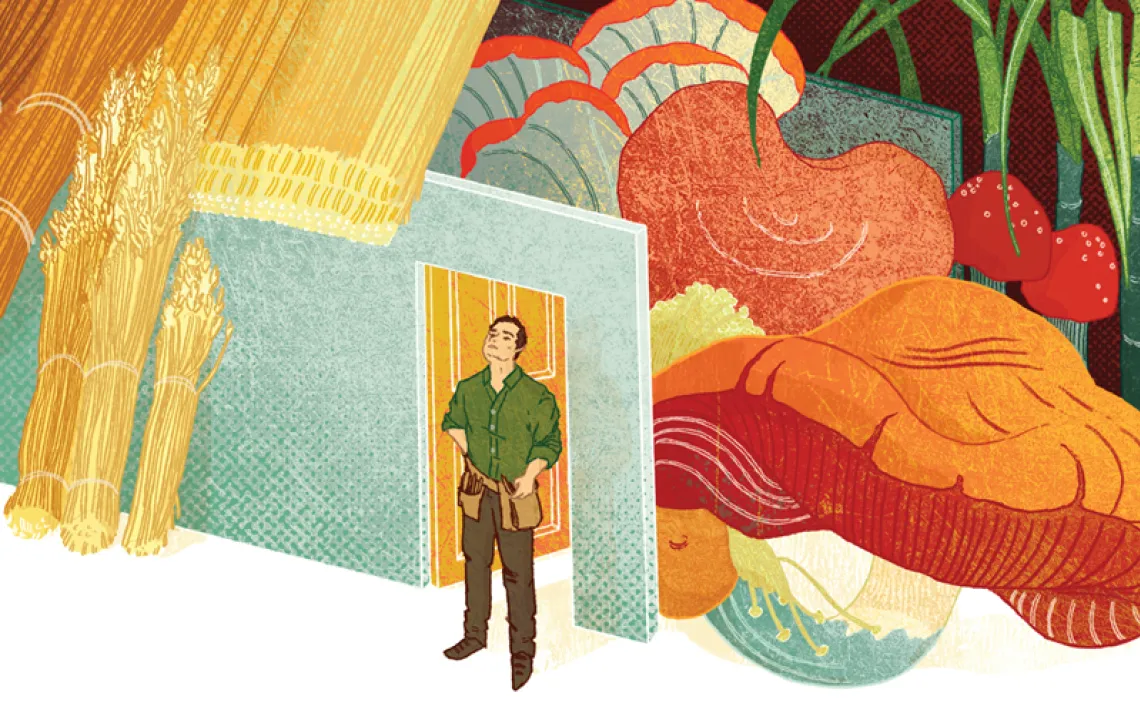
Watching our house go up was nerve-racking but also intriguing--the relative importance of various environmental choices became clear just from watching the shell of the place emerge. The real fun came from figuring out how to source materials for the house. Since we were living in a forest, some of it was easy. A neighbor with a team of horses cut a few trees in the forest fringing our meadow, and we used those big firs and spruces for beams. (The traditional technique is to put them up green and let them dry--the first year we lived in the house, we were regularly jolted awake by the gunshot crack of curing wood.) For floors and moldings, we turned to other neighbors. The innovative conservation group Vermont Family Forests was leading an effort to add value for local loggers, and we were one of the first customers for its new products. In particular, the group was pushing floors made not from a single, often imported, species of wood, but from "what the local forest wants to give." In our case, that meant birch, beech, and maple, mixed in a beautiful variety. Vermont Family Forests also specializes in "character wood," i.e., boards with knots and swirls that too often get tossed out in favor of the perfect clear grain that comes from managed plantations. If we'd lived in another region, we would have relied on some other wood for the floors and maybe built the walls with hay bales or adobe--materials that spoke of the place and spoke of it softly.
We got to make other choices too--carpet from recycled fibers, flooring for the mudroom that comes from cut-up tires, and decking made of old plastic Pepsi bottles and sawdust. In each case, the materials took less from the earth and, just as important, promised to be more durable than their conventional counterparts. Five years later, so far so good.
"Green" means a lot of things, of course, and with any finite budget, it's crucial to figure out what's most important. In recent years, the environmental movement has morphed steadily into the climate-change movement--we've come to understand that the single greatest threat the world faces is global warming, and hence the most important solutions have to do with energy. And students of energy have come to understand something else: Though we focus on how we generate power, job number one is almost always figuring out how to conserve it.
The real revelation had to do with insulation. Lots of insulation, mostly blown-in cellulose, which is to say shredded newspapers--just the right thing for a writer to surround himself with. In the ceiling, the insulation is more than a foot thick; when the contractors were blowing it into the walls under high pressure, a whole panel burst from the force. If the insulation is low-tech, the windows are high--probably the most expensive part of the house, ordered specially from a Canadian company. They come with three panes of glass and argon gas in between to increase their efficiency; coupled with a perfect southern exposure and all that insulation, they're enough to keep the house perfectly warm anytime the sun comes out and relatively snug even through a week of gray. Snug enough, in fact, that the biggest chore became how to ventilate: It takes a network of piping and a heat-exchange filter to keep sufficient fresh air flowing in the winter.
We also spent many hours on the Internet figuring out which appliances sipped the least energy. Some of that work paid off--the front-loading washer, for instance, really does the trick. It uses half the water of a traditional washer, which means half the energy necessary to heat the water, and it spins the clothes so fast that they emerge very nearly dry. (Though it must be said that when visitors hear that wild spin cycle for the first time, they invariably think that a small plane is taking off from the basement.) The refrigerator has its freezer on the bottom, which not only saves energy (warm air from the top-mounted compressor rises) but also means more of the items we use most often are at eye level. The compact fluorescent bulbs take a little getting used to; we're happy when one burns out now because we can replace it with a newer model that doesn't take so long to come up to full glow. And the dishwasher--well, we got it because it was supposed to use less hot water than washing by hand. But ours turned out to be a little too eco-sensitive. It doesn't actually heat the water enough to clean the plates, so we have to rinse by hand first.
EVEN BASIC APPLIANCES REMIND YOU that politics is at least as important a driver for change as consumer choice. The Bush administration has consistently scaled back its efficiency expectations, while in Japan and Germany, manufacturers compete on how little energy they use, driving a virtuous cycle of innovation. In fact, any house like ours is primarily a model, an experiment to see what works, to let architects and contractors try new approaches. The day it will really matter is when the results of these experiments are written into building codes and industry standards. That day is coming faster in some places than in others: California's new climate law, for instance, will almost certainly force changes on developers. But change needs to come sooner, for by now it's clear that most home builders, concerned only with the initial selling price, aren't taking the steps necessary to make their houses sustainable (and cheaper to operate) in the long run.
The real proof of that failure can be seen from the window of an airplane approaching any U.S. city. Even in, say, Reno, Nevada, with 300 days of sunshine a year, how many solar panels do you see on roofs? Not very many--in fact, the pace of installations across the United States has barely caught up with the first solar boom, during the Carter administration after the OPEC oil shocks.
For me and my wife, figuring out how to power our house was one of the final decisions. Some choices were obvious--for example, solar panels that heat water for domestic use pay back their installation costs in a couple of years, even in the mountains of northern Vermont. If your roof faces south, you'd be crazy not to install some, especially since a growing number of states offer a tax credit for doing so.
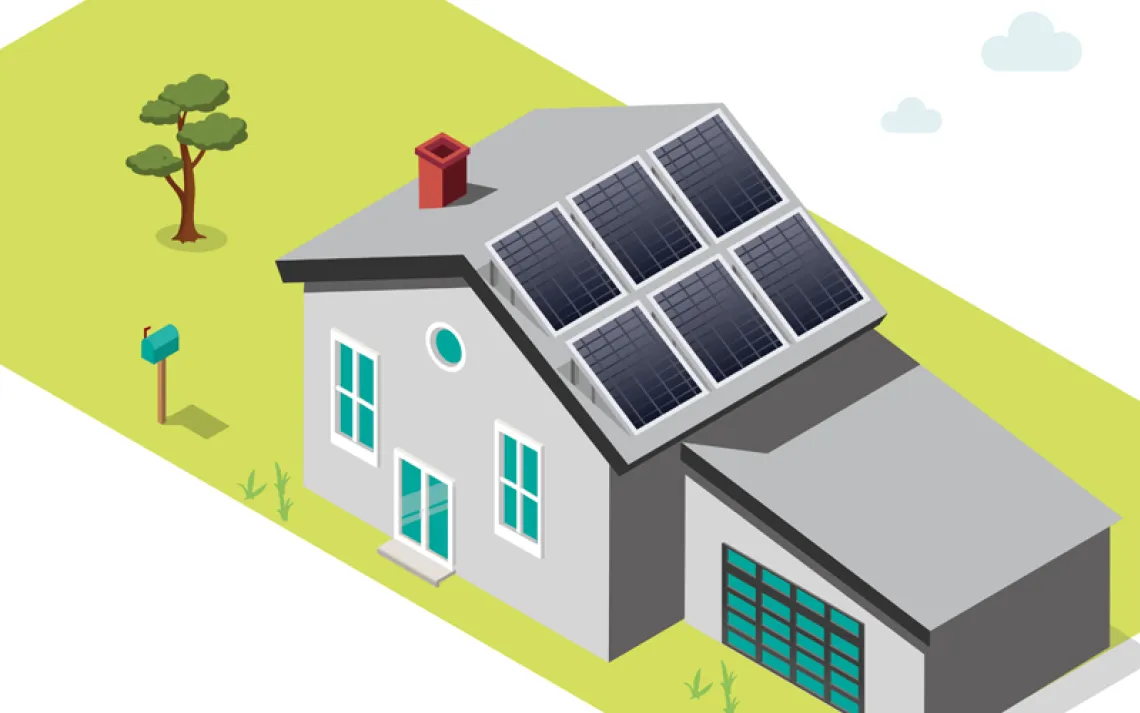
Photovoltaic panels for generating electricity are another matter. They're still pretty expensive, though the cost has begun to come down steadily (driven mostly, as usual, by the Japanese and Germans, who have subsidized enough installations to force real declines in cost). We swallowed hard and took the plunge--a dozen big panels cover most of the south-facing roofline. They work fine, but they won't pay for themselves for more than a decade. (Though my dishwasher, car, and computer aren't paying for themselves either.) It's sheer pleasure to know that we're generating most of our power from the sun, pleasure that is worth the price for us. On a sunny day, the electric meter on the side of the house turns backward all afternoon.
Still, we had two questions. One, would we simply start using more electricity now that it was, in some sense, free? The answer turned out to be just the opposite. Somehow the comprehension that your power comes from something real (the sun shining above) instead of something abstract (a wire in a wall) makes you more likely to turn off the light than before. It also makes you more likely to put the wash in a basket, go outside, and hang it up on the clothesline, an $18 device that can trim your annual household power use by 5 percent and gives you a few moments to listen to the birds sing. I wish we were even more aware of how much power we use--I've seen prototypes of lovely devices that hang in, say, your kitchen and change color with the electric load, reminding you to conserve. I can't wait to get one.
The other question was even more basic: Did we want our solar house to be on or off the grid? Traditionally, most solar installations have been off-grid--that is, they didn't have a wire leading in from the road. People generated power and stored it in batteries in the basement. They were totally self-sufficient. In recent years, though, with the invention of effective "inverters" that interface between home and network, more and more Americans have gone to "grid-tied" solar or wind. That is, when their homes generate power, they serve as a small utility, pushing electrons down the line into the larger grid. At night, people take power back from the network. In essence, they use the grid as a giant storage battery.
That's the route we took, and only partly because we were too lazy to maintain a bank of batteries. More important, we liked the idea of connection--of an energy grid that works more or less the way the Internet does, with some of us feeding in and all of us taking out. When the sun shines, the juice from our roof runs our neighbor's fridge and powers his vacuum. When the sun doesn't appear, we depend on someone else. (At the moment, that someone else is most likely a big coal-fired power plant, but in the not so distant future, with the right set of government policies, there's no reason it can't be a windmill or a mini-hydro plant.)
When we're aware of these connections, we're reminded of the most important technology of all, the technology of community. The real problem with living off the grid is that it can sometimes lead to an all-too-American isolation. It's like growing such a huge garden that you don't need to get food from anyone else. There's something noble about it, I suppose, but how much more satisfying is it to go to the farmers' market and buy items you can't grow?
And in the end, how much more green. One reason my wife and I chose the town we did was because we liked the community we found there--people who work side by side to make the whole place come together. We have committees diligently studying community-scale hydro- and wind power; everyone spends a weekend every other year to run the recycling operation at the town garage. The only way we're going to get out of the blind alleys into which we've stumbled is to work together locally and nationally--to build everything from transit networks to food systems that make us less isolated individuals and more parts of the whole. A house, at its best, is not a remote castle; it's a node on a network, a leaf on a branch, a hair on a root. That's the real green future.
Bill McKibben is a frequent contributor to Sierra whose most recent article was "Energizing America" (January/February). McKibben, a scholar in residence at Middlebury College, is the author of many books, including Deep Economy: The Wealth of Communities and the Durable Future (Times Books, 2007), Wandering Home (Crown, 2005), and The End of Nature (Random House, 1989).