 The Magazine of The Sierra Club
At the City of Joy, Women Learn to Farm, Heal, and Lead
This center in the Congo supports women who are victims of violence and war
Photos by Carlos Schuler
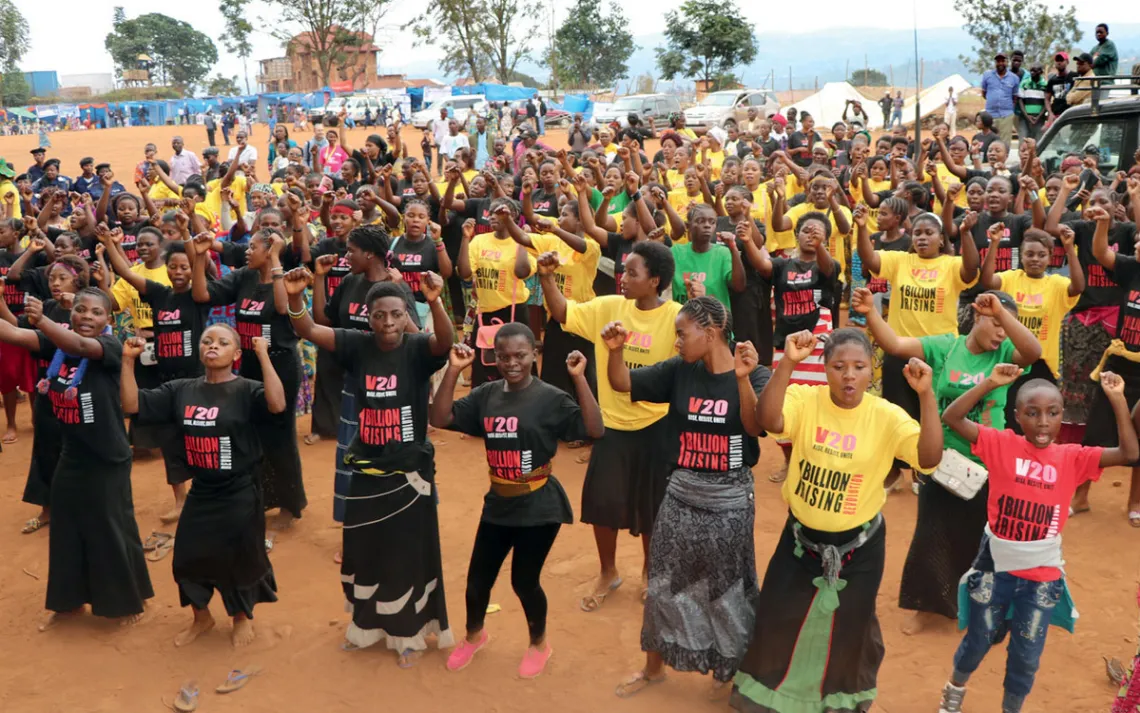
Nearly 90 women snake around a classroom in a jubilant conga line, laughing as they go. Their pace quickens as four female staff members pound drums, faster and faster. A teacher, Jane Mukunilwa, calls out a chant, and the women sing it back as they whirl in single file around the edges of the room.
The dancers, students in the City of Joy’s class of 2025, range in age from 18 to 30 and hail from villages and towns across the war-torn eastern provinces of the Democratic Republic of the Congo (DRC). Each of the women who participate in the City of Joy program in Bukavu, a city of 1.3 million people, has endured some form of violence. For many, it was at the hands of rebel soldiers or in the camps that house some of the 6 million displaced by conflict. Those who survive sexual assault struggle to recover and find acceptance within their families and communities, which often shun them.
At the City of Joy, the women learn to accept themselves, to begin a journey of healing, and to return to their communities as leaders. The center’s six-month program begins with the basics—reading and writing (in rural areas of the DRC, only one in five women is literate). From there, students move on to civic law, nutrition, reproductive health, and self-defense: tools to know their rights, their bodies, their strength.
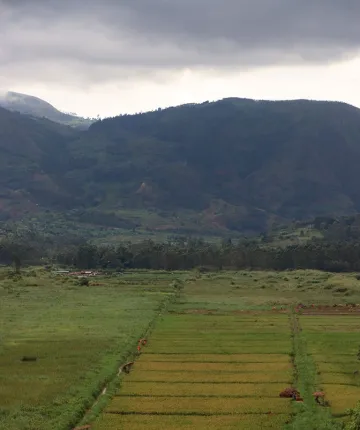
But learning and therapy are not confined to the classroom. Students also work on the City of Joy’s 835-acre farm, with its sweep of crops, livestock, fishponds, and beehives. As the farm and the surrounding community reel from the ongoing impacts of war and a changing climate, the women work as a collective to grow the food that sustains the center year-round. They are taught that developing a healthy relationship with the earth is another way of healing themselves.
Mukunilwa came to the City of Joy in 2011 to heal after being attacked by soldiers. Upon graduating, she chose to stay, wanting to serve as living proof of the center’s motto: “Turning pain to power.”
The farm at the City of Joy is ringed by about 30,000 trees—most of them tall, rustling eucalyptus planted by students. The center runs a restoration program for the surrounding, deforested hills and has woven climate change into its curriculum in response to the region’s increasingly extreme weather. Each year, heavy rains pummel the country, prompting rivers and lakes to burst their banks. Torrents of muddy water have torn down riverside villages. In 2024, floods killed more than 300 people and destroyed around 100,000 homes, according to the United Nations. The City of Joy has suffered too. Its classrooms often flood—a year ago, the farm lost its entire bean crop and much of its rice after the fields became waterlogged.
Despite facing severe impacts from climate change, the DRC has contributed little to the problem. The country is responsible for just 0.01 percent of the world’s annual carbon dioxide emissions. Its eastern provinces are rich, fertile mazes of emerald hills, lush forests, and jungle-matted volcanoes. Murky brown rivers snake through thick vegetation and spill out into chains of gray-blue lakes. Most of the DRC lies within the Congo Basin, the second-largest rainforest on the planet. But rampant deforestation—largely caused by cutting down trees for charcoal—is ruining the country’s forests and treasured carbon sinks.
“We are taking, taking, taking from Mother Earth,” says Christine Schuler Deschryver, the tall, charismatic woman who runs the City of Joy and is often dressed in bright Congolese fabrics. “But how do we give back?”
The City of Joy was born out of a series of conversations. In 2007, American playwright V (formerly Eve Ensler) interviewed Denis Mukwege, a Congolese doctor renowned for treating survivors of sexual violence, in New York. Mukwege, who would later win a Nobel Peace Prize, had founded Panzi Hospital to care for these women. V was deeply affected by her meeting with the doctor and wanted to see his work for herself. At his invitation, she traveled to the hillside hospital in Bukavu.
V spent several days sitting at women’s bedsides, listening to their harrowing stories. She asked what she could do to help.
“They asked for a place where they could heal, grow, become leaders, change their destinies,” V recalls.
They are taught that developing a healthy relationship with the earth is another way of healing themselves.
The City of Joy opened in 2011—funded by V-Day, an organization founded as part of V’s global movement to end violence against women and children. The center is run by Congolese staff.
Since its opening, 2,322 women have passed through the City of Joy’s doors. When their six months are up, graduates are meant to return to their communities as leaders and agents of change. They are reintegrated with ongoing support and guidance on applying the skills they’ve learned to a new life. Some graduates have gone on to start nonprofits as well as businesses, farms, orphanages, and homes for the elderly. They now refer other women to the City of Joy, which Schuler Deschryver calls a “revolution center.”
The center's teachers are loud and bold. That is intentional: Like Mukunilwa, they strive to be strong role models. In the group therapy sessions, intended not just to facilitate individual recovery but also to establish communal bonds, the students learn that they are not to blame for what they’ve been through.
“The group therapy taught me to accept myself,” Mukunilwa says. “It made me understand that I am not alone.”
Out on the farm, students gather the bounty of their efforts—beans, carrots, cassava, corn, tomatoes—and nourish the land. The women compost to enrich the soil and transform protein-rich algae into feed for fish and chickens. For every tree cut down for wood, at least one is planted. The farm employs dozens of graduates too.
One of them, Siou Borauzima, wakes up at dawn each morning. She slips on her boots and rushes out to the fields, squelching across marshy grassland to a row of tilapia ponds. After feeding the fish, she sets off for the rice fields.
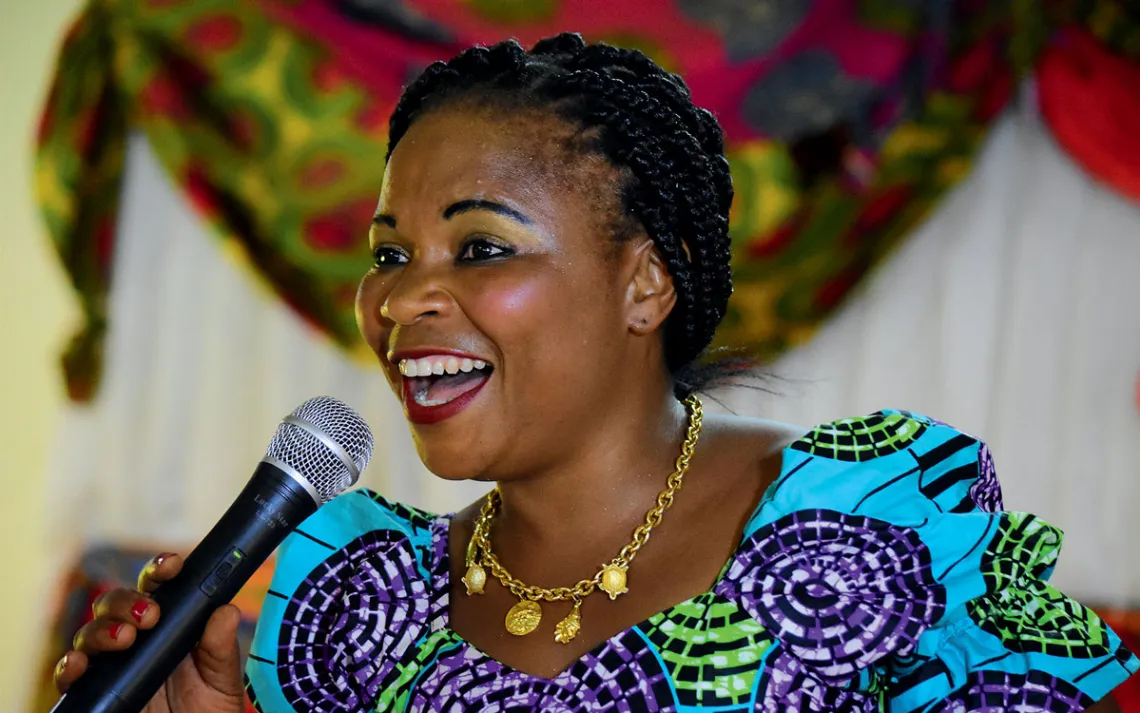
Jane Mukunilwa
Nature, she says, is still helping her heal.
Rebel soldiers sexually abused her and cut off her left hand. Borauzima subsequently gave birth to a daughter, Sintia. At first, she struggled to accept her child, but with support from the City of Joy, which helped them bond, the two are now close. Sintia studies at a nearby university and often visits her mother on the farm. Schuler Deschryver dreams that she will one day return to the center as a psychologist.
“The farm is like medicine to me,” Borauzima says, her voice rising with excitement as she talks about her work. “It is a peaceful place, a paradise, a place where you do not hear gunshots. And when you love nature, when you care for it, it gives back.”
Once they have finished the conga line dance, the women form a circle. Mukunilwa sings out a refrain in a beautiful, unwavering voice. “V-Day is a movement that brings change,” it goes, in Swahili. “Change for the women of Congo.”
The students sing it back, jumping into the circle, clapping and stomping their feet.
The center’s buildings are a clutch of brick bungalows curved in a U around a garden sprouting grass and waxy flowers. Outside the walls surrounding the City of Joy, eastern DRC is under occupation. People are struggling more than ever.
Yet here, in this circle of women, there is feverish hope. Around them, the classroom is adorned with banners. Under a blue-and-red Congolese flag is a laminated sign with the words “Self-care is how you take your power back.” Against another wall are six colorful photos of former students. A banner reads “Welcome.”
Mukunilwa’s open, round face radiates warmth. Her long braids drip over her shoulders as she bounces while she bangs a drum and sings. She bears little resemblance to who she was in 2011, when she showed up in Bukavu. Mukunilwa was treated at Panzi Hospital and then moved to the City of Joy, where, bit by bit, she started to heal. She was buoyed by the camaraderie among students.
“All the women at the City of Joy have suffered from similar stories, the same tragedies,” she says. “I have healed from the trauma. I have become a leader. Now I want to encourage other women who have lost hope.”


