Fresh Food for Everyone
Soul Fire Farm is on a mission to eliminate racism in the food system
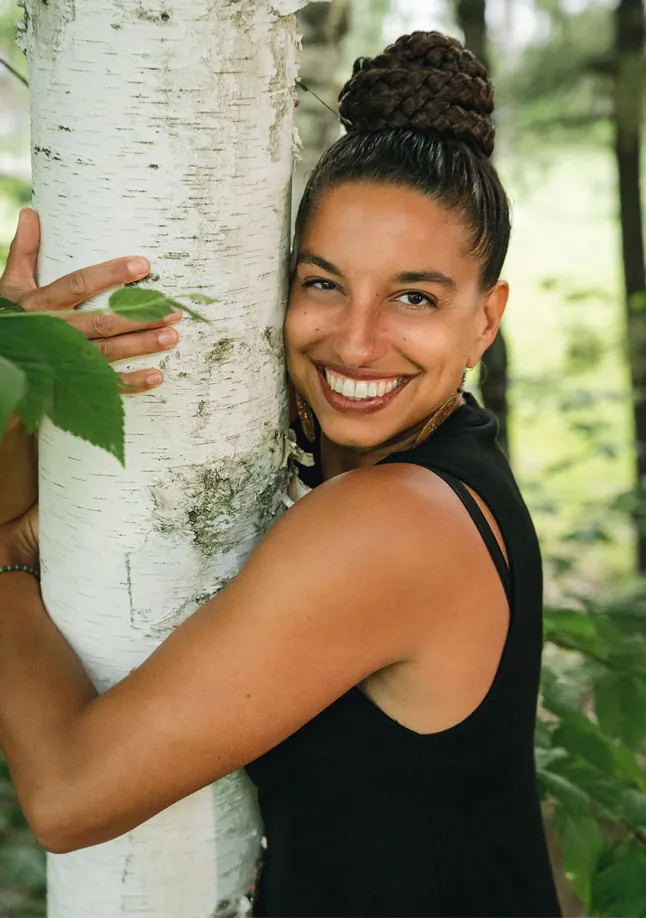
Photo by Jamel Mosely
Leah Penniman spent most of her childhood playing in the woods surrounding Ashburnham, a primarily white, working-class town in central Massachusetts. There, she and her siblings made friends with the trees, lakes, and mountains—wild places that offered a balm to the racial conflicts plaguing their community. When Penniman and her sister learned about global warming and how human activities were hurting the planet, they started the Junior Ecologist Kids Club. They picked up trash and rode their bicycles on pollution patrol.
In her teens, Penniman found a summer job at The Food Project in Boston, growing produce and serving food in urban neighborhoods. The experience was formative. She learned firsthand that for some communities of color, getting fresh food is nearly impossible.
“The system of segregation where certain people are enjoying food opulence and others are relegated to food scarcity is not natural,” Penniman says. “If you look at the red-lining maps, the housing discrimination maps, and you overlay them with food deserts, you get an almost perfect match.”
After years of training at other farms and teaching environmental science in public schools, Penniman decided to start her own farm to feed Black communities in need. In 2006, she and her husband bought 72 acres in a small hill town outside Albany, New York. The land had rocky clay soil, but it was what they could afford. They began enriching it.
Penniman’s goal for the farm was more transformational: to challenge the systemic racism that often underlies unequal access to fresh, affordable food.
Following four years of demanding yet joyful labor, Penniman opened Soul Fire Farm to make good on her commitment and began bringing fresh food to Albany’s South End neighborhood.
Soul Fire offered a community farm-share program designed to address food inequity. Members signed up to receive shares on a sliding scale, and the farm delivered boxes of fresh produce directly to their doorsteps every week. But feeding families was only part of the mission. Penniman’s goal for the farm was more transformational: to challenge the systemic racism that often underlies unequal access to fresh, affordable food.
Soul Fire Farm began rolling out initiatives that linked food justice to racial justice. In its third year, the farm started the Youth Food Justice program as a response to the disproportionate number of Black men incarcerated in the United States compared with white men. The program, implemented in collaboration with Albany County courts, offered teenagers and young men of color the option of completing 50 hours of farm training as an alternative to serving time.
“It really empowered these young men,” Penniman says. “When the county came out to assess the program, we put the teens in charge of demonstrating what they had learned by teaching the county professionals how to farm. So here are these older men in suits, carrying clipboards, and the teens are showing them how to get down on the ground to harvest a turnip.”
In the following years, Soul Fire Farm developed programs for adults, offering immersion opportunities for burgeoning BIPOC farmers and fellowships with stipends and professional development for those with already established farming projects. Over 1,000 farmers of color have benefited from these programs.
“It unlocked things that had otherwise been locked up,” says M. Dominique Villanueva, an in-augural recipient of the Braiding Seeds Fellowship, which provided $50,000 and 18 months of mentorship.
Villanueva started farming in 2018, growing food on an unused lot in her neighborhood of Fountain Heights in Birmingham, Alabama. She put the extra food from her garden on a table in front of her house. Before long, she was growing and distributing over 600 pounds of produce a year. “I was exhausted,” Villanueva says. “Then the pandemic hit, and I didn’t know if we could continue.”
That was when she learned about Soul Fire Farm’s fellowship. It was the boost she needed—to not only keep going but also expand operations. “I got our fiscal sponsor through this program. I’ve been able to receive hundreds of thousands of dollars in grants,” Villanueva says. She is using the money to open a grocery store in her neighborhood, which is experiencing the same kind of racialized food scarcity that moved Penniman to start Soul Fire Farm.
Heart of the Farm—run by the Fountain Heights Farms Cooperative—will be the first grocery business in this area in nearly 70 years. It will include a community kitchen and provide infrastructure for local vendors and food growers to sell their goods. Above the store, the building will have housing for the apprentices who come to train on Villanueva’s farm.
“It’s a full-circle moment,” Villanueva says. “Now I have something to share.”
Penniman assembled stories like these, along with the wisdom she had gleaned from her own experience, into a book project. Farming While Black: Soul Fire Farm’s Practical Guide to Liberation on the Land is widely considered an essential read for current and aspiring Black farmers, and it serves as an instruction manual for those who can’t make it to her farm.
The book’s success gave Penniman the visibility to influence legislation at the national level. She met with Senator Elizabeth Warren, who helped develop a platform that became the basis for a bill called the Justice for Black Farmers Act. Elements of the bill were later included in the Inflation Reduction Act.
Penniman’s work to create a more just food system is far from complete, especially as programs centering diversity, equity, and inclusion are under attack. To help the movement endure, she has changed how she spends her time.
“When I first was starting out, I did everything,” Penniman says. “Now I’m shifting to trying to empower others to take the lead. We have to constantly be equipping the generations to come.”