The Winds of Clean Energy Keep Blowing
A new Rhode Island offshore wind farm brings the country one step closer to a renewable energy future
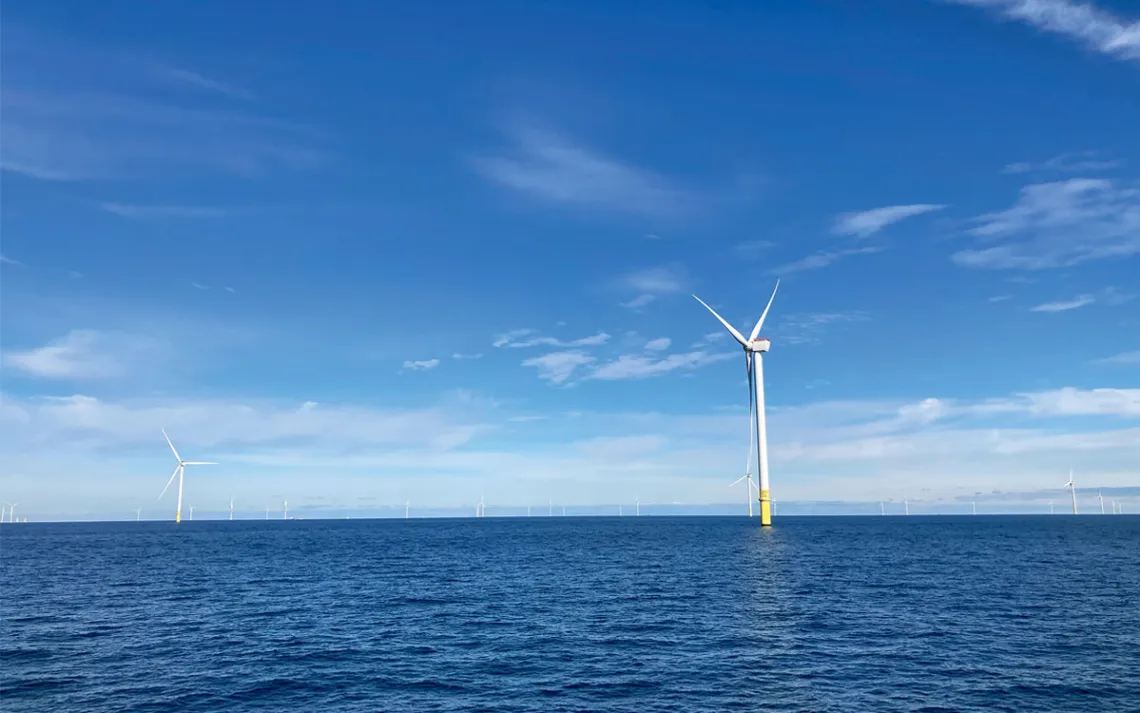
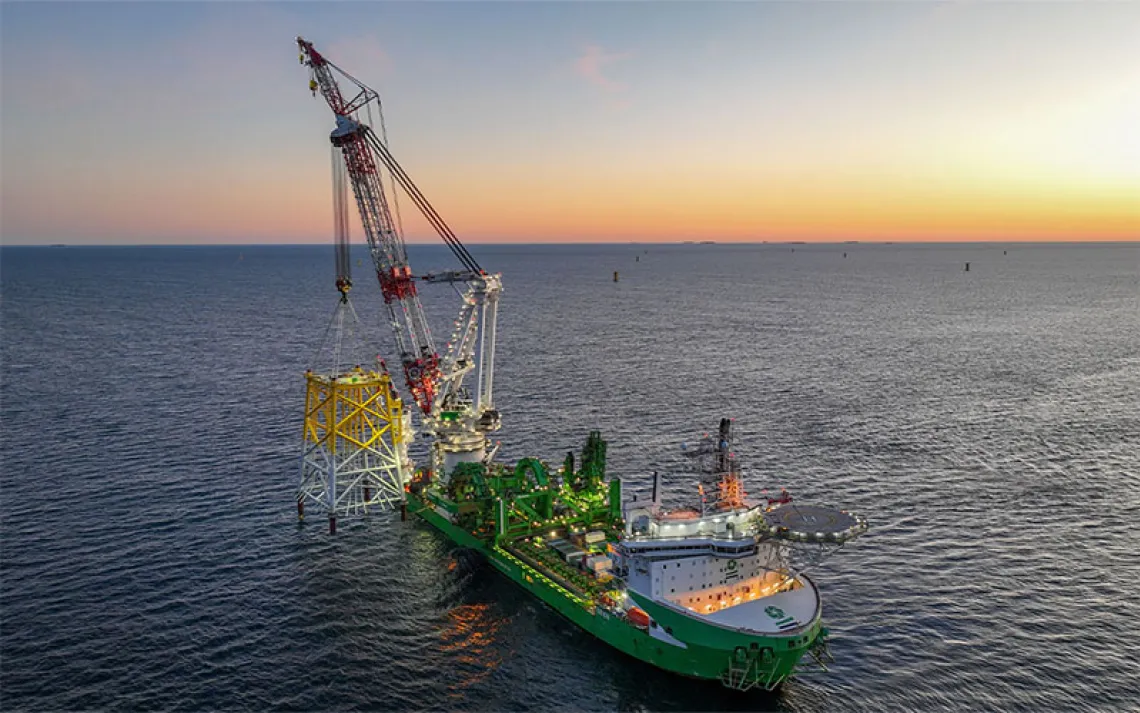
Photo Courtesy of Ørsted
It was a crisp, clear November morning when I boarded the Rhode Island Fast Ferry, a catamaran called the Julia Leigh. Our destination: South Fork Wind, America’s first commercial-scale offshore wind farm, about 20 miles southeast of Block Island.
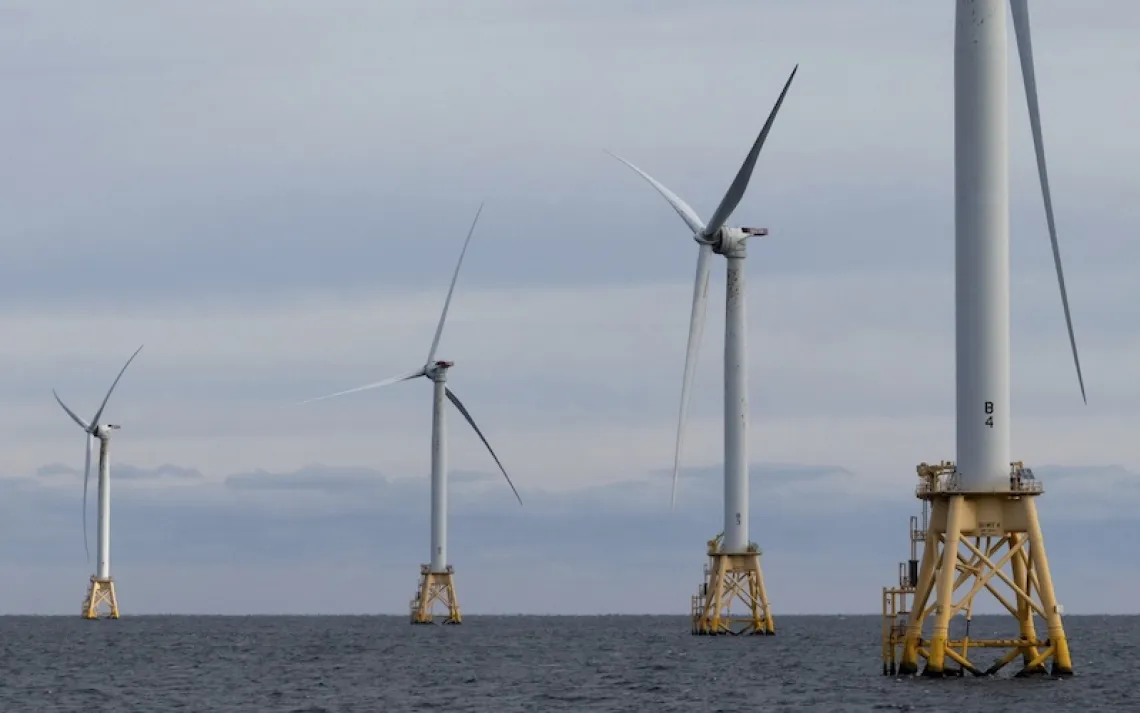
The 132-megawatt project, developed by Danish energy firm Ørsted, came online in early 2024. South Fork’s generation capacity from 12 turbines is nearly five times that of the Block Island Wind Farm, whose five turbines—also developed by Ørsted—have supplied 100 percent of the small community’s electricity since 2016.
These pioneering projects are helping drive a nationwide energy transition—replacing polluting power sources with clean, renewable ones. Yet wind power is facing enormous headwinds from a federal administration intent on shutting it down. “It’s been a tough year for offshore wind,” said Amber Hewett, senior director of the National Wildlife Federation’s offshore wind team, who joined the trip to South Fork. “This is still worth fighting for.”
As the climate crisis accelerates, the biggest greenhouse-gas-emitting nations will need to hasten their move away from the very thing driving it: fossil fuels. Wind, like solar, is a critical part of that transition, and the two are among the cheapest and most scalable ways to cut energy-related emissions. According to federal estimates, the carbon footprint of coal-fired energy is 90 times greater than that of wind, while the fracked-gas footprint is 40 times bigger. When large-scale wind farms are up and running, feeding energy to entire communities, they reduce our dependency on, or completely displace, dirty sources like methane gas and coal.
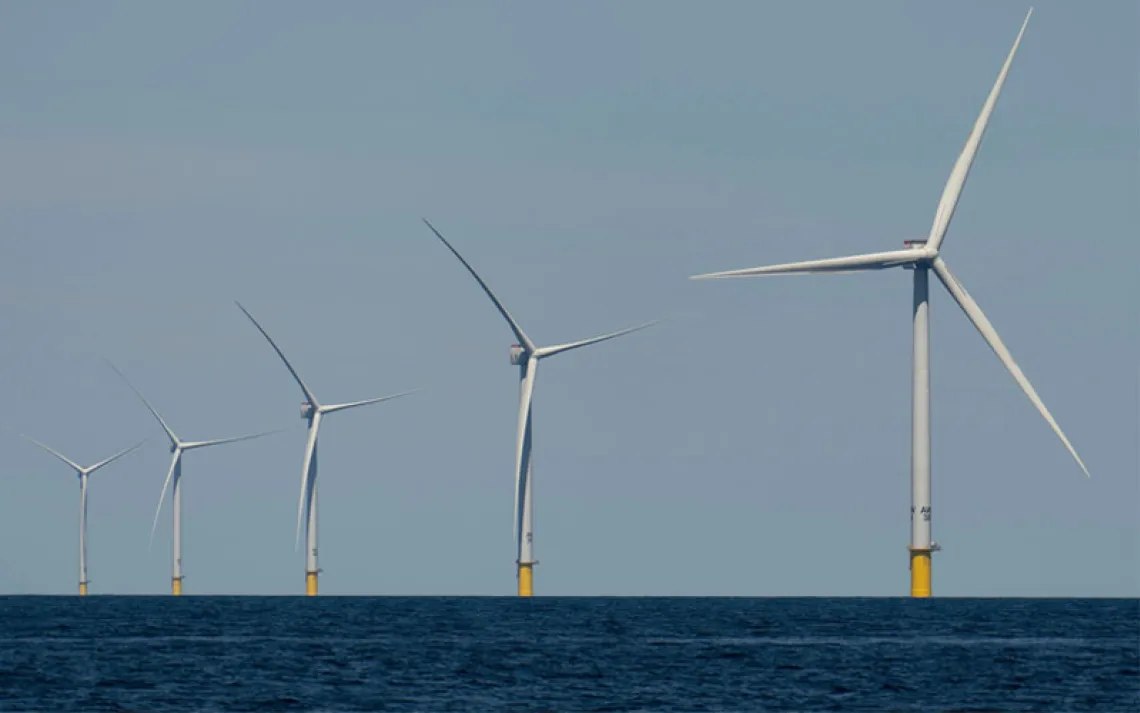
About 45 minutes into the trip, a series of wind turbines came into view on the horizon—part of another, even larger offshore wind farm called Revolution Wind, which Ørsted is developing slightly northeast of South Fork. The 65-turbine, 704-megawatt site is expected to come online in the second half of 2026, delivering carbon-free power to more than 350,000 homes in Connecticut and Rhode Island. The project has overcome stop-work orders issued by the Trump administration—first in August and again in December, when construction was already 87 percent complete.
After passing Revolution Wind, we arrived at South Fork—its towering three-bladed structures jutting from the ocean like marine skyscrapers. Our boat glided close to one of the turbines, whose rotating blades were remarkably quiet, making a gentle swooshing sound. Wind speeds were relatively light, and yet the blades were still spinning. In ideal wind conditions, a single rotation of the blades can generate enough electricity to run an average US household for a whole day.
Each of South Fork’s turbines is connected through an undersea cable to an offshore substation, where the electricity is converted to a higher voltage and then transmitted to shore via a 78-mile-long export cable. This substation—built by more than 350 workers from three states—was the first one constructed in the United States for an offshore wind farm, Ørsted’s Norm Zeyak explained.
More than 1.5 million hours of union labor went into building South Fork Wind, which created over 1,000 jobs. Construction was completed in spring 2024, and by the following July the farm was fully operational. It is now delivering enough clean, renewable electricity to New York’s Long Island grid to power the equivalent of 70,000 homes.
Contrary to the narrative that wind energy is unreliable and intermittent, South Fork has been producing power consistently. “Even as wind speeds vary naturally, the project produced electricity more than 92 percent of the time during the first half of 2025,” Zeyak said. According to Ørsted’s performance data, the project’s average capacity factor—a metric of how much power is generated relative to its maximum possible output—was around 46 percent for the first full year of operation. And for the first half of 2025, that figure was 53 percent, which is on par with performance metrics for New York state’s most efficient methane-gas plants.
Offshore wind production tends to be highest during the winter, when the gas system in the Northeast is under the most pressure due to constrained pipeline capacity and increased demand. “When you have competing needs in the winter with gas for heating and the price spikes because of that, offshore wind can really provide a steady source of cost-effective electricity for our communities that’s clean when natural gas isn’t,” Megan Rising, a senior director at the Union of Concerned Scientists, told me on the visit to South Fork.
South Fork’s turbines are spaced one nautical mile (a little over a mile) apart. This “creates a good, straight transit line for vessels and others to safely navigate through the wind farm,” Zeyak said, adding that the site is “completely open for both transit and fishing activities.” And underwater photos and benthic, or seafloor, monitoring indicate that marine life has been flourishing, with the turbine foundations serving as artificial reefs. Some participants on the tour even spotted a dolphin.
It was a beautiful day to be out on the water. As we made our way back to shore, I snapped a photo of the offshore turbines from the rear of the vessel. An American flag, attached to the stern, billowed in the wind.
“It was a stunning aesthetic and visual experience,” Christian Roselund, co-director of Climate Action Rhode Island’s Yes to Wind campaign, said of the tour. “[The turbines] look to me like a livable planet.”