The Trump Administration’s Campaign Against Renewable Wind Reaches a New Phase
Environmental advocates say that stop work orders will raise consumer prices and risk energy shortages
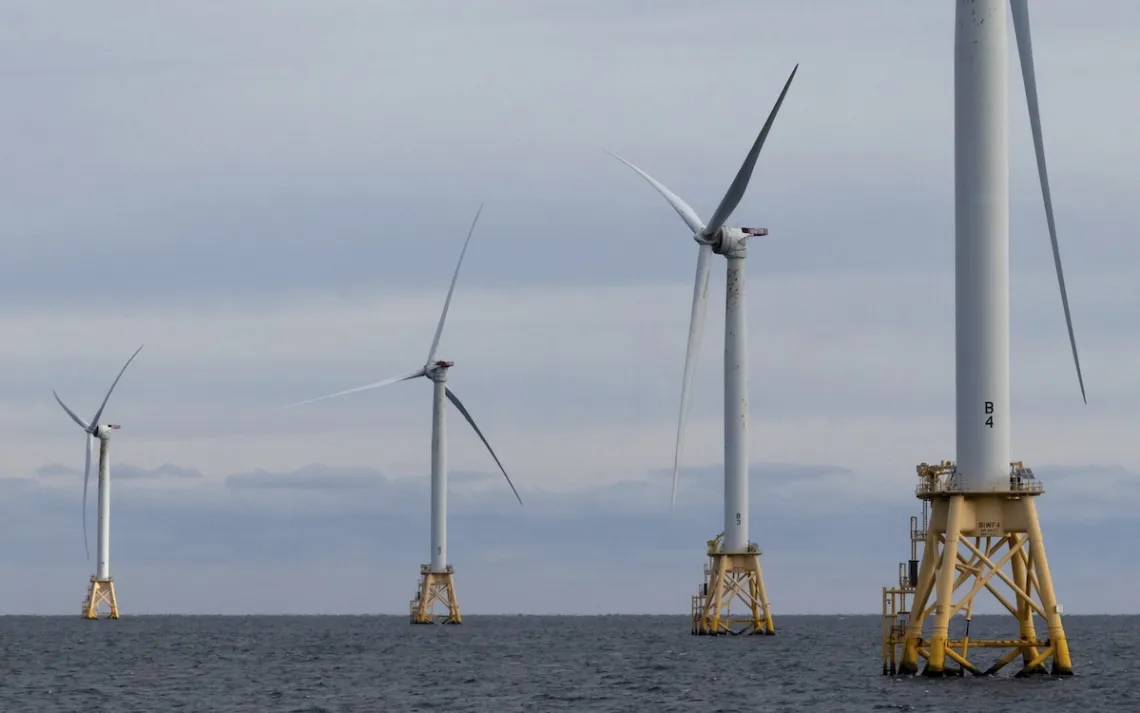
The Block Island Wind Farm off the coast of Rhode Island. | Photo by Julia Nikhinson/AP Images
Donald Trump has made no secret of his personal distaste for wind energy, issuing attacks on the renewable resource, without evidence, as either the “most expensive form of energy” or “driving the whales crazy.”
Meanwhile, his administration has taken its campaign against wind to a new phase. The acting head of the Bureau of Ocean Energy Management issued a stop work order last week to the developer of Revolution Wind, a 704-megawatt offshore wind project off the coast of Rhode Island. The project was fully permitted, and construction was 80 percent complete. It was expected to start operating in 2026, delivering clean electricity to power more than 350,000 homes across Rhode Island and Connecticut.
Environmental advocates say the administration’s August 22 directive is unprecedented and even illegal.
“There’s no basis in the law to stop construction on a project that has been fully permitted,” Kate Sinding Daly, senior vice president for law and policy at Conservation Law Foundation, told Sierra. She called the Trump administration’s explanation for its stop work order “very thin,” noting it included a vague reference to national security concerns that appears to be unexplained.
All offshore foundations had been installed and 45 out of the 65 turbines had already gone up when the stop work order was issued for Revolution Wind, according to project developer Orsted. The company said in a statement that it is “evaluating all options to resolve the matter expeditiously,” including through potential legal proceedings.
The order marks the second time the Trump administration has tried to block development of an offshore wind project. In April, the Department of the Interior issued a stop work order for Empire Wind located offshore of New York, though in that case construction was just beginning. The halt was then lifted in May and development has since resumed.
Elected officials in southern New England, including the governors of Rhode Island and Connecticut, slammed the Trump administration’s move and said they would fight to reverse the order.
“Stopping this work just before the finish line—that is an attack on our economy,” said Rhode Island Governor Dan McKee. The project was supporting over 1,000 union jobs and nearly $1.3 billion in investment in the state.
It was also expected to provide a critical source of reliable and affordable power at a time of rising electricity demand. Blocking it will likely lead to rising electricity prices for consumers and greater risks of supply shortages and interruptions to the power grid. “Delaying the project will increase risks to reliability,” ISO New England, the region’s grid operator, said in a statement.
Without offshore wind, states in the region will have an even more difficult time meeting their statutory greenhouse gas emissions reduction targets, slowing progress in the fight against climate change. Rhode Island Attorney General Peter F. Neronha warned that if Revolution Wind is stopped, the state’s signature climate law mandating 45 percent emissions reductions by 2030 is “dead in the water.”
President Trump, who dismisses climate science and has called climate change a hoax, launched a full-scale assault on renewable energy starting on his first day back in office in January. He declared a national energy emergency that deliberately excluded solar and wind. He also issued a day-one executive order temporarily halting all onshore and offshore wind project permitting.
“Solar is the way of the future, as is wind, and they are both now competitive if not outcompeting fossil fuels [on a cost basis]. The only way that dying industry can stay alive is by having unfair advantages, and the Trump administration appears willing to be the avenue by which it gets those advantages.”
In July, the Department of the Interior announced a memorandum increasing federal review processes and adding more red tape to assessments of solar and wind projects. “This isn’t oversight. It’s obstruction that will needlessly harm the fastest-growing sources of electric power,” Jason Grumet, CEO of American Clean Power Association, a clean energy trade group, said in response. The DOI also announced an order ending the so-called preferential treatment for these energy sources, which includes a directive for the Trump administration to consider revoking permits for already-approved solar and wind projects that are facing legal challenges.
Daly said it is “entirely unprecedented” for the federal government to try to revoke authorizations or block already-permitted projects, mainly because it is so brazenly unlawful. Yanking back permits risks creating regulatory instability and chaos that could threaten all kinds of development, she explained. The move to try to stymie the completion of Revolution Wind, Daly said, is solely “meant to serve fossil fuel companies” that supported Trump’s presidential bid to the tune of hundreds of millions of dollars.
“Solar is the way of the future, as is wind, and they are both now competitive if not outcompeting fossil fuels [on a cost basis],” Daly told Sierra. “The only way that dying industry can stay alive is by having unfair advantages, and the Trump administration appears willing to be the avenue by which it gets those advantages.”
The Trump administration is reportedly planning on attempting to block yet another offshore wind project—the Maryland Offshore Wind Project, which was approved by the Biden administration in December.
Just weeks ago, the DOI announced it was canceling authorization of the Lava Ridge onshore wind project in southern Idaho, which was also approved last December. On the same day it made that announcement, August 6, the agency announced its completion of an expedited environmental review for a major Utah coal project.
“All of these actions are making it clear that there is not an energy emergency. There’s a fossil fuel emergency for the people who make billions of dollars off the destruction of communities and the planet.”
In addition to ramping up and expediting fossil fuel leasing, the administration is also forcing coal plants that were scheduled to shut down to remain operating. The Department of Energy has now issued several emergency orders to keep uneconomic and polluting coal-fired power plants online. Those orders come at the same time the administration is actively trying to shut down solar and wind, which have become the cheapest sources of electric power.
On Friday the Department of Transportation announced it would be canceling $679 million in federal funding supporting the development of 12 offshore wind projects. In a press release, the DOT referred to these wind projects as “doomed.”
“All of these actions are making it clear that there is not an energy emergency. There’s a fossil fuel emergency for the people who make billions of dollars off the destruction of communities and the planet,” Patrick Drupp, director of climate policy for the Sierra Club, told Sierra. “It’s only going to harm Americans, both with their health and their pocketbooks.”
The moves by the Trump administration to obstruct renewables and bolster fossil fuels come at a time when the planet is facing a climate emergency, scientists warn. The 10 hottest years in recorded history have all occurred in the last decade, with 2024 registering as the hottest year yet and the first full year in which global average temperatures exceeded 1.5°C above preindustrial levels. It is very likely that the 1.5° temperature mark will continue to be breached over the next five years, the World Meteorological Organization reported in May. Scientists have warned that exceeding 1.5°C risks unleashing even more devastating—and potentially irreversible—climate change impacts and that every increment of warming avoided matters in terms of mitigating the societal and ecological harms.
“The fossil-fueled climate crisis is cutting lives short, imperiling ecosystems, costing global economies hundreds of billions of dollars in damages annually, and threatening national security and a livable future,” scientists wrote in an article titled “Scientists’ Warning on Fossil Fuels,” published in Oxford Open Climate Change earlier this year. “Action to speed the transition from fossil fuels to clean, renewable energy could not be more urgent.”