
These Volunteers Are Often the Unsung Heroes of Public Lands Management
Meet the people who help support underfunded public lands and the staff who steward them
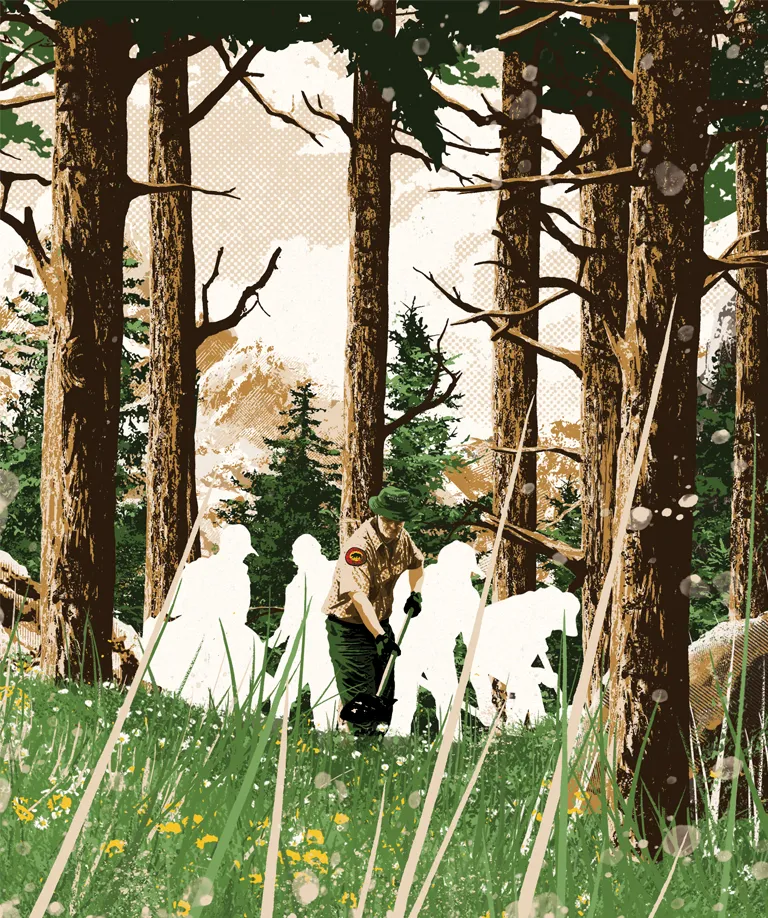
In early June 2004, soon after my college graduation, I put on a pair of dark-green pants and a standard-issue khaki shirt and reported for training at Rocky Mountain National Park. Over the course of a week that included lessons on avoiding bears, hantavirus, and lightning, I learned the details of what would be my full-time job for the next three months. I’d be staffing the front desk at one of the visitor centers, helping people choose day hikes, and giving presentations on wildlife. Best of all, I would also spend hours on the trails, answering visitors’ questions.
As an intern with the Student Conservation Association, a nonprofit dating back to 1957, I was paid $50 a week—enough for groceries and the occasional beer. I also received free lodging and $2,000 off my student loans. But the National Park Service paid me nothing: As far as the agency was concerned, I was a volunteer. I had such a transcendently wonderful time, though, I decided to do it again the next year with the same group, this time in Great Smoky Mountains National Park.
I didn’t realize it then, but I was joining an extensive and enthusiastic club of volunteers on American public lands. In 2023, about 280,000 people pitched in across all federal land-management agencies—the National Park Service, Forest Service, Bureau of Land Management, Fish and Wildlife Service, US Geological Survey, and Army Corps of Engineers. Combined, the volunteers contributed 10 million service hours at a value of $334 million.
Paid employees form the backbone of public-land management and stewardship, but volunteers are hosting campgrounds, picking up beach trash, scrubbing pit toilets, and inspecting boats for invasive species. They’re painstakingly restoring historic cabins, digging up archaeological artifacts, cultivating native tree seedlings, and surveying streams for duck DNA. “Volunteers have become a part of the public-land deliverable,” says Jim Kenna, former California state director for the BLM. “To imagine public lands without them. . . They would be a shadow of what they are today.”
Every May for the past 15 years, Chris Mahla has driven to Montana from Pennsylvania to volunteer in the Custer Gallatin National Forest, where he lives out his summers in a cabin remodeled by the Civilian Conservation Corps in 1934. If it’s a Monday, Wednesday, or Friday, he drives north to the trails off Highway 191; Tuesdays and Thursdays, he heads south. After Mahla arrives at one of the trailheads, the retired college administrator picks up trash and cleans the pit toilets. If he runs into hikers, he’ll remind them about bear safety. Sometimes, he’ll hike a bit himself, shovel in hand, to smooth out any rough trail sections. Then it’s off to the next spot on his list.
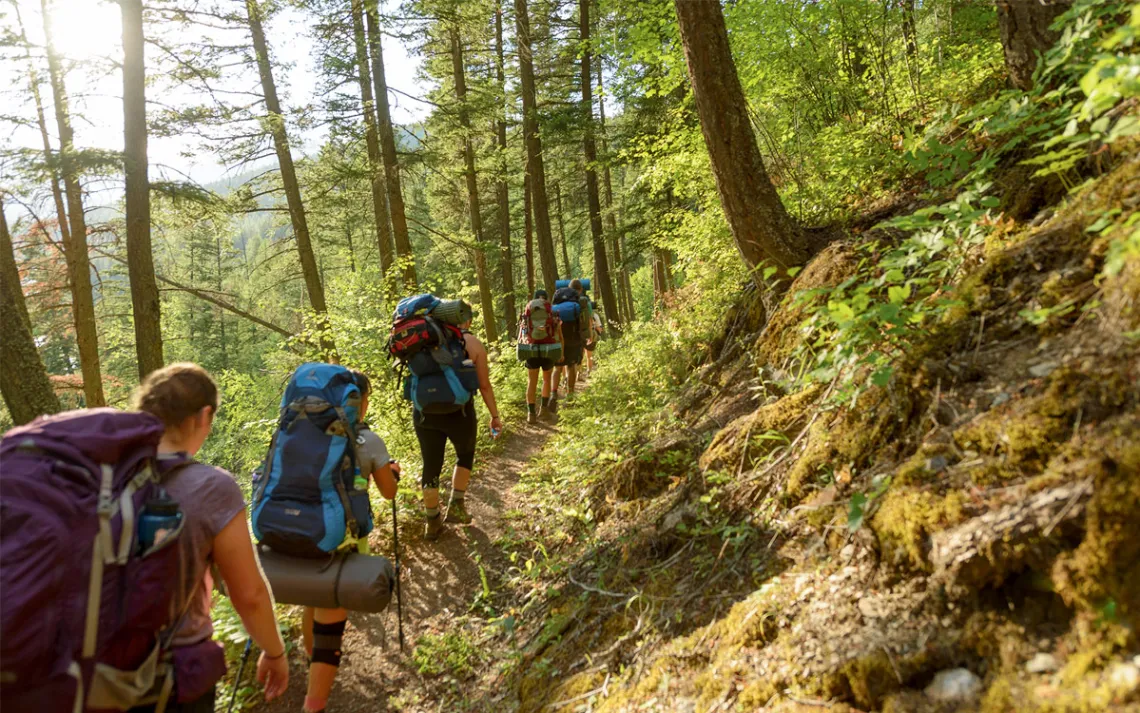
Student Conservation Association volunteers in Glacier National Park. | Photo by James Chandler
While he’s not paid, Mahla gets to fly-fish the Gallatin River right behind his cabin (where he stays rent-free). He spends his free time painting scenes of aspen groves and mountain goats. He has spotted moose, elk, bald eagles, and—most memorably—a gray wolf in his yard. Above all, he relishes the feeling that he’s contributing to a place he values deeply. “Financially, I’m all right,” Mahla says. “I’m healthy. A lot of people can’t do it. I decided that if I can do it, then what better way to help out and protect what we have?”
Up in my neck of the woods in western Montana, in the alpine wonderland of the Lolo and Flathead National Forests, volunteers provided more than 91,000 hours of labor in 2024.
Some individuals volunteer directly with a park or forest, while others participate through outside organizations that have formal agreements with land-management agencies: mountain biking clubs, equestrian groups, wildlife nonprofits, and snowmobile associations, to name a few. They’re motivated by a combination of personal interest, a sense of duty, and a desire to maintain their favorite places. Most of all, they do it for fun.
One evening in May, a group of seven women wielded Pulaskis and rakes while scaling the upper reaches of Marshall Mountain Park outside Missoula. Despite the horizontal rain, they’d come for a volunteer trail workday organized by a pair of local mountain biking groups. As they rebuilt a banked corner and raked rocks away from a jump landing, the women chatted about their kids, their favorite bike shorts, and the best biking destinations around the world. Ten minutes didn’t go by without a rider cruising past and thanking them. “I use these trails a lot, and it feels important to me to give back to the organization that makes it happen,” says Alex Sobin, the director of a local science museum.
This particular organization is the Missoula Mountain Bike Coalition, which has essentially taken over trail building and maintenance in parts of the Lolo National Forest. The nonprofit, which employs just three people, oversees a team of roughly 175 volunteers. Some of them perform regular trail work, and others (including my husband) clear downed trees off trails with chainsaws.
“The Forest Service has been chronically understaffed,” says Nic Hertzler, the coalition’s field program manager. “Which leaves a lot of maintenance to be picked up by partner organizations, like us, to go out and do that work in the absence of federal funding.”
People have been working for free on public lands for as long as there have been public lands to work on. Often, these early volunteers were the wives of rangers and other staff. The NPS didn’t formalize volunteer service until 1970, when Congress passed the Volunteers in the Parks Act. The law established a regulatory framework and offered legal protections for volunteers—and spelled out that they can’t replace employees. The Forest Service quickly followed with similar legislation in 1972.
It soon became clear that plenty of people were willing to donate their time. Within the first six months, about 900 people signed up for the official NPS volunteer program, and the numbers have ballooned over time. Well beyond picking up garbage, unpaid workers began to help with search-and-rescue, facilities management, and visitor center staffing.
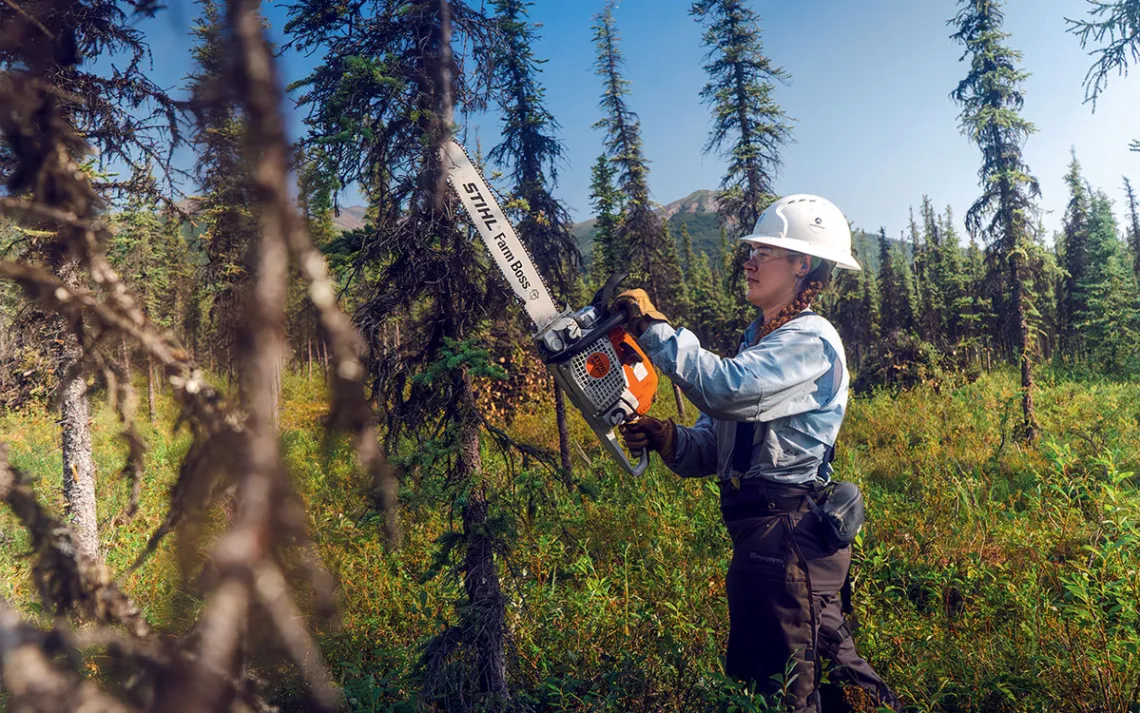
The SCA Alaska Corps maintains trails.
“Probably the biggest shift that has occurred over the decades has been the expansion of the volunteer role. Some of it is driven by volunteer motivation, but some is undoubtedly due to the ups and downs of the budget cycles,” notes Thomas Andrew Bryer, a professor at Old Dominion University and the author of Volunteers in the Parks: Tensions, Challenges and Opportunities in the National Park Service. “Volunteers cannot replace or displace paid staff, but they can provide a supplement to paid staff in a way that allows rangers to focus on other duties.”
Land managers have come to rely on this steady supply of willing labor. “Volunteers have always been a big part of the Forest Service family, in terms of how you deliver the work,” says Mary Erickson, who retired from a 40-year Forest Service career in 2024, most recently as the supervisor of the Custer Gallatin National Forest. “That history of volunteers is factored into the thought process of what work you can get done, what projects you could have volunteers assist with that free up your folks for other projects.”
But there are limits to what even the most industrious of volunteers can do. Since President Donald Trump took office in 2025, an aggressive round of firings, buyouts, and encouraged retirements has slashed the NPS’s permanent staff by 24 percent, according to an analysis by the National Parks Conservation Association. The Forest Service lost almost 6,000 employees, a 16 percent reduction. If Trump’s proposed 2027 budget comes to pass, even steeper cuts are ahead.
Jake Bramante got a taste of what that might mean for volunteerism last fall. Typically, autumn finds the hiking cartographer and self-described bird nerd on a mountaintop with his eyes to the sky. Bramante has been volunteering for Jewel Basin Hawk Watch, a citizen-science program, for the past 12 years. At least once a week, he hikes Mt. Brown in Glacier National Park or a similar site in the Flathead National Forest to survey migrating golden eagles, hawks, and falcons. Accurate counts are critical for biologists who are concerned about declining raptor populations. “There’s the reward of feeling like you’re able to help the animals you love,” Bramante says. “And there’s something really cool about going to a spot and sitting and letting nature wash over you.”
But during last fall’s government shutdown, the park staffer who coordinates volunteers was furloughed—and the program came to a screeching halt. For Bramante, the experience underscores why volunteers can’t simply step up and fill staffing gaps due to drastic budget cuts. “The volunteers were there and ready to get data,” he says. “It was the coordination piece that fell to the wayside. If we’re talking about DOGE [the Department of Government Efficiency], if we’re talking about being more efficient, the last thing you want to do is cut a job that coordinates volunteers.”
Volunteers and staff alike stress that public-lands agencies need to take the lead in any service projects: identifying priorities, training people, and making sure labor stays on track and aligns with agency missions. “There is a certain part of the work that is inherently governmental,” says Kenna. Volunteers can go only so far in picking up the slack; without skilled professionals to guide them, not much will get done.
These days, I don’t have the time to dedicate an entire summer to free work, but those blissful months in my twenties have stuck with me. I’ve felt a rich and personal connection to our public lands ever since. And because of that, I do spend several hours a week volunteering for local climate and public-land organizations, and I take my kids to river cleanups and refugee support events. I’ve also been a monthly donor to the Student Conservation Association for 22 years.
“There’s a different feeling when you’re actually taking care of a trail or a campground,” Erickson says. “You feel a lot more ownership. If people don’t know and appreciate the national forest, then they won’t think about it when they vote. They won’t invest in it. The concept of public lands that we have in this country wouldn’t continue.”


